Letters and expressions
Start here if letters feel confusing or substitution is uncertain. A letter represents a number or quantity; explain what it stands for in this question.
Maths learning path · for students and parents
Your child can calculate 4 × 7, but 4x feels like a different subject. Start with what the letter represents, then build expressions, equations and graphs in a sensible order.
Algebra describes relationships using numbers, letters and operations. It is more than finding x: an expression represents a quantity, an equation states equality, and a graph shows how values relate. This hub helps you choose the right detailed lesson rather than work through every page in order.
Suggested school progression through Class 10. Algebra 1 and Algebra 2 course names vary by country and school; this is not a complete US Algebra 2 syllabus or an AP course.
On a phone, swipe across the model to read every label.
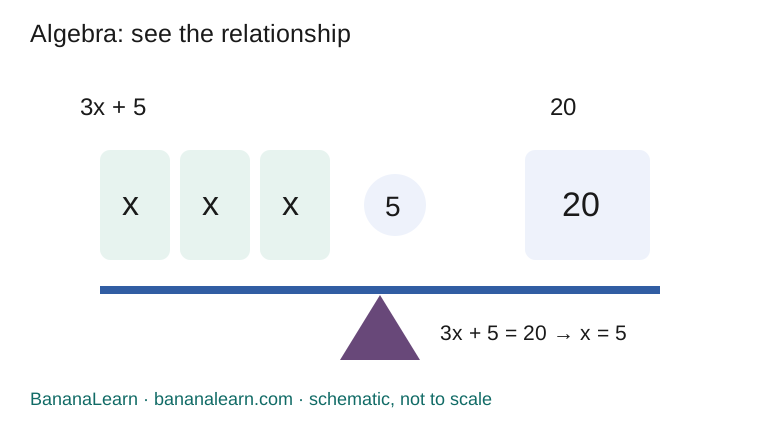
The route is a learning sequence, not a fixed timetable. A short independent check is more useful than guessing from a class label. If a prerequisite is secure, move ahead; if not, use its linked explanation first.
Start here if letters feel confusing or substitution is uncertain. A letter represents a number or quantity; explain what it stands for in this question.
Move here when expressions make sense. Choose operations that preserve equality, and check the result in the original equation.
Use these when basic equation-solving is secure. Expanding, factorising and graphing reveal different features of a relationship.
A notebook costs 35 cost-units. Buying n notebooks costs 35n; adding one delivery charge of 20 gives 35n + 20. For n = 3, the total is 105 + 20 = 125. The delivery charge is added once, not multiplied by n.
Change the story: if every notebook has a separate 20-unit cover, the total becomes n(35 + 20). Ask what each term counts before simplifying.
Solve 3x + 5 = 20. Subtract 5 from both sides to obtain 3x = 15, then divide both sides by 3: x = 5. Check: 3 × 5 + 5 = 20. The check catches a plausible-looking answer that does not satisfy the original statement.
The equals sign does not mean “write the next step”. Writing 3x + 5 = 20 = 15 is false because 20 is not 15. Use a new line for each equivalent equation.
For x² − 5x + 6 = 0, the factors are (x − 2)(x − 3). A product is zero when at least one factor is zero, so x = 2 or x = 3. Both values satisfy the original equation.
This zero-product step requires a zero on one side. From (x − 2)(x − 3) = 4, you cannot conclude that x is 2 or 3. Rearrange and choose a suitable method instead.
Avoid treating “move it across and change the sign” as the whole explanation. Subtraction or division on both sides explains why a transformation works. Also distinguish an expression to simplify from an equation to solve; the first may have no single numerical answer.
Try without opening the answer. A wrong answer is a clue to the next lesson, not a score for the whole subject.
23: multiply first, then add.
x = 11; 11 + 8 = 19.
x = 7; subtract 4, then divide by 2.
3x + 6; distribute to both terms.
(x + 2)(x + 3); the middle coefficients add to 5.
No. For x = 1, the first is 8 and the second is 5.
If a child guesses x but cannot explain a step, ask them to check it in the original equation and name what stayed equal. Revisit substitution if they treat 4x as 4 + x. Revisit multiplication and negative numbers if those calculations repeatedly interrupt an otherwise correct method.
Choose one example, explain it aloud, then try a changed problem without looking. Record which decision caused difficulty: translating the story, selecting an operation, calculating, or checking. The next lesson should address that decision rather than repeat a full chapter.
Keep one worked sample and one fresh independent attempt. Note the help required and revisit the same skill later with changed numbers or a new diagram. Faster answers can be useful, but the evidence should also include explanation and transfer.
BananaLearn offers one-to-one Maths tutoring, with English and Science also available. Share your child’s class, board or curriculum, one recent question and the part they find difficult. We can discuss teaching fit and available lesson times before you decide.
A useful first conversation should identify a starting point, how the child will practise independently and how progress will be checked. Bring a recent school question so the discussion starts with the skill your child needs.
The worked examples and checks are original BananaLearn content. The linked lessons provide fuller explanations and practice. Suggested levels do not replace the current school syllabus, book edition or teacher’s sequence. This page is a curated topic route, not a new curriculum certification.
How we prepare learning guides · Report a correction
Save this link: https://bananalearn.com/learn/algebra-learning-path.html