Your child can solve an equation, yet a graph or an unfamiliar function brings them to a stop. Algebra 2 asks them to recognise the relationship, choose a method and explain where that method works.
BananaLearn offers one-to-one online Algebra 2 tutoring. Lessons can connect polynomial, rational, exponential and logarithmic functions with the student’s school sequence. Bring a current question and an attempted solution so the first discussion starts with the reasoning that needs attention.
Manipulate signed numbers, fractions and powers without relying on a remembered button sequence.
Solve a linear equation, substitute into a function and explain the slope and intercept of a line.
Expand and factorise simple expressions, and recognise why an equation needs the same operation on both sides.
Use the eight checks below to identify a starting conversation, not to assign a placement score.
The checks on this page are conversation starters, not a validated assessment or admission requirement.
What can tutoring cover?
A planning map to compare with the school syllabus
Area
Skills and concepts
What independent understanding can look like
Functions and transformations
Notation, domain, range, composition and inverse relationships.
Explain why a denominator cannot be zero; compare a rule with its graph.
Quadratic relationships
Factorisation, completing the square, the quadratic formula and complex roots.
Choose a method and interpret zeros or a turning point.
Polynomials
Operations, factors, zeros and behaviour of graphs.
Use factors to explain an intercept; do not infer every feature from a sketch.
Rational expressions
Simplification, restrictions, equations and asymptotes where taught.
Keep excluded inputs after cancelling a factor.
Radicals and rational powers
Real-number domains, exponent rules and checking transformed equations.
Substitute possible solutions into the original equation.
Exponentials and logarithms
Growth, decay, inverse relationships and solving equations.
Distinguish a fixed multiplier from a fixed addition.
Systems, sequences and data
Linear/nonlinear systems, arithmetic/geometric patterns and school-specific data work.
Explain what the solution or model represents.
School-specific extensions
Trigonometry, probability or other units when included in the actual course.
Use the teacher’s syllabus to decide scope rather than assume a universal course list.
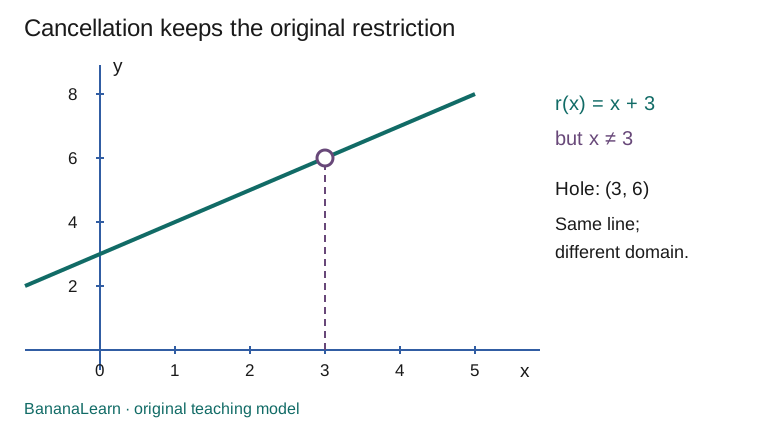
The simplified line keeps a hole
On a small screen, swipe across the graph to read every label.
The line y = x + 3 excludes the point (3, 6) when it comes from (x² − 9)/(x − 3).
Start with the school’s course, then choose the first skill
Algebra 2 is not taught in an identical order in every school. Some integrated Maths courses distribute these ideas across several years. Share the school topic list, book edition, recent feedback and assessment date. The map above is a planning aid rather than a replacement syllabus.
A student stuck on a logarithm equation may need help with inverse operations; another may understand the logarithm but lose a sign when rearranging. A short explanation and one fresh question help distinguish those cases before choosing more practice.
Make the function visible in several forms
Connect a rule, a table, a graph and a sentence about the quantities. For f(x) = x² − 4, f(3) is an output of 5; solving f(x) = 5 asks for the inputs 3 and −3. Those are different tasks even though the same expression appears.
Ask the student to state the allowed inputs before simplifying or composing rules. A graphing tool can check a picture, but a visible gap or a cropped window needs an algebraic explanation. Our rational-function model below shows why cancelling a factor does not restore an excluded input.
Compare methods rather than repeat one recipe
For a quadratic that factors neatly, factorisation can be efficient. Vertex form makes a maximum or minimum easier to read. The quadratic formula works when convenient integer factors are absent. Choosing between them is itself a teachable skill.
Write down why each transformation is valid and check the result. Squaring both sides can introduce an extra candidate; dividing by an expression can discard a case. A correct-looking final number is not enough when the route has changed the allowed solutions.
Prepare for Precalculus through transfer
Precalculus builds on functions, exponent rules and algebraic manipulation. A student who can factor an isolated expression but cannot simplify a difference quotient may need practice recognising the same structure in a new setting.
Try a changed example after a worked solution and revisit the idea on a later day. Keep the student’s own explanation alongside the answer. This gives parents and tutors a concrete basis for deciding whether to revisit a prerequisite or move to a more demanding application.
Use tutoring for a specific learning problem
Support can address current classwork, catch-up or extension. For catch-up, identify one prerequisite that blocks the present chapter. For extension, add a condition or ask for a second method rather than simply supplying larger numbers.
Discuss lesson times in the student’s local time zone, the current price and the review point before booking. A useful first goal is observable: for example, simplify a rational expression while retaining its domain restriction and explain that restriction without prompting.
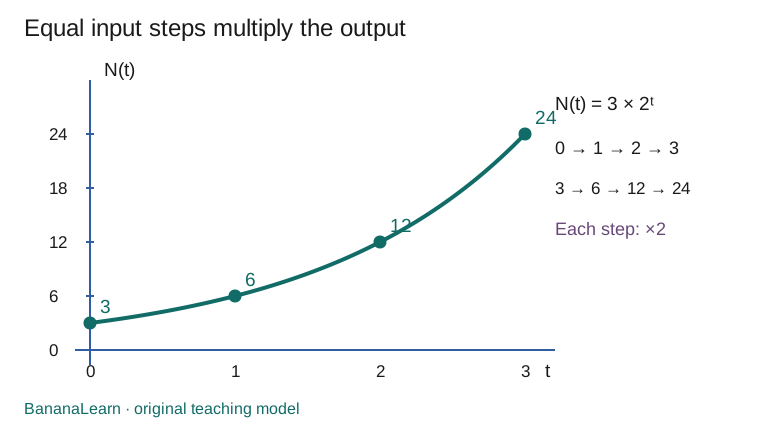
Equal steps, equal multipliers
On a small screen, swipe across the graph to read every label.
An illustrative exponential has values 3, 6, 12 and 24 at inputs 0, 1, 2 and 3.
Five worked examples: method, meaning and checks
These original examples show selected teaching ideas. They do not represent an entire syllabus or official exam paper.
1. A cancelled factor leaves a restriction
Simplify r(x) = (x² − 9)/(x − 3). The original denominator gives x ≠ 3. Factor the numerator: r(x) = (x − 3)(x + 3)/(x − 3). For allowed inputs, cancellation gives r(x) = x + 3.
At x = 2 the output is 5. At x = 3 the original expression is undefined, even though the simplified line would give 6. The graph is the line y = x + 3 with a hole at (3, 6). Keep “x ≠ 3” with the answer.
Check the reasoning: Try x = 4 and explain why that substitution is allowed. The output is 7; its denominator in the original expression is nonzero.
2. Vertex form answers a different question from factors
Rewrite q(x) = x² − 6x + 5 by adding and subtracting 9: q(x) = (x − 3)² − 4. A square cannot be negative, so the minimum output is −4 at x = 3.
To find the zeros instead, factor q(x) = (x − 1)(x − 5), giving x = 1 and x = 5. The vertex and zeros describe different graph features. Expanding either form recovers the original expression.
Check the reasoning: If the question asks for the minimum, giving only the zeros is incomplete. Match the form to the requested quantity.
3. An exponential has a constant multiplier
An illustrative quantity follows N(t) = 3 × 2^t. At t = 0, 1, 2, 3 the values are 3, 6, 12, 24. Each one-unit step multiplies the output by 2; the additions 3, 6 and 12 are not constant.
Solve N(t) = 18: divide by 3 to get 2^t = 6, then t = log₂6, approximately 2.585. If a context permits only whole-number t values, an exact value of 18 is not reached at one of those discrete steps.
Check the reasoning: State the model’s time units and domain before interpreting this as a real process. The invented values illustrate exponential structure, not measured growth.
4. Check candidates after squaring
Solve √(x + 5) = x − 1 over the reals. The right side must be non-negative, so x ≥ 1. Squaring gives x + 5 = x² − 2x + 1, then x² − 3x − 4 = 0.
Factor to (x − 4)(x + 1) = 0. Candidate x = 4 works: √9 = 3. Candidate x = −1 fails: √4 = 2 while x − 1 = −2. The only solution is 4.
Check the reasoning: Squaring made positive and negative quantities harder to distinguish. Checking in the original equation removes the extra candidate.
5. Complex solutions extend the number system
Solve x² + 4 = 0. Over the reals there is no solution because a real square is non-negative. Over the complex numbers, i² = −1, so x = 2i or x = −2i.
Check (2i)² + 4 = 4i² + 4 = 0, and the same holds for −2i. The number system must be stated: “no real solutions” and “two complex solutions” can both describe this equation accurately.
Check the reasoning: Do not treat a calculator’s real-mode error as proof that the equation has no solution in any number system.
Try eight questions, then check the reasoning
Work on paper before opening each answer. Mark whether you needed a hint and which step was unclear; a total score alone will hide that information.
1. Evaluate f(−2) for f(x) = 2x² − 3.
5. Substitute the whole input: 2(−2)² − 3 = 2 × 4 − 3. Squaring −2 gives 4, not −4.
2. Solve x² − 5x + 6 = 0.
x = 2 or 3. Factor to (x − 2)(x − 3) = 0. Either factor can be zero; both values satisfy the original equation.
3. Simplify (x² − 16)/(x − 4), including its restriction.
x + 4 for x ≠ 4. Factor the numerator as (x − 4)(x + 4), cancel for allowed inputs and retain the excluded input.
4. Solve 5^(x − 1) = 125.
x = 4. Write 125 = 5³, so x − 1 = 3. Substitution gives 5³ = 125.
5. Solve log₃(x − 1) = 2 over the reals.
x = 10. A logarithm input must be positive. Convert to x − 1 = 3² = 9, then check x > 1.
6. Find the inverse of f(x) = 3x − 2.
f⁻¹(x) = (x + 2)/3. Set y = 3x − 2, solve x = (y + 2)/3 and rename the input. Substitution into f recovers the original input.
7. Find the fifth term of 2, 6, 18, … .
162. The common ratio is 3, so the nth term is 2 × 3^(n − 1). For n = 5, this is 2 × 81.
8. Solve √(x + 2) = x over the reals.
x = 2 only. The right side requires x ≥ 0. Squaring gives x² − x − 2 = 0, whose candidates are 2 and −1. Only 2 satisfies the original equation.
Common mistakes worth discussing
Cancelling across a sum
(x + 3)/(x + 1) does not simplify to 3. Cancellation removes common factors of the complete numerator and denominator, not individual terms.
Removing an excluded input
A simplified formula and its original expression can differ in domain. Write restrictions before cancellation and preserve them afterwards.
Treating logarithms as linear
log(a + b) is not generally log a + log b. The product rule concerns a product of positive inputs; test a numerical case before applying a remembered rule.
Accepting every transformed solution
Squaring, taking roots or dividing by a variable expression needs conditions and a final check in the original equation.
A practical plan for the first discussion and later review
First discussion. Bring one current school task and the student’s attempt. Identify whether notation, algebraic fluency, representation or interpretation is the first sticking point.
Focused teaching. Explain that skill with a model and a worked example. Ask the student to name the reason for each step, not just repeat the symbols.
Fresh independent attempt. Change the function, condition or requested quantity. Record which prompts were needed and whether the student can check the answer.
Later review. Return to the skill in mixed work. Compare independent explanations and adjust the next topic; no fixed number of lessons is promised.
Keep a simple learning record
Current school topic and the question attempted.
The first step the student could not explain.
One corrected explanation in the student’s own words.
A fresh independent attempt, date and prompts needed.
The skill to revisit at the next agreed review.
Use initials or a private notebook if sharing examples; sensitive school records are not needed for an initial enquiry.
Questions parents and students ask
What grade is Algebra 2?
Placement varies by school and prior study. Use the course name, topic list and current task rather than assume that every student in a particular grade studies the same material.
How is Algebra 2 different from Algebra 1?
Algebra 1 establishes expressions, linear relationships and early quadratics. Algebra 2 develops a broader range of functions and more demanding algebra, including rational, exponential and logarithmic relationships where the school includes them.
Should my child take Algebra 2 or Precalculus tutoring?
Start with the school course. If the current problem is an Algebra 2 prerequisite inside a Precalculus unit, teaching can revisit that prerequisite without changing the student’s course label.
Can tutoring follow the school textbook?
Yes. Share the title, edition, chapter and method used in class so explanations connect to the work the student must complete.
Do you guarantee a grade or rapid catch-up?
No specific grade or completion time is promised. Agree a learning priority and compare fresh independent work at a review point.
Can overseas families book lessons?
Share the country, local time zone and preferred windows. Teaching availability and the applicable plan are discussed before scheduling.
Course-scope references checked 2 November 2026. All explanations, questions, graphs and invented models on this page are original BananaLearn material. The linked books and official specifications are references, not copied lesson content.
Tell us the course, school year, current topic and country/time zone. For AP or another examination course, include the assessment year and pathway. Describe one difficult task and the preferred lesson windows so we can discuss a useful starting point and availability.