
Start with the key idea
To solve a quadratic by factorisation, write it as ax² + bx + c = 0 with a nonzero, factor the expression and apply the zero-product property. Set each factor equal to zero, solve the resulting linear equations and check any restrictions from the original problem.
1. Put every term on one side first
The zero-product property applies to a product equal to zero. For x² = 5 x − 6, subtract 5 x and add 6 on both sides to obtain x² − 5 x + 6 = 0. Moving a term is shorthand for performing the same operation on both sides.
If the equation is x(x − 5) = −6, it is not valid to say x = −6 or x − 5 = −6. Many products equal −6. Zero is special: a product of real numbers is zero only when at least one factor is zero.
Before factoring, collect like terms and identify a, b and c with their signs. A coefficient of x² must remain nonzero. If the squared terms cancel entirely, the resulting equation is linear and should be solved as such.
2. For x² + bx + c, match a sum and a product
Expanding (x + p)(x + q) gives x² + (p + q)x + pq. Therefore p and q must add to b and multiply to c. For x² + 5 x + 6, choose 2 and 3: their sum is 5 and their product is 6.
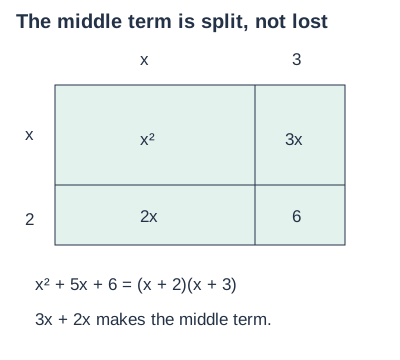
When c is positive, the two numbers have the same sign. The sign of b tells you which sign. For x² − 5 x + 6, both are negative: −2 and −3. When c is negative, use opposite signs and test which magnitude gives the required sum.
Avoid choosing factors from the constant term alone. For x² + 7 x + 12, both 2 and 6 multiply to 12, but they add to 8. The correct pair is 3 and 4. Expand your proposed brackets before finding roots.
3. Split the middle term when a is not one
For 2 x² + 7 x + 3, multiply a and c to get 6. Find two numbers with product 6 and sum 7: 6 and 1. Write 2 x² + 6 x + x + 3, then group as 2 x(x + 3) + 1(x + 3).
The shared bracket gives (2 x + 1)(x + 3). Splitting 7 x into 6 x + x preserves the expression. It does not create extra terms or change the equation; it reveals a common factor in two groups.
If the second group has a negative sign, factor that sign carefully. For 2 x² − 5 x − 3, split −5 x into −6 x + x: 2 x(x − 3) + 1(x − 3). Both brackets must match before combining.
4. Use the zero-product property without losing a root
From (x − 2)(x − 3) = 0, conclude x − 2 = 0 or x − 3 = 0. This gives x = 2 or x = 3. You do not require both brackets to be zero at the same time.
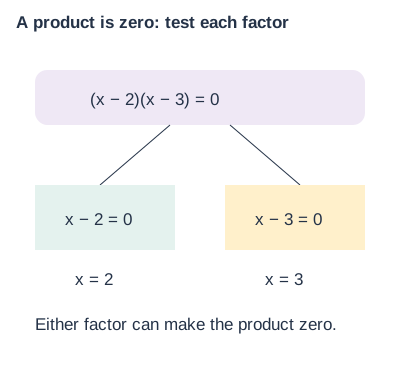
For x(x − 4) = 0, the roots are 0 and 4. Dividing both sides by x would silently assume x is nonzero and lose the root 0. Factoring out a common variable is safe; cancelling it without checking zero is not.
A repeated factor such as (x − 3)² = 0 has one distinct root, 3, repeated twice algebraically. Two factors do not always give two different numbers. Substitute into the original equation to verify the result.
5. Translate a word problem and reject impossible values
A rectangle has width x cm and length x + 3 cm. Its area is 40 cm², so x(x + 3) = 40. Rearranging gives x² + 3 x − 40 = 0, which factors as (x + 8)(x − 5) = 0.
The algebraic roots are −8 and 5. A rectangle cannot have a negative physical width, so choose x = 5 cm and length 8 cm. Check both the area, 5 × 8 = 40 cm², and the difference of the sides, 3 cm.
State the restriction before selecting the answer. In a different context a negative root may be valid, for example an abstract number problem. Do not discard every negative answer automatically merely because another story involved a length.
6. Recognise when this method is inconvenient
Some quadratics factor neatly with integers; others do not. For x² − 2 = 0, the real roots are √2 and −√2, so integer factor-pair searching will not succeed. A square-root method is more direct.
If a factor search fails, recheck signs and coefficients, then choose another appropriate method such as completing the square or the quadratic formula. A failed integer search does not prove that the equation has no real solutions.
Finally substitute each candidate into the equation as it was originally written. This checks algebraic manipulation and helps catch a copied sign. For an equation derived from a story, also state the quantity and unit that the chosen root represents.
5 worked examples with reasoning
1. Solve x² − 7 x + 12 = 0.
- Find numbers with sum −7 and product 12: −3 and −4.
- (x − 3)(x − 4) = 0, so x = 3 or 4.
- Check: 9 − 21 + 12 = 0 and 16 − 28 + 12 = 0.
2. Solve 2 x² + 7 x + 3 = 0.
- Split the middle term: 2 x² + 6 x + x + 3.
- Factor to (2 x + 1)(x + 3) = 0.
- Roots are −1/2 and −3; both make the original expression zero.
3. Solve x² = 5 x.
- Rearrange to x² − 5 x = 0.
- x(x − 5) = 0.
- Roots are 0 and 5. Do not divide by x and lose zero.
4. A rectangle is 4 cm longer than its width and has area 45 cm². Find its dimensions.
- Let width be x > 0. Then x(x + 4) = 45.
- x² + 4 x − 45 = (x + 9)(x − 5) = 0.
- Choose width 5 cm and length 9 cm. Reject −9 cm; check 5 × 9 = 45.
5. Solve x² − 6 x + 9 = 0.
- Recognise (x − 3)² = 0.
- The only distinct root is x = 3.
- Check 9 − 18 + 9 = 0; it is a repeated root.
Save the guide or print the practice
Download to save or share
Complete guide with answers (PDF) · Worksheet without answers (PDF) · Worksheet and answer key (PDF)
Try each task before opening its answer. Give an example or reason, not only a label.
14 practice questions with explanations
Try each task before opening its answer. Give an example or reason, not only a label.
Write an answer and your reason before opening the explanation. Check the reasoning as well as the final answer.
- Solve
Solve x² + 5 x + 6 = 0.
Answer and reasoning
−2 and −3.
(x + 2)(x + 3) = 0.
- Solve
Solve x² − x − 6 = 0.
Answer and reasoning
3 and −2.
(x − 3)(x + 2) = 0.
- Solve
Solve x² − 9 = 0.
Answer and reasoning
3 and −3.
Use (x − 3)(x + 3).
- Solve
Solve x² + 4 x = 0.
Answer and reasoning
0 and −4.
Factor x(x + 4).
- Solve
Solve 2 x² − 5 x − 3 = 0.
Answer and reasoning
3 and −1/2.
(2 x + 1)(x − 3) = 0.
- Repeated
Solve x² + 6 x + 9 = 0.
Answer and reasoning
−3, a repeated root.
The expression is (x + 3)².
- Rearrange
Write x² + 2 = 3 x in zero form.
Answer and reasoning
x² − 3 x + 2 = 0.
Subtract 3 x from both sides.
- Solve
Solve x² − 3x + 2 = 0.
Answer and reasoning
1 and 2.
(x − 1)(x − 2) = 0.
- Check
Are 2 and 6 the pair for x² + 7 x + 12?
Answer and reasoning
No.
Their sum is 8. Use 3 and 4 instead.
- Logic
Why can dividing x(x − 7) = 0 by x be unsafe?
Answer and reasoning
It loses the possible root 0.
Division assumes x is nonzero.
- Context
A square has area 49 cm². What is its side length?
Answer and reasoning
7 cm.
The equation gives ±7, but a physical side is positive.
- Context
A rectangle has width x and length x + 1, area 20 square units. Find its dimensions.
Answer and reasoning
4 by 5 units.
(x + 5)(x − 4) = 0; reject −5.
- Limits
Does no integer factor pair mean no real roots?
Answer and reasoning
No.
Roots may be irrational, as for x² − 2 = 0.
- Property
Can ab = 6 justify a = 0 or b = 0?
Answer and reasoning
No.
The zero-product property requires the product to be zero.
Use the ideas without looking at the notes
Rearrange to zero, factor, set each factor to zero and check every root. Keep the algebraic roots separate from the values permitted by the story.
Common questions
Must the right side be zero?
Yes, before applying the zero-product property. Rearrange the equation first.
What if one root is zero?
Keep it unless the original equation or context excludes zero.
Can both roots be negative?
Yes. For example, x² + 5 x + 6 = 0 has roots −2 and −3.
Does every quadratic factor into integer brackets?
No. Some need irrational or non-real roots, or another solving method.
Why check the original equation?
It catches sign errors and confirms that a candidate satisfies the actual question.
Connect your learning
Ask about guided Maths learning if your child needs help explaining these ideas.
About this guide
Original explanations, examples, diagrams and practice by BananaLearn. The grade label indicates the intended learning level; this is not an official textbook extract or exam paper.