
Start with the key idea
An identity is an equality true for every permitted value of its variables. The distributive property gives (a+b)²=a²+2 ab+b², (a −b)²=a²−2 ab+b² and (a+b)(a −b)=a²−b². Area models explain positive-length cases; algebra extends the identities to all real values.
1. Distinguish an identity from an equation to solve
The statement (x+2)²=x²+4 x+4 is true for every real x. It is an identity. The equation x+2=7 is true only when x=5, so it is a condition to solve.
Testing a few numbers can catch a false proposed identity, but it cannot prove it for every value. A derivation using the distributive property explains why the equality holds generally. Keep numerical checks and algebraic proof separate.
Compare the identity x² − 1 = (x − 1)(x + 1) with the equation x² − 1 = 0. The first rewrites an expression for any real x; the second asks which x values make that expression zero. Keeping the purposes separate helps when identities later become tools for solving equations rather than answers by themselves.
2. See all four pieces of a squared sum
A square with side a+b has area (a+b)². Split each side into lengths a and b. The four resulting rectangles have areas a², ab, ab and b². Adding all four gives a²+2 ab+b².
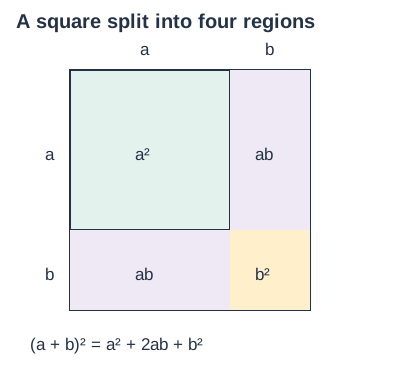
The mixed rectangles are easy to forget when only the two corner squares are noticed. Colour or label each region, then check that the regions exactly cover the large square. The physical model assumes positive lengths; the algebraic expansion itself works for negative values too.
For a numerical model, choose a = 4 and b = 2. The large square has side six and area thirty-six. Its pieces have areas sixteen, eight, eight and four. Adding only the two squares gives twenty and leaves both rectangles uncounted. This concrete counterexample shows exactly what the missing middle term represents.
3. Derive the squared difference carefully
Expand (a −b)(a −b): a²−ab −ab+b². The two mixed terms combine to −2 ab, while (−b)(−b) gives+b². Thus (a −b)²=a²−2 ab+b².
For example, (x −3)²=x²−6 x+9. The final 9 is positive. A common error is to make every term negative after seeing a minus sign; multiplying the factors explicitly shows which signs belong.
The expression a² − b² is also different from (a − b)². For a = 5 and b = 2, the first is twenty-one while the second is nine. Their factorisations reveal why: a² − b² = (a − b)(a + b), whereas a squared difference multiplies the same smaller expression by itself.
4. Multiply each part of one bracket by each part of the other
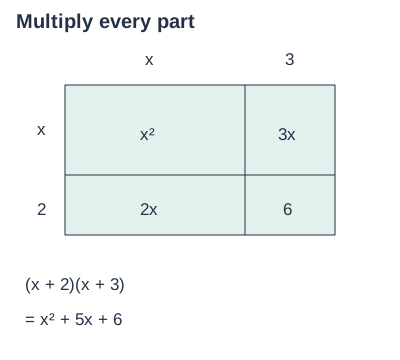
For (x+2)(x+3), the four products are x², 3 x, 2 x and 6. Combine the middle terms to get x²+5 x+6. An area grid provides a place for every product.
For (a+b)(a −b), the products are a², −ab,+ab and −b². The mixed terms cancel, leaving a²−b². The cancellation is a feature of these opposite signs, not a rule that all middle terms disappear.
Use a product grid as an organiser even when variables are negative, but call it an algebra grid rather than a literal physical rectangle with negative lengths. Each cell records one multiplication. That preserves the useful completeness check without pretending that a negative side length is an ordinary measured distance.
5. Use a suitable identity for mental calculation
To calculate 102², write (100+2)²=10,000+400+4=10,404. The middle term 2×100×2 is essential. For 98×102, use (100−2)(100+2)=10,000−4=9,996.
Choose a nearby convenient number because it reduces effort. An identity should clarify a calculation, not make a simple multiplication harder. Estimate the size first: 102² should be a little greater than 10,000.
For 103 × 97, both factors are three away from one hundred in opposite directions. The difference-of-squares pattern gives 100² − 3² = 9,991. If the factors were 103 and 98, their offsets would not be opposite, so that exact shortcut would not apply without a different rearrangement. Match the pattern before using it.
6. Reverse the pattern and verify coefficients
The expression x²+10 x+25 matches (x+5)² because 2×x×5=10 x and 5²=25. The expression x²+10 x+20 does not fit that same perfect-square pattern. Check both the middle and constant terms.
When the first term is 4 x², the bracket begins 2 x. For 4 x²−12 x+9, the other term is 3, giving (2 x −3)². Expand the bracket again as a final check; recognising a pattern should never replace verification.
A perfect-square check involves three conditions: the first and last terms are squares, and the middle term is twice their roots’ product with the correct sign. For 9 x² + 12 x + 4, the roots are 3 x and 2 and twice their product is 12 x, so it is (3 x + 2)². Checking only the outer terms would be insufficient.
More original practice from this guide
Algebraic Identities with Area Models — practice
Work on paper first. Open each answer afterwards and compare the reasoning. Print the questions with or without the separate answer key; no account is required.
Name: ____________________ Date: __________
In the area model for (x + 4)², what do the two matching rectangles represent?
Answer and a way to check
4x and 4x
Each rectangle has sides x and 4. There are two of them.
Which expansion matches (x + 4)²?
Answer and a way to check
x² + 8x + 16
Add x², two copies of 4x, and 16.
Expand (x + 6)².
Answer and a way to check
x² + 12x + 36
Write x², then 2 × 6 × x, then 6².
Expand (x − 4)².
Answer and a way to check
x² − 8x + 16
Use a² − 2ab + b². The last term is still a square, so it is positive.
Expand (x + 7)(x − 7).
Answer and a way to check
x² − 49
The middle terms +7x and −7x cancel. What remains is x² minus 7².
Explain why (a + b)² is not equal to a² + b². Use the area regions.
Answer and a way to check
The two rectangles ab and ab are missing from a² + b², so (a + b)² = a² + 2ab + b².
Count the regions: one large square, two rectangles, one small square.
A student writes (x − 5)² = x² − 25. What is the mistake?
Answer and a way to check
The student used the difference-of-squares identity on a square.
(x − 5)² is (x − 5)(x − 5), not (x + 5)(x − 5). Expand both and compare.
A square patio has side (n + 2) m. Write an expanded expression for its area.
Answer and a way to check
n² + 4n + 4
Area is (n + 2)². Use x² + 2xb + b² with b = 2.
Answers to the additional practice
Algebraic Identities with Area Models — answer key
4x and 4x Each rectangle has sides x and 4. There are two of them.
x² + 8x + 16 Add x², two copies of 4x, and 16.
x² + 12x + 36 Write x², then 2 × 6 × x, then 6².
x² − 8x + 16 Use a² − 2ab + b². The last term is still a square, so it is positive.
x² − 49 The middle terms +7x and −7x cancel. What remains is x² minus 7².
The two rectangles ab and ab are missing from a² + b², so (a + b)² = a² + 2ab + b². Count the regions: one large square, two rectangles, one small square.
The student used the difference-of-squares identity on a square. (x − 5)² is (x − 5)(x − 5), not (x + 5)(x − 5). Expand both and compare.
n² + 4n + 4 Area is (n + 2)². Use x² + 2xb + b² with b = 2.
Help a learner explain the method
Help at home
Ask the learner to point to each region in the area model and match it to a term before practising symbolic expansions.
Keep one example of the learner’s own working. A repeated difficulty across fresh questions can guide a discussion with their teacher; one short practice sheet does not establish a diagnosis or a full mastery profile.
5 worked examples with reasoning
1. Expand (x+4)².
- Use a=x, b=4.
- x²+2×x×4+16.
- Answer x²+8 x+16.
2. Expand (2 x −3)².
- Square 2 x to get 4 x².
- Mixed term=−2×2 x×3=−12 x.
- Answer 4 x²−12 x+9.
3. Expand (y+7)(y −7).
- The brackets have opposite 7 terms.
- Use difference of squares.
- Answer y²−49.
4. Calculate 99².
- Write (100−1)².
- 10,000−200+1=9,801.
- The result is slightly below 10,000.
5. Factorise x²+6 x+9.
- 9=3² and 6 x=2×x×3.
- The expression fits a squared sum.
- Answer (x+3)²; expansion verifies it.
Save the guide or print the practice
Download to save or share
Complete guide with answers (PDF) · Worksheet without answers (PDF) · Worksheet and answer key (PDF)
Try each task before opening its answer. Give an example or reason, not only a label.
14 practice questions with explanations
Try each task before opening its answer. Give an example or reason, not only a label.
Write an answer and your reason before opening the explanation. Check the reasoning as well as the final answer.
- Expand
Expand (x + 2)².
Answer and reasoning
x²+4 x+4.
Include both mixed products.
- Expand
Expand (x − 5)².
Answer and reasoning
x²−10 x+25.
The last term remains positive.
- Product
Expand (x + 6)(x − 6).
Answer and reasoning
x²−36.
Mixed terms cancel.
- Expand
Expand (3x + 1)².
Answer and reasoning
9 x²+6 x+1.
Square 3 x and include 2×3 x×1.
- Expand
Expand (x + 1)(x + 4).
Answer and reasoning
x²+5 x+4.
Combine 4 x and x.
- Number
Calculate 101² using an identity.
Answer and reasoning
10,201.
10,000+200+1.
- Number
Calculate 49 × 51 using an identity.
Answer and reasoning
2,499.
50²−1².
- Factor
Factorise x² − 16.
Answer and reasoning
(x −4)(x+4).
Difference of squares.
- Factor
Factorise x² − 8x + 16.
Answer and reasoning
(x −4)².
The middle term is −2×x×4.
- Error
Is (a+b)²=a²+b² always true?
Answer and reasoning
No.
The 2 ab term is missing.
- Test
Use a=1, b=2 to disprove that false rule.
Answer and reasoning
9 is not 5.
(1+2)²=9 while 1²+2²=5.
- Identity
Is x+3=8 an identity?
Answer and reasoning
No.
It holds only for x=5.
- Model
Why do two ab terms appear in the square model?
Answer and reasoning
There are two mixed rectangles.
Each has side lengths a and b.
- Check
Is x²+6 x+8 equal to (x+3)²?
Answer and reasoning
No.
The squared bracket has constant 9, not 8.
Use the ideas without looking at the notes
Draw the four product regions, expand every pair and combine like terms. Use one numerical substitution as an error check, then justify the identity algebraically.
Common questions
Why is (a+b)² not just a²+b²?
The product also contains two mixed terms, ab and ab.
Can the identities use negative numbers?
Yes for real numbers; the geometric positive-length picture is only one illustration.
Does trying three values prove an identity?
No. It checks those values; an algebraic derivation establishes the general statement.
Why is the last term positive in (a −b)²?
It comes from multiplying −b by −b.
How do I check a factorisation?
Expand the proposed factors and compare every coefficient.
Connect your learning
Ask about guided Maths learning if your child needs help explaining these ideas.
About this guide
Original explanations, examples, diagrams and practice by BananaLearn. The grade label indicates the intended learning level; this is not an official textbook extract or exam paper.