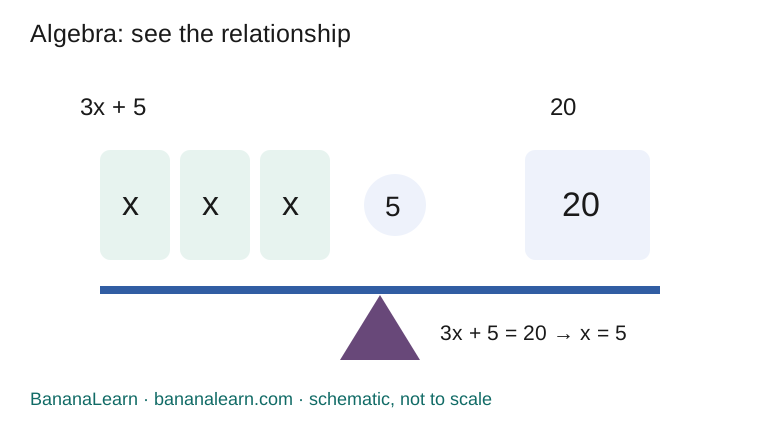
Your child follows an example, then gets stuck as soon as the numbers change. Algebra 1 tutoring should make the choices behind the steps clear enough to use on a new problem.
BananaLearn provides one-to-one online Algebra 1 tutoring. Support can cover expressions, equations, inequalities, functions, graphs, systems and introductory quadratics, paced around the student’s school course and starting point.
On a phone, swipe across the illustration to read every label.
Original teaching model; worked reasoning appears below.
Match the school’s Algebra 1 sequence
Algebra 1 is a course name, not a universal list taught in the same order everywhere. Send the current unit, textbook or teacher’s topic list. An integrated Maths course may spread the same ideas across several years rather than label one year Algebra 1.
Use the topic map below to identify where help is needed; it is not a claim that every school uses the same assessment structure.
Secure expressions, signs and equality
Begin with the meaning of a variable, substitution, the distributive property and operations with signed numbers. Then connect equation-solving to transformations that keep both sides equal.
If a student expands 2(x + 3) as 2x + 3, repeated equation practice will keep reproducing the same difficulty. An area or grouping model can make the missing multiplication visible.
Build equations, inequalities and systems
Work from one-step and multi-step equations to variables on both sides, inequalities and pairs of linear equations. Explain why dividing an inequality by a negative number reverses its direction.
For systems, compare a graph with substitution or elimination. Ask what a solution means: it satisfies both relationships, rather than merely appearing in one equation.
Connect functions, tables and graphs
Read inputs and outputs, rates of change and starting values. Link a table, an equation, a graph and a verbal situation so the student can move between representations.
The slope in y = mx + b describes change in y per unit change in x. The intercept needs a contextual interpretation; a mathematical starting value is not automatically a real-world observation.
Recognise quadratic structure
Develop expanding, factorising and solving simple quadratic equations when they belong to the school course. Compare factors, zeros and the shape of a quadratic graph.
The zero-product rule applies when the product equals zero. Ask students to check each solution in the original equation rather than treating factorisation as a purely mechanical exercise.
Use data and models carefully
Some Algebra 1 courses include scatter plots, fitted lines, residuals and statistical summaries. These topics need interpretation as well as calculation. Match them to the actual school syllabus.
A model is useful within its assumptions and domain. A line fitted to a short dataset does not establish a cause or guarantee that the same trend continues indefinitely.
Turn errors into a focused learning plan
Separate errors in reading, representation, method and calculation. A sign error after a sound setup calls for different practice from an incorrect equation built from the story.
A practical lesson can compare two methods, ask the student to explain a choice, then use a changed task. Review a later independent sample to see whether the idea transfers.
Choose tutoring with a parent-visible goal
Bring a current task and one earlier example the student found difficult. Discuss which skill to target first, how independent work will be checked and when the plan will be reviewed.
Ask about available lesson times, fees and class arrangements before deciding. Our broader Algebra learning path provides free linked explanations for practice between discussions.
See the teaching approach
Preserve equality
Solve 3(x − 2) = 15. Divide both sides by 3 to obtain x − 2 = 5, then add 2: x = 7. Checking gives 3(7 − 2) = 15.
Expanding first also works: 3x − 6 = 15. Comparing methods helps the student choose a clear route rather than memorise one arrangement.
Explain a graph’s intersection
Two fictional plans cost A = 20 + 2v and B = 8 + 3v cost-units for v visits. Equating them gives 20 + 2v = 8 + 3v, so v = 12 and both cost 44.
The intersection answers “when are costs equal?” It does not say which plan is cheaper for every number of visits. At 5 visits, A = 30 and B = 23.
Use quadratic factors
For x² − 7x + 12 = 0, factorise to (x − 3)(x − 4) = 0. The solutions are x = 3 and x = 4.
If a student obtains only one solution, ask which factor could be zero and check both cases.
Six questions to check the idea
These original questions illustrate reasoning. They are not an official exam paper or a placement score.
Expand 4(x − 2).
4x − 8. Multiply both terms inside the brackets by 4: 4 × x + 4 × (−2).
Solve 5x + 3 = 28.
x = 5; subtract 3, then divide by 5.
Solve −2x < 6.
x > −3; division by a negative reverses the inequality.
For y = 3x + 2, find y when x = 4.
14. The starting value is 2 and each input unit adds 3.
Solve x + y = 10 and x − y = 2.
x = 6 and y = 4; adding the equations gives 2x = 12.
Factorise x² + 6x + 8.
(x + 2)(x + 4). The numbers 2 and 4 multiply to 8 and add to 6; expanding checks the result.
Questions parents and students ask
Is Algebra 1 always taught in the same grade?
No. Course placement and sequencing vary. Share the school course name, current unit and textbook.
Can tutoring help with both catch-up and extension?
Yes. The starting task and independent explanation help establish whether to revisit a prerequisite or move to a more demanding application.
Will the tutor follow the school’s method?
Share the method and notation used in class. Discuss how explanations and alternative methods will connect to the school’s expectations.
How can we judge progress?
Compare independent work on a skill before and after teaching, including changed questions and the amount of prompting needed.
Share the student’s class or course, current topic, country/time zone and preferred lesson windows. For an exam course, include the intended assessment date or year. We will discuss teaching priorities and availability.