What does it mean?
Factorising rewrites a sum as a product. It reverses expansion without changing the expression’s value. In 8x² − 12x, both terms contain a factor 4x. Dividing each term by that factor produces 2x and −3 inside the bracket.
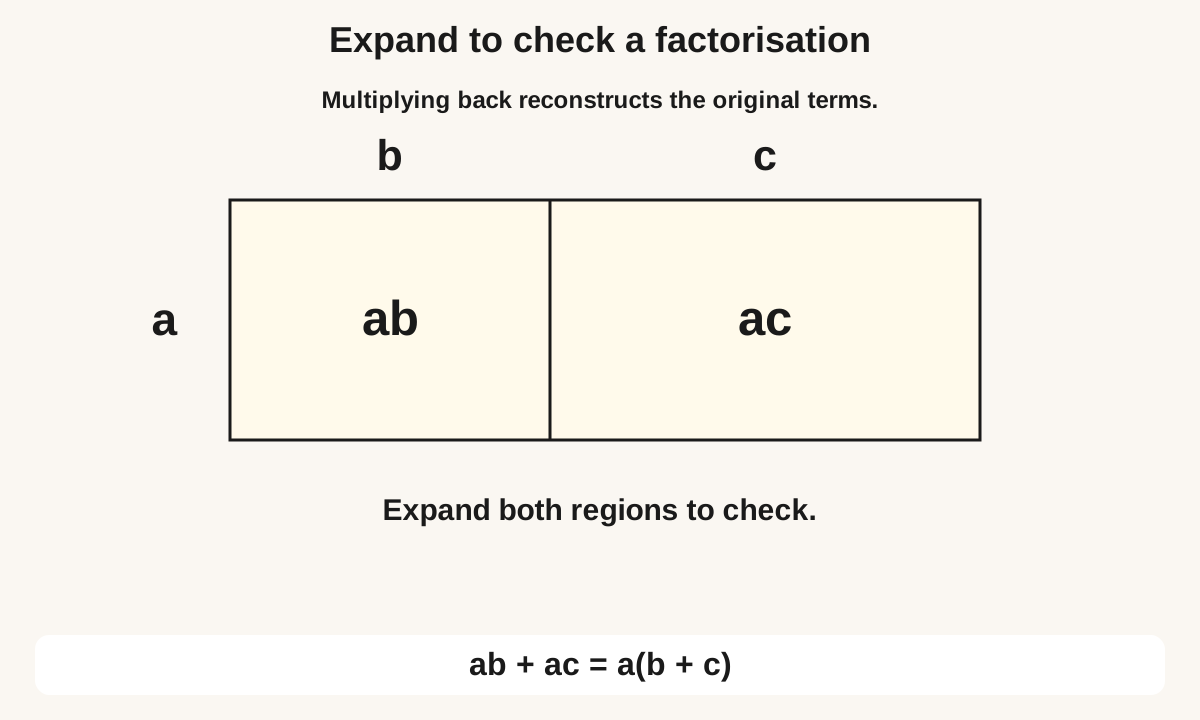
Expansion turns 3(2x + 5) into 6x + 15. Factorising reverses that. Look for a number that divides every coefficient. 6 and 15 are both multiples of 3, so 6x + 15 = 3(2x + 5). If every term also contains x, take x out as well: 8x² − 12x = 4x(2x − 3). Check by expanding the bracket. The terms inside must have no remaining common factor if you want a fully factorised form.
Learning goal: Reverse expansion by extracting a common factor. The grade is a suggested starting point; school sequences vary. Use the first worked example to check readiness, and Pre-algebra if an earlier idea needs revisiting.
See the idea
Read each diagram with its labels, then follow the worked examples. Practice questions include their own measurements and information.

Enlarge diagram to read the labels
Swipe across the enlarged diagram to read every label.
Enlarge diagram to read the labels
Swipe across the enlarged diagram to read every label.
Choose a method and explain why it works
First look for a common number factor and common variable factors. After removing them, inspect the remaining expression for a useful structure such as a difference of squares. For example, x² − 25 = (x − 5)(x + 5). Fully factorised means no further factorisation is needed over the number system being used in the question.
Notation: Highest common factor of 8 and 12 is 4. 8x² means 8 × x × x.
Key rule and when to use it
Factorising reverses expansion. Extract the greatest common factor before checking for identities or grouping. Expand the final product to verify it.
Worked examples, step by step
Example 1: Factorise 6x + 15.
- 3 divides 6 and 15. There is no x in the second term, so x is not common.
- 6x + 15 = 3(2x + 5).
- Check: 3 × 2x = 6x and 3 × 5 = 15.
Answer: 3(2x + 5)
Check: The grid is 3 rows of a (2x + 5) strip.
Example 2: Factorise 8x² − 12x.
- Every term contains x, and the coefficients 8 and 12 share a factor 4. This is not only a number factor.
- 8x² − 12x = 4x(2x − 3).
- Check: 4x × 2x = 8x² and 4x × (−3) = −12x.
Answer: 4x(2x − 3)
Check: A factor tree of 24 = 8 × 3 reminds you to hunt shared prime factors of 8 and 12, then also pull out x.
Example 3: Factorise x² − 25.
- 25 is 5², so this is a² − b² with a = x and b = 5.
- Write (x − 5)(x + 5).
- Check: x² + 5x − 5x − 25 = x² − 25.
Answer: (x − 5)(x + 5)
Check: Factor pairs of 25 include 5 and 5, matching the two squares.
Example 4: Factorise 3x + 6 + xy + 2y by grouping.
- This is four terms, not a difference of squares. Pair as (3x + 6) + (xy + 2y).
- 3x + 6 = 3(x + 2) and xy + 2y = y(x + 2).
- Both pairs share (x + 2), so (3 + y)(x + 2).
Answer: (3 + y)(x + 2)
Check: Expand: 3x + 6 + xy + 2y, which matches the original order of terms.
Example 5: Factorise 3x² − 27 completely.
- Remove the common factor 3: 3(x² − 9).
- The bracket is a difference of squares: x² − 3² = (x − 3)(x + 3).
- Answer: 3(x − 3)(x + 3). Expanding returns 3x² − 27.
Common mistakes and important boundaries
A common factor must divide every term. x is not common to 6x + 15 because 15 contains no x factor. A difference of squares needs subtraction and two squares; x² + 25 is not (x + 5)(x − 5). Expand the proposed factors to check signs and coefficients.
A point to explain
A learner may factor only one term, or take out a factor that does not divide every term.
Compare an uncertain attempt with the closest worked example. Look at the meaning of each operation, unit and label before repeating the arithmetic.
Factorising Expressions: Common Factors and Identities — practice
Work on paper first. Open each answer afterwards and compare the reasoning. Print the questions with or without the separate answer key; no account is required.
Name: ____________________ Date: __________
Factorising 6x + 15 undoes which expansion?
Answer and a way to check
3(2x + 5)
Ask which outside number divides both 6 and 15. Then divide each term by that number.
A factor tree for 12 can help with 12x + 18. Which common factor is greatest?
Answer and a way to check
6
List factors of 12 and of 18. Choose the greatest number that appears in both lists.
Factorise 9x + 12.
Answer and a way to check
3(3x + 4)
3 divides 9 and 12. Divide each term by 3 and write the results inside a bracket.
Factorise 10x − 15.
Answer and a way to check
5(2x − 3)
5 divides 10 and 15. Keep the minus with the 3.
Factorise 6x² + 9x.
Answer and a way to check
3x(2x + 3)
Both terms contain x. 3 divides 6 and 9. Take 3x outside.
Why is 2 not a complete common factor of 8x + 12 if we want the greatest factor?
Answer and a way to check
2 divides both terms, but 4 also divides both, so 4 is a greater common factor.
List 1, 2, 4, 8 for the first coefficient and compare with factors of 12.
A student writes 6x + 9 = 6(x + 9). What is the mistake?
Answer and a way to check
The student divided only the first term by 6.
6 must divide both 6x and 9. Check 9 ÷ 6.
A ribbon is cut into 4 equal lengths of (2x + 3) cm. Write a factorised expression for the total length, then expand it.
Answer and a way to check
4(2x + 3) = 8x + 12
Four equal pieces means 4 times one piece. Write that product, then expand to check.
x² − 9 is a difference of squares because 9 is which square?
Answer and a way to check
3²
Which number multiplies by itself to make 9?
Which factorisation matches x² − 16?
Answer and a way to check
(x − 4)(x + 4)
b is the number whose square is 16. Write (x − b)(x + b).
Factorise x² − 49.
Answer and a way to check
(x − 7)(x + 7)
49 is a square. Write (x minus that root) times (x plus that root).
Factorise 4x² − 9.
Answer and a way to check
(2x − 3)(2x + 3)
Write each term as a square, then use the difference-of-squares brackets.
Factorising Expressions: Common Factors and Identities — answer key
3(2x + 5) Ask which outside number divides both 6 and 15. Then divide each term by that number.
6 List factors of 12 and of 18. Choose the greatest number that appears in both lists.
3(3x + 4) 3 divides 9 and 12. Divide each term by 3 and write the results inside a bracket.
5(2x − 3) 5 divides 10 and 15. Keep the minus with the 3.
3x(2x + 3) Both terms contain x. 3 divides 6 and 9. Take 3x outside.
2 divides both terms, but 4 also divides both, so 4 is a greater common factor. List 1, 2, 4, 8 for the first coefficient and compare with factors of 12.
The student divided only the first term by 6. 6 must divide both 6x and 9. Check 9 ÷ 6.
4(2x + 3) = 8x + 12 Four equal pieces means 4 times one piece. Write that product, then expand to check.
3² Which number multiplies by itself to make 9?
(x − 4)(x + 4) b is the number whose square is 16. Write (x − b)(x + b).
(x − 7)(x + 7) 49 is a square. Write (x minus that root) times (x plus that root).
(2x − 3)(2x + 3) Write each term as a square, then use the difference-of-squares brackets.
Questions students and parents ask
Is 2(4x + 6) a correct factorisation of 8x + 12?
It is equivalent but not fully factorised over integer coefficients. The bracket still has common factor 2, giving 4(2x + 3). State whether a question requires full factorisation.
Can more than one correct factorised form exist?
Equivalent forms can use a negative common factor or reorder factors. If the instruction says factorise fully, check that no further common factor or required identity remains.
Is this a complete set of textbook exercise solutions?
No. This guide adapts BananaLearn’s own teaching examples and practice. It is not official NCERT material or a promise of the exact chapter sequence in a particular board, country or textbook edition.
What if the examples are still difficult?
Revisit Pre-algebra. Try the first example with its model, then attempt one fresh question independently. A correct copied answer is not evidence that the method can be used without support.
Help at home
Ask the learner to expand their final answer. This checks the proposed factorisation without relying on visual resemblance to a remembered formula.
Keep one example of the learner’s own working. A repeated difficulty across fresh questions can guide a discussion with their teacher; one short practice sheet does not establish a diagnosis or a full mastery profile.
Connect this idea to the next skill
About this guide
Based on BananaLearn’s Grade 8 course lesson “Take Out a Common Factor” and its related lesson “Factor Further”. The explanations have been adapted for independent reading; course diagrams are reused where they fit the idea, and missing classroom givens are made explicit in questions.
Explore the next topic
Need another way to understand it?
Bring one question your child found difficult to a free 50-minute session. Tell us their grade, curriculum and time zone so we can discuss a suitable next step.
Request a free session