Read and measure the diagram
Start here if the difficulty is identifying an angle, using a protractor or keeping area and perimeter separate.
Maths learning path · for students and parents
Two triangles can look almost identical and still need different methods. Before choosing a formula, identify what is known, what must be found and which geometric fact justifies the next step.
Geometry studies shapes, positions, sizes and relationships. Measurement gives numerical results; proof explains why a relationship must hold. This hub links visual foundations to angle reasoning, triangles, similarity and coordinate methods, with a short check to help you choose a starting point.
Suggested progression through Class 10, with school-dependent sequencing. A sketch is not automatically drawn to scale. Use stated measurements and marked relationships rather than judging lengths or angles by appearance.
On a phone, swipe across the model to read every label.
The route is a learning sequence, not a fixed timetable. A short independent check is more useful than guessing from a class label. If a prerequisite is secure, move ahead; if not, use its linked explanation first.
Start here if the difficulty is identifying an angle, using a protractor or keeping area and perimeter separate.
Choose this route when you can calculate a missing angle but cannot explain why a theorem applies. Match corresponding parts before using a criterion.
A right angle, a circle sector and a pair of coordinates lead to different tools. Identify the conditions before substituting values.
A triangle has angles 48° and 67°. The third angle is 180° − 48° − 67° = 65°. The justification is the interior-angle sum of a triangle in the school geometry model, not how wide the sketch looks.
An exterior angle next to the 65° interior angle is 115° because they form a straight line. It also equals the two remote interior angles: 48° + 67°.
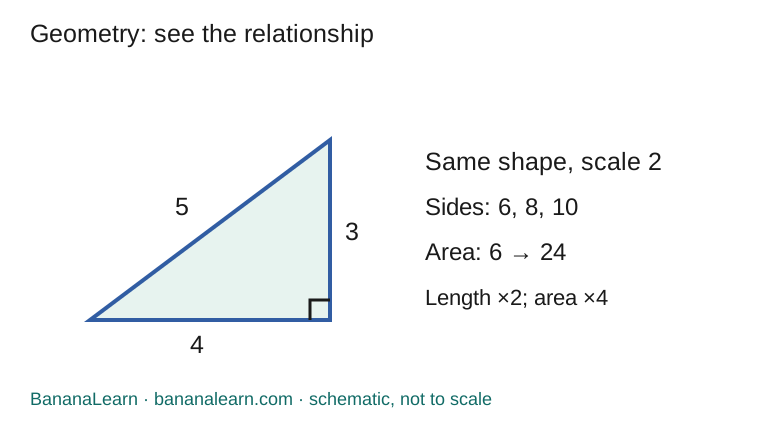
Two similar triangles have corresponding side lengths 4 cm and 10 cm. The enlargement factor is 10 ÷ 4 = 2.5. A corresponding 6 cm side becomes 15 cm. The area factor is 2.5² = 6.25, not 2.5.
Similarity is a condition, not a guess from appearance. If triangles are not known to be similar, a single pair of matching lengths does not establish a common scale factor.
For A = (1, 2) and B = (7, 10), horizontal change is 6 and vertical change is 8. These perpendicular changes form a right triangle, so AB = √(6² + 8²) = √100 = 10 coordinate units.
Do not add horizontal and vertical changes to obtain the straight-line distance. Their sum, 14, describes a particular two-part grid route rather than the segment AB.
Keep angle marks, parallel-line marks and length marks distinct. Equal-looking sides are not given equal lengths unless stated or proved. Do not apply Pythagoras to an arbitrary triangle, confuse a chord with an arc, or use a length scale directly as an area scale.
Try without opening the answer. A wrong answer is a clue to the next lesson, not a score for the whole subject.
55°, because the adjacent angles total 180°.
70°, from 180 − 35 − 75.
9, because each of two dimensions is scaled by 3.
13 cm: √(25 + 144).
No. Shapes can have equal area and different side lengths or angles.
(5, 7): average corresponding coordinates.
When a child knows a formula but cannot start a diagram problem, ask them to mark the given information and write the required quantity with a unit. Then ask which fact permits the first calculation. A correct number with an unsupported reason still identifies a useful teaching need.
Use a diagram-reading round before timed questions: list the givens, mark the target and predict the method. After solving, check whether a length or area is plausible and whether its units match the question. Follow the linked proof guides when a written justification is required.
Keep one worked sample and one fresh independent attempt. Note the help required and revisit the same skill later with changed numbers or a new diagram. Faster answers can be useful, but the evidence should also include explanation and transfer.
BananaLearn offers one-to-one Maths tutoring, with English and Science also available. Share your child’s class, board or curriculum, one recent question and the part they find difficult. We can discuss teaching fit and available lesson times before you decide.
A useful first conversation should identify a starting point, how the child will practise independently and how progress will be checked. Bring a recent school question so the discussion starts with the skill your child needs.
The worked examples and checks are original BananaLearn content. The linked lessons provide fuller explanations and practice. Suggested levels do not replace the current school syllabus, book edition or teacher’s sequence. This page is a curated topic route, not a new curriculum certification.
How we prepare learning guides · Report a correction
Save this link: https://bananalearn.com/learn/geometry-learning-path.html