
Start with the key idea
A useful trial gives the child a chance to attempt a suitable task, receive an explanation or feedback, and try again. Observe how the tutor finds the first difficulty, responds to mistakes and adjusts the next step. Treat comfort, learning evidence and practical arrangements as separate checks. One lesson can help you judge fit; it cannot prove long-term progress.
Before the trial: bring one real learning question
Choose a small concern from ordinary schoolwork: interpreting a remainder, supporting an inference with a clue, or explaining what a circuit does. Share a recent task, the class or year level, and the curriculum or textbook if known. A whole report card is less useful than a specific example when the question is how the tutor will teach.
Tell the tutor which parts your child can usually do and what help was given on the sample. If the work was copied, corrected with an adult or completed in class, say so. This gives the tutor context without turning an early mistake into a label.
Agree how you will observe. Some children work more naturally with a parent nearby; others become self-conscious. Ask whether there is a short parent conversation before or after the learning part. Do not secretly record a lesson. Confirm any recording arrangements with the provider.
Look for a learning sequence, not a polished demonstration
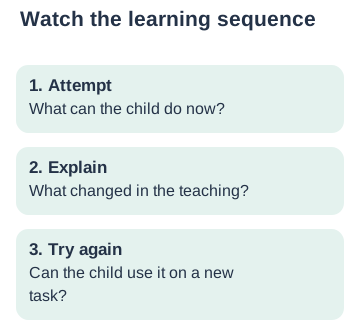
A useful pattern is attempt, explanation, fresh attempt and next step. The first attempt helps the tutor see the current approach. The explanation should respond to that evidence. The fresh attempt gives the child a chance to use the idea. The next step states what still needs work. A trial need not follow a rigid timetable to show these elements.
Watch who does the thinking. The tutor can model a method, but the child should also point, draw, explain, choose or calculate. Quiet time can be productive thinking time; a lively conversation can still leave the learner passive. Do not judge quality simply by how much either person speaks.
Distinguish a hint from an answer. “What does the four count in this story?” invites interpretation. “Write seven here” supplies a result. Both are observable actions, but they tell you different things about what the child can currently do alone.
Watch the response to a mistake
A useful response identifies the first step that needs attention. If a learner adds every number in a word problem, another addition demonstration may miss the actual difficulty. The tutor could ask the learner to describe the situation or draw the quantities before selecting an operation.
Listen for explanations that connect to the task. “Because that is the rule” may be insufficient when the child does not understand what the rule represents. A drawing, object, sentence comparison or simpler example can make the missing relationship visible. The right representation depends on the subject and learner.
Mistakes should not become humiliation or a sales tactic. “You cannot do anything without us” is not a useful assessment. Equally, a claim that every problem is fixed after one example goes beyond the evidence. A careful tutor can name what worked and what remains uncertain.
Three concrete things to watch across subjects
Maths: in 27 children travelling in cars with four seats each, the calculation gives six remainder three. Ask whether the teaching connects the remainder to the need for a seventh car. A fresh task might use 19 children and five seats. The child should explain why four cars are needed, not merely repeat “round up”.
English: a child says a character is nervous. Look for a request to connect that idea to a detail in the passage. A fresh sentence should require another supported inference. Agreement with the tutor is weaker evidence than the child locating and explaining the clue.
Science: when comparing a closed and an open circuit, look for an explanation of the complete conducting path. A new labelled sketch can check whether the learner identifies the break. No household mains electricity or home experiment is needed to observe this teaching.
Check whether the child can participate comfortably
Observe whether the child can hear, see the working and ask for clarification. On an online lesson, can they write or show their solution without spending most of the time navigating tools? A technical problem and a teaching problem are different issues; record them separately.
Ask your child afterwards: “Which part made more sense?”, “Was there somewhere you wanted to ask a question?” and “What would you try next time?” These questions give more information than only “Did you like the teacher?” Do not pressure the child to give the answer you want.
A quiet or hesitant first lesson does not automatically show poor fit. Note whether the tutor notices the hesitation and gives an appropriate way to respond. Persistent discomfort, dismissive feedback or communication that the child cannot follow deserves a direct discussion.
Make a decision from evidence and unresolved questions
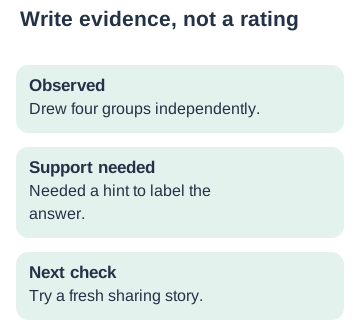
Keep three separate notes: teaching evidence, child experience and practical fit. Write “used a drawing after the first mistake; child solved the fresh example with one hint”, rather than “excellent teacher”. A concrete note makes it easier to compare options fairly.
Ask for the proposed first learning goal and how it will be checked. Also confirm who teaches regular lessons, session length, scheduling, fees and cancellation terms. A convincing trial with a different tutor may tell you little about the person who will teach later.
Choose continue, clarify or try another option. Continue when the evidence and arrangements fit. Clarify when the concern is fixable, such as the writing tool or an unclear goal. Try another option when the explanation, interaction or arrangements do not fit. There is no meaningful universal pass mark for a trial.
Your one-page trial observation record
Write the date, subject and task. Under “first attempt”, note what the child did and any help. Under “teaching”, describe the example, explanation or feedback. Under “fresh attempt”, record the new task and the support still required. Finish with the next learning goal.
Add the child’s own comment and one practical question you still need answered. Keep student work and contact details private. The worksheet below gives situations to help you practise observing; the blank record in the save section is for your own lesson.
Return to the record after a few regular lessons with fresh work. The trial is a starting observation, not a promise of marks or proof that tutoring caused a later score change.
3 worked examples with reasoning
1. The child answers correctly only after the tutor points to each step. Is the skill secure?
- Record the successful supported attempt.
- Ask for a similar fresh task with less help when appropriate.
- Describe the support still needed; do not call the skill independent yet.
2. A quiet learner types a thoughtful explanation instead of speaking. Is participation poor?
- Look at the quality and relevance of the response.
- Check that typing is a comfortable way to participate and that questions are answered.
- Do not equate volume or speed of speech with learning.
3. The trial was good, but regular sessions use another teacher.
- Ask how the regular teacher is matched and how the trial findings will be shared.
- Confirm whether you can discuss the goal with that teacher.
- Treat the first trial as evidence about that lesson, not every future teacher.
Save the guide or print the practice
Download to save or share
Complete guide with answers (PDF) · Worksheet without answers (PDF) · Worksheet and answer key (PDF)
Use these situations to practise making a decision. The model responses are examples, not a score or a diagnosis of your child.
8 decision tasks with model responses
Use these situations to practise making a decision. The model responses are examples, not a score or a diagnosis of your child.
Write an answer and your reason before opening the explanation. Check the reasoning as well as the final answer.
- Observe
A tutor demonstrates three questions; the child watches. What evidence is missing?
Answer and reasoning
A learner attempt on a suitable fresh question.
A clear explanation alone does not show what the child can use.
- Maths
19 children travel in cars with five seats each. How many cars are needed?
Answer and reasoning
Four cars.
Three cars carry only 15; the remaining four children need another car.
- Support
The learner gets the answer after being given the operation. What should the note include?
Answer and reasoning
The operation was supplied.
Calculation and choosing an operation are different parts of the task.
- English
A child calls a character kind. What follow-up checks reasoning?
Answer and reasoning
Ask which detail supports that description and why.
A label needs a connection to evidence in the passage.
- Comfort
The child cannot read the shared screen. What do you check first?
Answer and reasoning
Adjust the display or writing arrangement and check readability.
This may be an access problem rather than a lack of understanding.
- Fit
What should you confirm if the trial tutor is temporary?
Answer and reasoning
Who will teach regular lessons and how information is handed over.
Consistency cannot be inferred from one substitute teacher.
- Decision
Replace “the trial was great” with an observation.
Answer and reasoning
Example: the child drew the groups on the fresh task with one reminder.
The note identifies an action and the help involved.
- Review
Does one successful lesson prove a lasting improvement?
Answer and reasoning
No; check later fresh work under comparable conditions.
Immediate supported success and lasting independent use are different evidence.
Your printable decision record
Trial observation sheet: Date ___ Subject ___ Task ___ First attempt ___ Help given ___ Tutor explanation ___ Fresh task ___ What the child did ___ Child comment ___ Practical question ___ Next step ___.
Use “observed”, “not observed” or “need to clarify” beside each part. Do not add these into a numerical score.
Common questions
Should I sit through the whole trial?
Agree this with the tutor and your child. You may observe a short part or discuss examples afterwards; the aim is to understand teaching without making the child uncomfortable.
Should the child get every answer right?
No. Appropriate difficulty gives the tutor something to teach. Watch how the difficulty is identified and what changes after explanation.
Is an enjoyable trial enough?
Enjoyment matters, but also check learner participation, feedback and practical fit. Keep these observations separate.
Should I prepare the child with the answers?
No. Explain the purpose and share relevant schoolwork, but rehearsing the exact answers makes the trial less informative.
How soon should I decide?
You can decide when the teaching and arrangements are clear enough. Ask about unresolved points rather than treating sales urgency as learning evidence.
Connect your learning
Ask about one-to-one learning support if you would like to discuss your child’s learning needs.
About this guide
Original explanations, examples, diagrams and practice by BananaLearn. This parent guide offers practical decision tools, not an assessment or a guarantee of learning outcomes. Monetary examples, where included, are hypothetical.