Before you start
Work with signed numbers, powers and substitution. Read p(x) as “the value of polynomial p at input x”, not p multiplied by x. The guide covers foundational polynomial language and zeros; it is not tied to one textbook edition or exercise number.
Need a starting point? Pre-algebra builds a related prerequisite or visual idea.
What makes an expression a polynomial?
A polynomial in x is a finite sum of terms with non-negative integer powers of x. Its coefficients can be positive, negative, fractional or irrational real numbers. For instance, 3x² − 2x + 7 and x/2 + 4 are polynomials in x.
An expression such as 1/x contains x to the power −1, so it is not a polynomial in x. The expression √x uses a fractional power of the variable and is not a polynomial in x either. By contrast, √2 times x is a polynomial: √2 is a constant coefficient, not a square root of the variable.
Terms, coefficients and degree
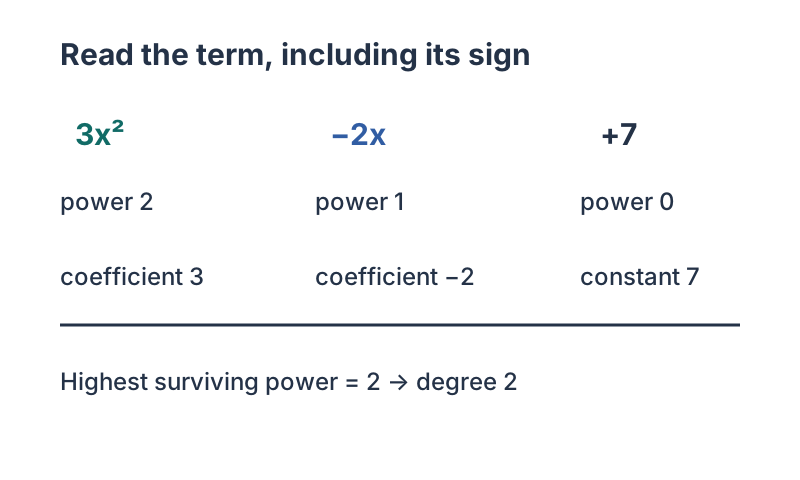
In 3x² − 2x + 7, the terms are 3x², −2x and 7. Keep the minus sign with the coefficient −2. The constant term 7 can be seen as 7x⁰. The degree is the highest power with a non-zero coefficient after collecting like terms.
A non-zero constant such as 5 has degree 0. A linear polynomial has degree 1; a quadratic has degree 2. The zero polynomial has no degree under the convention used here. Do not treat a term with coefficient zero as the highest surviving power.
Evaluate first, then decide whether the input is a zero
To evaluate p(−2), replace every x with (−2). Brackets matter: (−2)² = 4, while −2² is commonly read as −(2²) = −4. Work through the powers before multiplication and addition.
A number a is a zero of p when p(a) = 0. For p(x) = 2x − 6, solving 2a − 6 = 0 gives a = 3. Check by substitution into the original expression. A candidate input is not confirmed just because a factor or coefficient looks familiar.
See a zero in a table and graph
A table records input-output pairs. When one output equals 0, its input is a zero of the rule. On a graph of y = p(x), the corresponding point lies on the horizontal x-axis because its y-coordinate is 0.
The zero is the x-coordinate, such as 3. The point is (3, 0). A plotted polynomial may cross the axis or just touch it. Sampling a few table inputs can reveal a zero but cannot prove that no other zeros exist outside the sampled values.
The zero polynomial is a different idea
The zero polynomial is the rule that gives 0 for every input. For example, collecting like terms in 4x − 4x gives 0. Every real number is a zero of that rule.
A non-zero constant, such as p(x) = 5, never outputs 0 and has no zeros. A non-zero polynomial of degree n has at most n distinct real zeros; it need not have exactly n. For example, x² + 1 has no real zero, because a square is never negative.
See the relationships
Read the labels and explanation together. These diagrams illustrate the examples stated in their captions; the practice questions give their own values.

Worked examples, step by step
Example 1: Find the degree and constant term of 4x³ − 5x + 2.
- The powers present are 3, 1 and 0.
- The highest is 3, so the degree is 3.
- The constant term is 2. There does not have to be an x² term.
Example 2: Simplify 2x² + 3x − 2x² + 5 before finding its degree.
- The x² terms cancel.
- The expression becomes 3x + 5.
- Its degree is 1, not 2. Use the simplified polynomial.
Example 3: Evaluate p(−2) for p(x) = x² + 3x + 2.
- Substitute with brackets: (−2)² + 3(−2) + 2.
- Calculate 4 − 6 + 2 = 0.
- Hence −2 is a zero of p.
Example 4: Find a zero of p(x) = 5x − 20.
- Set the output equal to zero: 5x − 20 = 0.
- Add 20 and divide by 5 to get x = 4.
- Check: p(4) = 20 − 20 = 0.
Example 5: Is 2 a zero of q(x) = x² + 1?
- q(2) = 2² + 1 = 5.
- The output is not zero, so 2 is not a zero.
- In fact this polynomial has no real zero: x² ≥ 0 makes x² + 1 positive for every real x.
Common mistakes and how to repair them
Calling the coefficient the zero
In 2x − 6 the zero is 3; 2 is the coefficient of x and −6 is the constant term. These names describe different roles.
Dropping brackets around negative inputs
Write every substituted negative input in brackets before squaring or multiplying. Then follow the order of operations.
Assigning degree from a term that cancels
Collect like terms first. The surviving highest non-zero term determines the degree.
Practise before opening the answers
Write your working on paper. Open each answer after making an attempt, then compare the explanation. For construction questions, use the named physical tools.
Is 3x² − x + 1 a polynomial? State its degree.
Show answer and reasoning
Yes; degree 2. All variable powers are non-negative integers and the x² coefficient is non-zero.
Is 2/x + 3 a polynomial in x?
Show answer and reasoning
No. The term 2/x has variable power −1.
Find the coefficient of x in 7x² − 4x + 9.
Show answer and reasoning
−4. The sign belongs to the coefficient.
Find p(−1) for p(x) = x² − 2x + 1.
Show answer and reasoning
4. (−1)² − 2(−1) + 1 = 1 + 2 + 1.
Is −3 a zero of p(x) = x + 3?
Show answer and reasoning
Yes. p(−3) = −3 + 3 = 0.
Find the zero of 3x + 12.
Show answer and reasoning
−4. 3x = −12 gives x = −4; substitute back to check.
Find the degree of 5x³ − 5x³ + 2.
Show answer and reasoning
0. The expression simplifies to the non-zero constant 2.
Does p(x) = 0 have only one zero? Explain.
Show answer and reasoning
No; every real input is a zero. The rule outputs 0 for every input. This is the zero polynomial.
Questions students and parents ask
Can a polynomial have a fractional coefficient?
Yes. For example, (1/2)x² + 3 is a polynomial. Restrictions apply to powers of the variable, not to whether a constant coefficient is a whole number.
Are a root and a zero the same?
A zero of p is an input a satisfying p(a) = 0. That same number is called a root of the equation p(x) = 0.
Is p(0) always zero?
No. p(0) equals the constant term. For p(x) = 2x − 6 it equals −6, so 0 is not a zero.
Is the degree of the zero polynomial zero?
No under the convention used here: its degree is undefined. Degree 0 applies to a non-zero constant polynomial.
A simple way to practise together
Ask the learner to sort expressions into polynomial and not polynomial, explaining the variable’s power each time. Then use one substitution to distinguish “the input is zero” from “the output is zero”.
Keep learning and practising
- Grade 8 Substitution in Algebraic Expressions
- Grade 8 Factorising Expressions: Common Factors and Identities
- Class 10 Quadratic Formula: Steps, Discriminant and Examples
For a change of pace, explore our learning games. The games list explains the skills each one practises; not every guide has a matching game level. Return to a fresh question here to check this specific idea.
About this guide
Adapted for independent reading from BananaLearn’s Grade 9 teaching material. We reused our course visual library where it fits and created supporting diagrams for the written explanations. The examples and practice are original learning resources, not official NCERT solutions or reproduced exam questions. School sequences and textbook editions differ.
Need another explanation?
Bring one question your child found difficult to a free 50-minute session. Share their grade, curriculum and time zone so we can discuss the next step.
Request a free session