Your child recognises the formula but cannot decide which function fits the problem. Precalculus brings algebra, graphs and trigonometry together so those choices have a reason.
BananaLearn offers one-to-one online Precalculus tutoring for school coursework, foundation repair and preparation for Calculus. Lessons can connect function behaviour, exponential and logarithmic models, and trigonometry with the student’s actual syllabus. AP Precalculus families should include the exam year and current unit.
Solve and rearrange linear and quadratic equations; keep denominator and square-root restrictions.
Work with powers, logarithms and function notation, including negative or fractional inputs.
Read coordinates, slopes and graph transformations, and explain a result in words.
Know right-triangle ratios; use the unit-circle model below to extend them to rotation.
The checks on this page are conversation starters, not a validated assessment or admission requirement.
What can tutoring cover?
A planning map to compare with the school syllabus
Area
Skills and concepts
What independent understanding can look like
Functions and representations
Domain, range, composition, inverse functions and transformations.
Move between an expression, a table, a graph and a context.
Polynomial and rational behaviour
Zeros, end behaviour, multiplicity, holes and asymptotes as required.
Separate a restriction from an intercept and explain each algebraically.
Exponential and logarithmic models
Growth/decay, inverse functions, equations and contextual interpretation.
Identify the reference value and the multiplicative rate.
Radian measure and the unit circle
Angle as arc-length/radius; coordinates, exact values and signs.
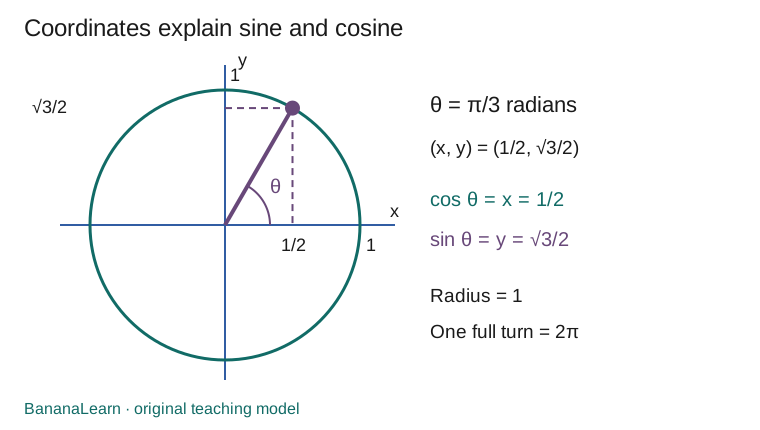
Connect cos θ and sin θ to the point on the circle.
Periodic functions
Amplitude, period, midline and phase shifts.
Read a cycle and justify parameters from a graph.
Trigonometric equations and identities
Solutions in a stated interval and justified equivalent forms.
Keep all solutions within the requested domain.
Additional school units
Polar coordinates, sequences, conics, vectors or matrices when included.
Confirm the school scope rather than treat every extension as compulsory.
Calculus readiness
Rates of change, function interpretation and efficient algebra.
Simplify a difference quotient and explain why its increment cannot yet be zero.
A unit-circle point explains sine and cosine
On a small screen, swipe across the graph to read every label.
At π/3 radians, the horizontal coordinate is 1/2 and the vertical coordinate is √3/2.
Choose the correct course pathway
A school Precalculus course and AP Precalculus can overlap without being identical. Ask for the actual syllabus and the current chapter. Some schools include conics, vectors or additional sequence work; others organise the course differently.
College Board’s AP framework groups learning into polynomial/rational, exponential/logarithmic and trigonometric/polar work, with an additional unassessed unit involving parameters, vectors and matrices. The AP page links current 2026–27 clarifications and May 2027 exam-format updates. Use that current source for test arrangements rather than an older timing table.
Make domain and inverse relationships explicit
Before composing two rules, check that the first output is an allowed input to the second. Before finding an inverse, ask whether different inputs could produce the same output. An unrestricted quadratic is not one-to-one over the reals.
For f(x) = (x − 2)², restricting the domain to x ≥ 2 selects one branch. Its inverse is f⁻¹(x) = 2 + √x for x ≥ 0. A domain restriction is a mathematical condition, not a cosmetic note appended after the algebra.
Build trigonometry from a rotating point
On a unit circle, the point reached by angle θ has coordinates (cos θ, sin θ). Radians measure an angle by the ratio of arc length to radius. One complete turn is 2π radians, so half a turn is π.
The circle makes signs and repeated solutions visible. In quadrant II, cosine is negative and sine is positive. For a periodic equation, a calculator’s principal value is often only a starting point; the interval determines which further angles are required.
Use graphs to test a model, then explain it
For a sinusoidal model, ask what the midline represents, how far the output moves from it and how long a cycle takes. State whether inputs are radians, degrees, seconds or another quantity before interpreting the horizontal scale.
Graphing technology can reveal an implausible window or parameter choice. It does not establish that a model describes actual measured data. Our graphs are original teaching examples; the assumptions and context belong in the written interpretation.
Bridge to Calculus with meaning
Average rate of change compares two outputs over a nonzero input change. Calculus later asks what happens as that change approaches zero. Strong function notation and factorisation make the later reasoning easier to follow.
Preparing for Calculus does not mean rushing through derivative rules. A student who can simplify and interpret a difference quotient, distinguish output from rate and use radians has concrete foundations to build on. Use a changed task to check those foundations independently.
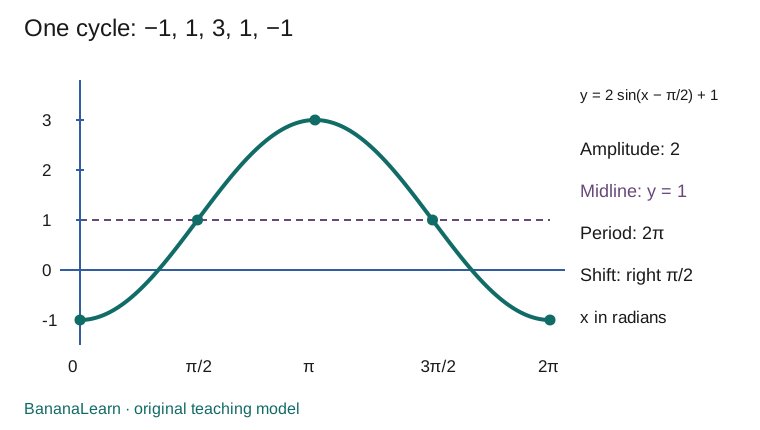
Build a transformed graph from checkpoints
On a small screen, swipe across the graph to read every label.
For 2 sin(x − π/2) + 1, the amplitude is 2, the midline is 1 and the period is 2π.
Five worked examples: method, meaning and checks
These original examples show selected teaching ideas. They do not represent an entire syllabus or official exam paper.
1. Build an inverse with its domain
Let f(x) = (x − 2)² with x ≥ 2. Set y = (x − 2)². Because x − 2 ≥ 0, take the non-negative square root: √y = x − 2, so x = 2 + √y.
Thus f⁻¹(x) = 2 + √x, with input domain x ≥ 0 and output range at least 2. For example, f(5) = 9 and f⁻¹(9) = 5. Without the original domain restriction, inputs −1 and 5 both give 9 and a single inverse function would not be defined.
Check the reasoning: The symbol f⁻¹ denotes an inverse function here. It is not the reciprocal 1/f(x).
2. Read an exact unit-circle point
At θ = π/3, or 60°, an equilateral triangle split in half gives a right triangle with hypotenuse 1, adjacent side 1/2 and opposite side √3/2. The unit-circle point is therefore (1/2, √3/2).
Its coordinates give cos(π/3) = 1/2 and sin(π/3) = √3/2. Their ratio gives tan(π/3) = √3. The exact values retain more information than prematurely rounded decimals.
Check the reasoning: At 2π/3 the horizontal coordinate changes sign but the vertical coordinate stays positive. Use the quadrant to check the answer.
3. Read a transformed sine graph
For y = 2 sin(x − π/2) + 1, the amplitude is 2 and the midline is y = 1. The coefficient of x inside the sine is 1, so the period is 2π. The graph is shifted right by π/2.
At x = 0 the output is −1; at π/2 it is 1; at π it is 3; at 3π/2 it is 1; at 2π it is −1. These checkpoints establish one complete cycle without guessing the shape.
Check the reasoning: Amplitude is the distance from the midline to a peak. The full peak-to-trough height here is 4, not 2.
4. Keep both trigonometric solutions
Solve sin x = 1/2 for 0 ≤ x < 2π. The reference angle is π/6. Sine is positive in quadrants I and II, giving x = π/6 and x = 5π/6.
The interval contains exactly those two solutions. If the task asked for all real solutions, periodic repetitions would need to be included. If it used degrees, the corresponding answers would be 30° and 150° in a 0° to 360° interval.
Check the reasoning: A single inverse-sine calculator value does not by itself enumerate an entire cycle.
5. Simplify an average-rate expression
For f(x) = x², the average rate from x to x + h is [f(x + h) − f(x)]/h with h ≠ 0. Expand the numerator: (x + h)² − x² = 2xh + h².
Factor out h and divide for nonzero h to obtain 2x + h. At x = 2 and h = 0.5 the average rate is 4.5; at h = 0.1 it is 4.1. The values suggest a limiting rate of 4 as h approaches zero.
Check the reasoning: Do not substitute h = 0 into the original quotient. The limit describes behaviour near zero; direct division by zero remains undefined.
Try eight questions, then check the reasoning
Work on paper before opening each answer. Mark whether you needed a hint and which step was unclear; a total score alone will hide that information.
1. Convert 150° to radians.
5π/6. Multiply by π/180: 150π/180 simplifies to 5π/6.
2. Find cos(2π/3).
−1/2. The reference angle is π/3, and cosine is negative in quadrant II.
3. Find the period of y = sin(3x), with x in radians.
2π/3. The inside angle increases by 2π when 3x increases by 2π.
4. For f(x) = 2x + 1 and g(x) = x², find f(g(3)).
19. Apply the inside rule first: g(3) = 9, then f(9) = 2 × 9 + 1.
5. Solve 2^(x + 1) = 16.
x = 3. Since 16 = 2⁴, x + 1 = 4.
6. State the real domain of √(5 − x).
x ≤ 5. The radicand must satisfy 5 − x ≥ 0.
7. Solve cos x = 0 for 0 ≤ x < 2π.
x = π/2 or 3π/2. Cosine is the horizontal unit-circle coordinate, which is zero at the top and bottom points.
8. Find the average rate of f(x) = x² from x = 1 to x = 3.
4. The output change is 9 − 1 = 8 and the input change is 3 − 1 = 2, so the quotient is 8/2. This is a secant slope, not the derivative at either endpoint.
Common mistakes worth discussing
Confusing inverse and reciprocal
For f(x) = 2x, the inverse is x/2, while the reciprocal is 1/(2x). They answer different questions.
Mixing radians and degrees
Check the unit stated in the question and the calculator mode. A derivative formula such as d(sin x)/dx = cos x uses radian measure.
Using the peak height as amplitude
Measure from the midline to a peak. For 2 sin x + 1, the maximum is 3 but the amplitude is 2.
Forgetting an interval or domain
A trigonometric equation can have infinitely many real solutions. A stated interval selects a finite subset; include its endpoint conditions.
A practical plan for the first discussion and later review
Locate the gap. Bring the school syllabus and one current task. Separate algebraic errors from missing function meaning or radian knowledge.
Connect representations. Work through the same relationship as an equation, graph and verbal explanation. Label the domain and units.
Test transfer. Use a new coefficient, restricted interval or model context. Ask the student to justify why each answer belongs.
Review readiness. Check a later mixed task involving composition, trigonometry and rates. Decide which foundation needs more work before Calculus.
Keep a simple learning record
Current school topic and the question attempted.
The first step the student could not explain.
One corrected explanation in the student’s own words.
A fresh independent attempt, date and prompts needed.
The skill to revisit at the next agreed review.
Use initials or a private notebook if sharing examples; sensitive school records are not needed for an initial enquiry.
Questions parents and students ask
Is Precalculus the same as Algebra 2?
They overlap, but Precalculus typically connects more function behaviour and trigonometry in preparation for Calculus. Your school’s sequence determines the precise boundary.
Do you support AP Precalculus?
Yes. Include the current unit and assessment year. The official AP course and exam description determines exam-specific scope; a general Precalculus topic list is not a full exam specification.
Does my child have to finish every topic before starting Calculus?
Readiness depends on the receiving course. Function interpretation, algebraic fluency and trigonometry are important; use the teacher’s requirements and actual work rather than a universal checklist score.
Can we work on trigonometry only?
Yes. Describe whether the difficulty concerns right triangles, radians, the unit circle, graphs, identities or equations so the starting task fits.
Are these official AP practice questions?
No. The examples and checks are original BananaLearn teaching material. Official course and exam information is linked separately.
What should parents send before the first lesson?
The course name, current topic, a brief description of a difficult question and preferred local lesson windows. Ask about the current fees and class arrangements before booking.
Course-scope references checked 2 November 2026. All explanations, questions, graphs and invented models on this page are original BananaLearn material. The linked books and official specifications are references, not copied lesson content.
Tell us the course, school year, current topic and country/time zone. For AP or another examination course, include the assessment year and pathway. Describe one difficult task and the preferred lesson windows so we can discuss a useful starting point and availability.