Maths · Suggested Grade 10
Completing the Square: Class 10 Method, Model & Practice
To turn x² + 6x into a complete square, add 9—not 6. Splitting the 6x strip into two equal pieces explains where that missing corner comes from.
Original explanations and practice by BananaLearn · Published 1 November 2026
On a small screen, swipe across the illustration to read every label.
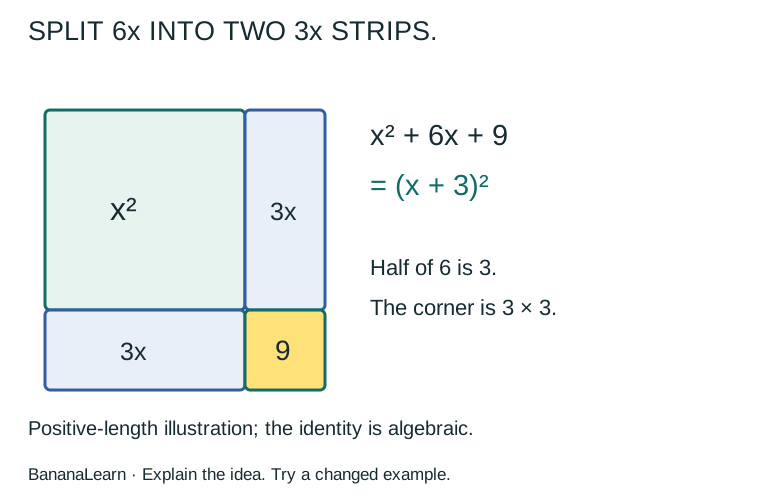
The identity behind the method
A perfect-square expression has the form (x + a)² = x² + 2ax + a². For x² + 6x, half the coefficient of x is 3, so the missing term is 3² = 9. Thus x² + 6x + 9 = (x + 3)².
The positive-length area model shows an x-by-x square with two x-by-3 strips. A 3-by-3 corner completes the larger square. The algebraic identity also works for negative x, even though the simple length picture does not represent negative lengths.
An equation must stay balanced
Solve x² + 6x = 7. Add 9 to both sides: x² + 6x + 9 = 16. Rewrite as (x + 3)² = 16. The square has two real possibilities: x + 3 = 4 or x + 3 = −4. Therefore x = 1 or x = −7.
Check in the original equation: 1 + 6 = 7 and 49 − 42 = 7. Keeping both branches matters. Taking only the positive square root would lose one valid solution. A later word-problem context may reject a negative length, but algebra alone does not.
Negative coefficients and exact surds
For x² − 8x = 5, half the coefficient is −4 and its square is 16. Add 16 to both sides to get (x − 4)² = 21. Hence x = 4 ± √21. A decimal can be useful for checking, but this is the exact answer.
For x² + 4x + 1 = 0, move the constant first: x² + 4x = −1. Add 4 to obtain (x + 2)² = 3, giving x = −2 ± √3. The number added is the square of half the x coefficient, not half the constant.
When the coefficient of x² is not one
Solve 2x² + 8x − 10 = 0. Divide every term by 2: x² + 4x − 5 = 0. Then x² + 4x = 5, so (x + 2)² = 9 and x = 1 or −5. Dividing only the first term would produce a different equation.
For rewriting an expression rather than solving an equation, factor the leading coefficient: 2x² + 8x + 3 = 2(x² + 4x) + 3 = 2[(x + 2)² − 4] + 3 = 2(x + 2)² − 5. The outer factor must multiply the correction term too.
Odd coefficients produce fractions
For x² + 5x = 6, half of 5 is 5/2, whose square is 25/4. Add 25/4 to both sides: (x + 5/2)² = 49/4. Thus x + 5/2 = ±7/2, giving x = 1 or −6.
Fractions do not make the method invalid. Keep exact fractions while completing the square. If factorisation is obvious, x² + 5x − 6 = (x + 6)(x − 1) is quicker. Completing the square remains useful when factors are not obvious and for understanding the quadratic formula.
One root, two roots or no real roots
After rewriting, an equation (x + a)² = k has two distinct real roots if k > 0, one repeated real root if k = 0, and no real roots if k < 0. A real square cannot be negative. For x² + 2x + 5 = 0, the completed form is (x + 1)² = −4, so there is no real solution.
This guide stays within real numbers. Do not report x = −1 ± 2 as if √(−4) were 2. If a class later introduces complex numbers, the answer language changes, but the real-number conclusion here is complete and correct.
Use a repeatable check
Write the original equation, normalise the x² coefficient if needed, isolate the constant, add the square of half the x coefficient to both sides, then solve both branches. Finally substitute each proposed root into the original equation.
When a learner adds a number on only one side, pause at the balance step. When they lose a root, return to the simpler question Which real numbers have square 16? The record below separates the missing corner from the final root calculation.
Complete, solve and check
Copy the record into a notebook or use it to organise your own answer. Blank spaces are for your work.
| Equation | Term added | Completed square | Roots |
|---|---|---|---|
| x² + 6x = 7 | 9 | (x + 3)² = 16 | 1, −7 |
| x² − 8x = 5 | 16 | (x − 4)² = 21 | 4 ± √21 |
| Your equation | ___ | ___ | ___ |
12 questions with explained answers
Try the questions before opening the answers. Explain the reason, then try a changed example to check your understanding.
Complete x² + 10x + ___.
Show answer and explanation
25
Half of 10 is 5; 5² = 25.Complete x² − 6x + ___.
Show answer and explanation
9
Half of −6 is −3; its square is 9.Rewrite x² + 8x + 16.
Show answer and explanation
(x + 4)²
The middle term is 2 × 4 × x.Solve x² + 6x = 7.
Show answer and explanation
1 or −7
(x + 3)² = 16.Solve x² − 8x = 5.
Show answer and explanation
4 ± √21
(x − 4)² = 21.Solve x² + 4x + 1 = 0.
Show answer and explanation
−2 ± √3
(x + 2)² = 3.Solve 2x² + 8x − 10 = 0.
Show answer and explanation
1 or −5
Divide by 2; then (x + 2)² = 9.Solve x² + 5x = 6.
Show answer and explanation
1 or −6
(x + 5/2)² = 49/4.Rewrite 2x² + 8x + 3.
Show answer and explanation
2(x + 2)² − 5
Expand back to verify the constant.How many real roots has (x − 3)² = 0?
Show answer and explanation
One repeated root, x = 3
Only zero has square zero.Solve x² + 2x + 5 = 0 over the reals.
Show answer and explanation
No real roots
(x + 1)² = −4.Why add 9 to both sides of x² + 6x = 7?
Show answer and explanation
To preserve equality while forming (x + 3)²
Adding only on one side changes the equation.
Keep the ideas connected
For help with a school-learning difficulty, bring one attempted question to a discussion about tutoring and curriculum fit. Maths is our priority; English and Science tutoring are also available.
Sources, scope and sharing
The examples, diagrams and practice are original BananaLearn work. Grade labels suggest a learning level; teaching sequences and school requirements can differ. Official sources below support the stated facts and resource links. These activities are independent resources, not official exam questions or endorsed campaign materials.
How we prepare learning guides · Report a correction
Share this guide: https://bananalearn.com/learn/class-10-completing-the-square.html