Secure the prerequisites
Start here if fractions, square roots or the right-angle condition make the trigonometric calculation harder to follow.
Maths learning path · for students and parents
“Opposite” is not a permanent name for a side. Change the angle you are looking from, and the opposite and adjacent sides can swap. Getting that choice right makes sine, cosine and tangent much easier.
Right-triangle trigonometry connects an acute angle to ratios of side lengths. Similar right triangles have the same ratios for the same acute angle, even when the triangles have different sizes. Use this hub to move from side labels to ratios, missing lengths and height-and-distance problems.
Focus: introductory right-triangle trigonometry and Class 10-style applications. This is not a complete unit-circle, radians, inverse-function, AP or Calculus course. Use a calculator in degree mode when the angle is given in degrees and calculators are permitted.
On a phone, swipe across the model to read every label.
The route is a learning sequence, not a fixed timetable. A short independent check is more useful than guessing from a class label. If a prerequisite is secure, move ahead; if not, use its linked explanation first.
Start here if fractions, square roots or the right-angle condition make the trigonometric calculation harder to follow.
Label the sides relative to the marked acute angle, then choose the ratio containing the known and required sides.
Draw the horizontal reference, the vertical height and the line of sight. Decide whether the requested height includes an observer’s height.
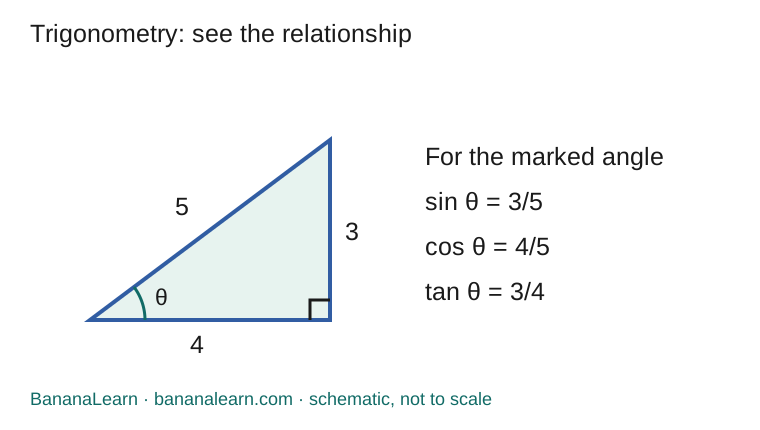
Take a right triangle with legs 3 and 4 and hypotenuse 5. For the acute angle opposite the side of length 3, sin θ = 3/5, cos θ = 4/5 and tan θ = 3/4. For the other acute angle, sine and cosine swap these two numerator lengths.
The hypotenuse stays opposite the right angle. The adjacent side used in cosine or tangent is the non-hypotenuse side next to the chosen acute angle.
A point on level ground is 12 m from the base of a vertical pole. The angle of elevation to the top is 30°. In the simplified model with the angle measured from ground level, tan 30° = h/12, so h = 12/√3 = 4√3 m, approximately 6.93 m.
If an observer measures that angle from eye level 1.5 m above the ground, the same right triangle gives the height above the eye. The pole height is then 4√3 + 1.5 m, approximately 8.43 m, assuming the stated level ground and vertical pole.
For an acute angle in a right triangle, sin θ and cos θ are between 0 and 1 because each compares a leg with the longer hypotenuse. A calculation giving sin θ = 5/3 signals reversed side labels or an invalid setup.
Tangent is a leg-to-leg ratio and can exceed 1. In a 3–4–5 triangle, the angle opposite the length-4 side has tan θ = 4/3. A single range rule cannot be applied to all three ratios.
Do not label sides relative to the right angle when finding ratios for an acute angle. Keep a sloping line of sight separate from horizontal ground distance. Check degree/radian mode when allowed a calculator, retain exact forms until rounding is requested, and include observer height only when the model requires it.
Try without opening the answer. A wrong answer is a clue to the next lesson, not a score for the whole subject.
5/13; both lengths refer to the same selected acute angle.
12/13.
5/12.
No. It remains opposite the right angle.
45°, because tan θ = 1 for an acute right-triangle angle.
Yes. Tangent compares the two legs; it is not restricted to less than 1.
If a child recalls SOH–CAH–TOA but repeatedly chooses the wrong ratio, pause the calculation. Ask them to circle the selected angle, identify the right angle and label the three sides. Only then select the two side lengths needed. This separates a labelling gap from an arithmetic gap.
Use the same triangle twice, choosing a different acute angle the second time. Explain which labels change and which stay fixed. Next, turn a word problem into a labelled diagram before calculating. Revisit similarity if the child asks why a larger triangle can have the same trigonometric ratio.
Keep one worked sample and one fresh independent attempt. Note the help required and revisit the same skill later with changed numbers or a new diagram. Faster answers can be useful, but the evidence should also include explanation and transfer.
BananaLearn offers one-to-one Maths tutoring, with English and Science also available. Share your child’s class, board or curriculum, one recent question and the part they find difficult. We can discuss teaching fit and available lesson times before you decide.
A useful first conversation should identify a starting point, how the child will practise independently and how progress will be checked. Bring a recent school question so the discussion starts with the skill your child needs.
The worked examples and checks are original BananaLearn content. The linked lessons provide fuller explanations and practice. Suggested levels do not replace the current school syllabus, book edition or teacher’s sequence. This page is a curated topic route, not a new curriculum certification.
How we prepare learning guides · Report a correction
Save this link: https://bananalearn.com/learn/trigonometry-learning-path.html