What does it mean?
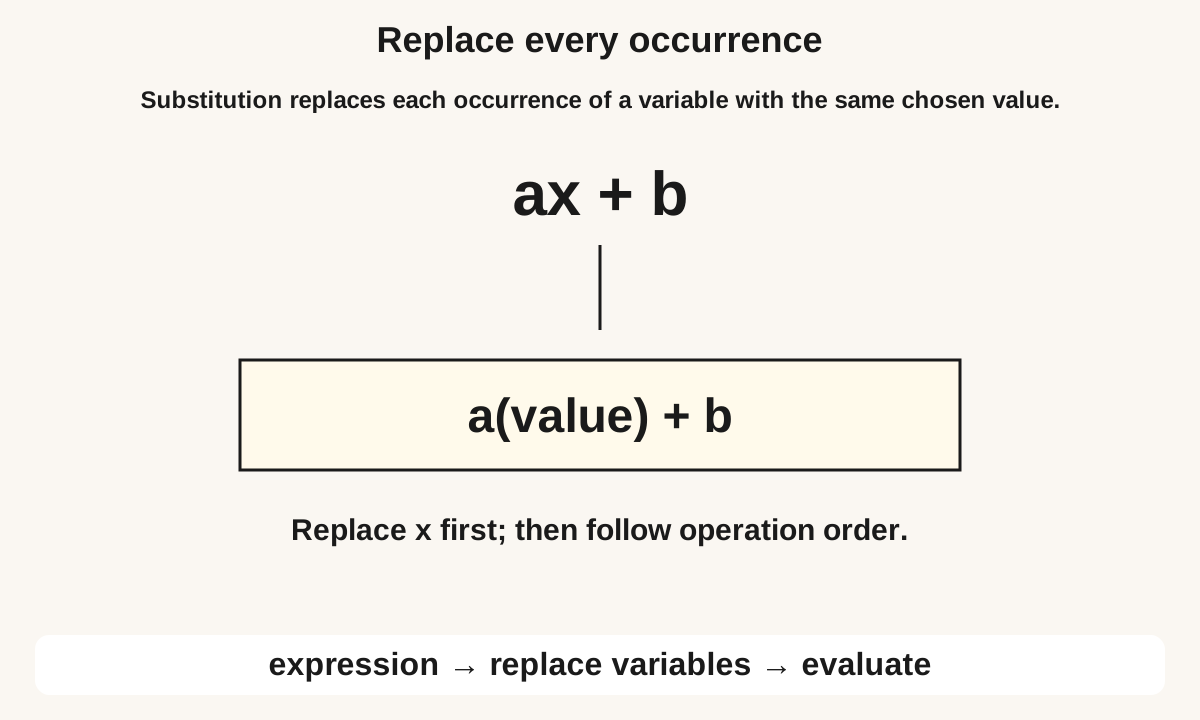
Substitution means replacing a variable by a specified value. It does not mean finding an unknown value that makes an equation true. In 4x + 5 with x = 3, the expression becomes 4 × 3 + 5. The multiplication sign was implicit in 4x; it does not disappear when the letter is replaced.
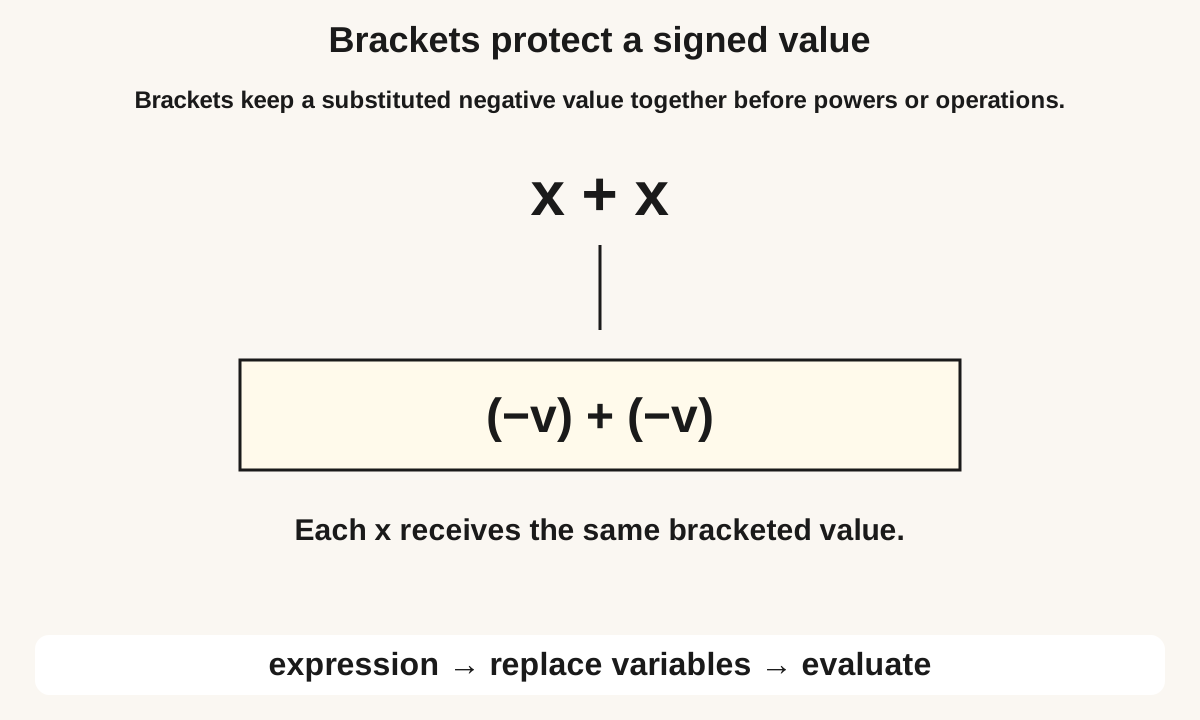
An expression is built from terms. In 4x + 5, the coefficient of x is 4 and the constant term is 5. To substitute, replace the letter with the given number. If the number is negative, put it in brackets first: 4x with x = −3 becomes 4 × (−3). Then follow the order of operations: powers, then multiplication, then addition and subtraction. Substitution does not solve for x. It finds the value of the expression for one chosen x.
Learning goal: Interpret terms, coefficients and variables; substitute accurately. The grade is a suggested starting point; school sequences vary. Use the first worked example to check readiness, and Pre-algebra if an earlier idea needs revisiting.
See the idea
Read each diagram with its labels, then follow the worked examples. Practice questions include their own measurements and information.
Enlarge diagram to read the labels
Swipe across the enlarged diagram to read every label.
Enlarge diagram to read the labels
Swipe across the enlarged diagram to read every label.
Choose a method and explain why it works
Copy the complete expression, replace each occurrence of the variable and bracket any negative value. Evaluate powers first, then multiplication and division, then addition and subtraction. For several variables, make a small value key and substitute them consistently. Keep a context’s units attached to the final result.
Notation: 4x means 4 × x. x^2 means x × x. Write 4(−3), not 4−3, when x = −3.
Key rule and when to use it
Substitute every occurrence, bracket negative values and follow the order of operations. A coefficient multiplies the substituted value.
Worked examples, step by step
Example 1: Find the value of 4x + 5 when x = 3.
- Replace x with 3: 4 × 3 + 5.
- Multiply first: 12 + 5.
- Add: 17.
Answer: 17
Check: 4 groups of 3 is 12, then 5 more is 17. The algebra tiles 4x + 5 with x = 3 match that total.
Example 2: Find the value of 2x^2 − 5 when x = −3.
- This expression has a power, not only a linear term. Replace x with (−3): 2(−3)^2 − 5.
- (−3)^2 = 9, then 2 × 9 = 18.
- 18 − 5 = 13.
Answer: 13
Check: A square is never negative here: (−3)^2 is 9, not −9. The result 13 is greater than the constant −5, as expected.
Example 3: Evaluate 3x² + 2x − 1 when x = −2.
- Substitute with brackets: 3(−2)² + 2(−2) − 1.
- Square first: 3 × 4 − 4 − 1.
- The value is 12 − 4 − 1 = 7.
Common mistakes and important boundaries
Brackets change the meaning of a negative square: (−3)² = 9, while −3² means −(3²) = −9 under standard order of operations. A coefficient is a multiplier, so 3x at x = 2 is 6, not the concatenated number 32. Test every occurrence of a repeated variable.
A point to explain
A learner may write 3x as 3 + x, skip brackets around a negative value, or treat x^2 as 2x.
Compare an uncertain attempt with the closest worked example. Look at the meaning of each operation, unit and label before repeating the arithmetic.
Substitution in Algebraic Expressions — practice
Work on paper first. Open each answer afterwards and compare the reasoning. Print the questions with or without the separate answer key; no account is required.
Name: ____________________ Date: __________
In 7x − 4, what is the coefficient of x?
Answer and a way to check
7
The coefficient is the number that multiplies the variable, not the constant term.
An algebra model has three x-pieces and two unit-pieces. Which expression represents their total?
Answer and a way to check
3x + 2
Each long tile is one x. Each small tile is 1. Write those as separate terms.
Find the value of 5x − 2 when x = 4.
Answer and a way to check
18
Replace x with 4 first. Multiply 5 by that number, then subtract 2.
Find the value of 8 − 3x when x = 5.
Answer and a way to check
-7
Multiply 3 by 5 first. Then subtract that product from 8.
Find the value of x^2 + 2x when x = −2.
Answer and a way to check
0
Write (−2)^2 first. Then add 2 × (−2).
Explain why substituting x = −4 into 2x should be written 2(−4), not 2−4.
Answer and a way to check
2(−4) means 2 multiplied by −4. 2−4 means subtract 4 from 2, which is a different calculation.
Compare the two writings: one is multiplication, the other is subtraction. Which one matches 2x?
A student evaluates 3x + 1 at x = 2 and writes 32 + 1 = 33. What is the mistake?
Answer and a way to check
The student placed 2 next to 3 instead of multiplying 3 by 2.
3x means 3 multiplied by x. Write that product, then add 1.
A printing cost in rupees is 50 + 12n, where n is the number of copies. Find the cost for n = 4.
Answer and a way to check
₹98
Replace n with 4. Multiply 12 by 4, then add 50.
Substitution in Algebraic Expressions — answer key
7 The coefficient is the number that multiplies the variable, not the constant term.
3x + 2 Each long tile is one x. Each small tile is 1. Write those as separate terms.
18 Replace x with 4 first. Multiply 5 by that number, then subtract 2.
-7 Multiply 3 by 5 first. Then subtract that product from 8.
0 Write (−2)^2 first. Then add 2 × (−2).
2(−4) means 2 multiplied by −4. 2−4 means subtract 4 from 2, which is a different calculation. Compare the two writings: one is multiplication, the other is subtraction. Which one matches 2x?
The student placed 2 next to 3 instead of multiplying 3 by 2. 3x means 3 multiplied by x. Write that product, then add 1.
₹98 Replace n with 4. Multiply 12 by 4, then add 50.
Questions students and parents ask
What happens if a substituted value makes a denominator zero?
The expression is undefined at that value. For 6/(x − 2), x = 2 is excluded; substituting it does not produce 0 or an ordinary number.
Can substitution check an algebraic identity?
It can disprove one if a value gives unequal results. Agreement for one or several values is a useful check but does not prove an identity for every allowed value.
Is this a complete set of textbook exercise solutions?
No. This guide adapts BananaLearn’s own teaching examples and practice. It is not official NCERT material or a promise of the exact chapter sequence in a particular board, country or textbook edition.
What if the examples are still difficult?
Revisit Pre-algebra. Try the first example with its model, then attempt one fresh question independently. A correct copied answer is not evidence that the method can be used without support.
Help at home
Ask what each symbol becomes before any arithmetic. Separating substitution from calculation helps locate whether the difficulty is notation or operations.
Keep one example of the learner’s own working. A repeated difficulty across fresh questions can guide a discussion with their teacher; one short practice sheet does not establish a diagnosis or a full mastery profile.
Connect this idea to the next skill
About this guide
Based on BananaLearn’s Grade 8 course lesson “Substitute a Value”. The explanations have been adapted for independent reading; course diagrams are reused where they fit the idea, and missing classroom givens are made explicit in questions.
Need another way to understand it?
Bring one question your child found difficult to a free 50-minute session. Tell us their grade, curriculum and time zone so we can discuss a suitable next step.
Request a free session