Maths · Suggested Class 10
Basic Proportionality Theorem: Class 10 Proof & Examples
A line parallel to one side of a triangle cuts the other two sides in the same ratio. The hard part is often choosing corresponding parts: AD:DB compares two pieces, while AD:AB compares a piece with the whole.
Original BananaLearn guide · 2 November 2026
On a phone, swipe across the illustration to read every label.

State BPT with a labelled triangle
In triangle ABC, let D lie on AB and E lie on AC, with DE parallel to BC. The Basic Proportionality Theorem says AD/DB=AE/EC. In this internal-cut form, D and E lie strictly between the endpoints, so these side lengths and denominators are positive.
Some textbooks call this Thales’ theorem, although that name is also used for a different circle theorem. Use the complete statement to avoid ambiguity. BPT concerns ratios along the two sides, not an assertion that the two sides have equal lengths. A drawn horizontal line is not enough; the required parallel relation must be given or proved.
Prove the first area ratio
Join B to E and C to D. Triangles ADE and BDE have bases AD and DB on the same line AB and share the same perpendicular height from E. Their area ratio is therefore area(ADE)/area(BDE)=AD/DB, because the common height and factor ½ cancel.
Similarly, triangles ADE and CDE have bases AE and EC along AC and share a height from D. Thus area(ADE)/area(CDE)=AE/EC. These comparisons use the correct common heights, not an assumption that sloping sides can always serve as heights.
Use the parallel condition to finish the proof
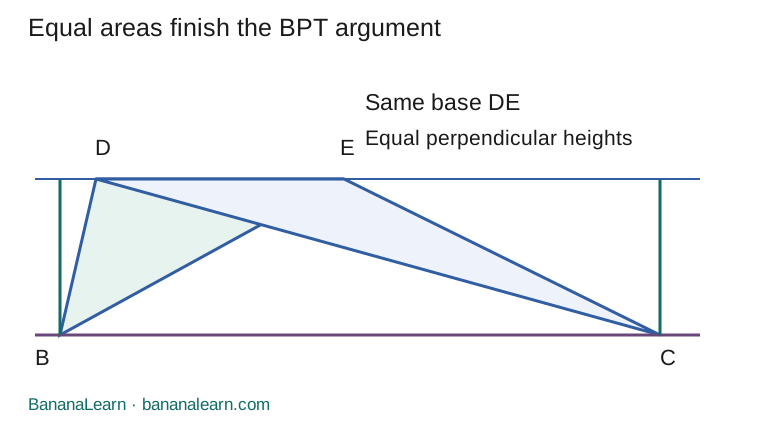
Triangles BDE and CDE share base DE. Their other vertices B and C lie on the line BC, which is parallel to DE. Their perpendicular heights to DE are equal, so their areas are equal. Substitute that equality into the two area ratios to obtain AD/DB=AE/EC.
This proves BPT without requiring the small and large triangles to have equal area. The crucial equal-area pair is BDE and CDE. Mark that pair on the diagram. A proof that says all triangles have the same height is too vague and usually includes triangles for which the statement is false.
On a phone, swipe across the illustration to read every label.
Worked example: find a missing piece
Suppose AD=3 cm, DB=5 cm and AE=6 cm, with DE parallel to BC. Then 3/5=6/EC. Cross-multiplying gives 3EC=30, so EC=10 cm. The whole side AC is 6+10=16 cm, not 10 cm.
Check with the part-to-whole fractions: AD/AB=3/8 and AE/AC=6/16=3/8. Both give the same fraction of the journey from A. If an answer seems plausible but these fractions disagree, revisit the endpoint order or whether the question asked for EC or AC.
Worked example: the whole side is given
Let AB=15 cm, AD=6 cm and AC=20 cm. Because DE is parallel to BC, AD/AB=AE/AC. Hence 6/15=AE/20 and AE=8 cm. The remaining piece EC is 20−8=12 cm. The part-to-part ratios also agree: AD/DB=6/9 and AE/EC=8/12.
Do not insert AB directly where DB belongs in AD/DB=AE/EC. Either subtract to find DB=15−6=9 or consistently use part-to-whole ratios. Both methods are valid. The error comes from mixing one part-to-part ratio with a part-to-whole ratio on the other side.
The converse checks whether a cut is parallel
The converse states that if D and E divide AB and AC internally in the same ratio, then DE is parallel to BC. For AD=4, DB=6, AE=10 and EC=15, the ratios 4/6 and 10/15 both equal 2/3, so the converse establishes parallelism.
If the second side instead has AE=10 and EC=12, the ratios are 2/3 and 5/6, so they differ. Under the stated side-position conditions the cut is not parallel. Do not round different ratios into equality; cross-multiplication gives an exact check.
An algebra example and the midpoint connection
Suppose AD=x+1, DB=4, AE=6 and EC=8. Then (x+1)/4=6/8=3/4, so x+1=3 and x=2. All resulting lengths are positive. Algebraic solutions that create zero or negative lengths cannot represent this internal geometry configuration.
If D is the midpoint of AB, then AD/DB=1. BPT gives AE/EC=1, so E is also a midpoint. This is the midpoint converse as a special case. Conversely, the general BPT works for many ratios besides 1:1; it does not always make the small segment half the third side.
Use a diagram before chasing a formula
Write the order A–D–B on one side and A–E–C on the other. Circle the whole lengths, if any, so they are not mistaken for pieces. State the parallel condition. Choose either matching piece ratios or matching whole-side fractions and stay with that choice for the first equation.
The resource below records both versions so a learner can check an answer independently. This is a school-level internal-triangle theorem guide, not a claim that every board uses the same chapter ordering. Use the current official textbook and your teacher’s required proof language when preparing for a particular exam.
Keep the two ratio forms separate
Copy this record into a notebook. Fill each blank using your own example or the activity above.
On a phone, swipe across a wide table to see every column.
| Quantity | First side | Second side |
|---|---|---|
| Near-A piece | AD=___ | AE=___ |
| Remaining piece | DB=___ | EC=___ |
| Whole side | AB=___ | AC=___ |
| Piece ratio | AD/DB=___ | AE/EC=___ |
| Whole fraction | AD/AB=___ | AE/AC=___ |
12 questions with explained answers
Try each question first. Open the explanation to check your reasoning. These are original BananaLearn questions, not official exam questions.
AD=2, DB=3, AE=4 and DE parallel BC. Find EC.
Check answer and reasoning
6
2/3=4/EC gives EC=6.AD=3, DB=5 and AE=6. Find AC.
Check answer and reasoning
16
EC=10, then AC=AE+EC=16.AB=18, AD=6 and AC=15. Find AE.
Check answer and reasoning
5
The common part-to-whole fraction is 6/18=1/3.For that example, find DB and EC.
Check answer and reasoning
DB=12, EC=10.
Subtract the known parts from their own whole sides.AD:DB=2:5. What is AD:AB?
Check answer and reasoning
2:7
AB contains 2+5=7 equal ratio parts.AD=4, DB=6, AE=10, EC=15. Is DE parallel BC?
Check answer and reasoning
Yes, by the converse.
4/6=10/15=2/3.AD=4, DB=6, AE=10, EC=12. Is the cut parallel?
Check answer and reasoning
No, under the internal-cut conditions.
4/6 and 10/12 are unequal.Solve AD=x+1, DB=4, AE=6, EC=8 with a parallel cut.
Check answer and reasoning
x=2
(x+1)/4=6/8 gives x+1=3.Which equal-area pair uses the parallel lines in the proof?
Check answer and reasoning
Triangles BDE and CDE.
They share base DE and have equal heights from B and C.Why do ADE and BDE have area ratio AD:DB?
Check answer and reasoning
They share a perpendicular height from E to line AB.
Their bases lie on AB, so the common height cancels.A learner writes AD/AB=AE/EC. What must be corrected?
Check answer and reasoning
Use AD/AB=AE/AC, or AD/DB=AE/EC.
Match part-to-whole with part-to-whole, or piece-to-piece with piece-to-piece.Does BPT require AB=AC?
Check answer and reasoning
No.
The theorem compares ratios along the two sides; it does not require an isosceles triangle.
Choose your next learning step
- Revisit the half-length special case
- Connect corresponding side ratios
- Review part and whole ratios
- CBSE Class 10 Maths syllabus and support
Explore BananaLearn games, learning resources and tutoring. Maths is our priority; English and Science tutoring are also available. Share your current schoolwork when checking teaching fit.
Sources and scope
Explanations, activities, diagrams and practice are original BananaLearn work. Class labels suggest a learning level; school sequences and current textbook editions can differ. Sources checked 2 November 2026.
How we prepare guides · Report a correction
Share the complete guide: https://bananalearn.com/learn/class-10-basic-proportionality-theorem-proof.html