Maths · Suggested Class 10
Sector & Segment Area: Class 10 Worked Examples
A pizza slice includes the centre. The small cap cut off by a straight chord does not. Both belong to the same circle, but their areas need different calculations.
Original BananaLearn guide · 2 November 2026
On a phone, swipe across the illustration to read every label.
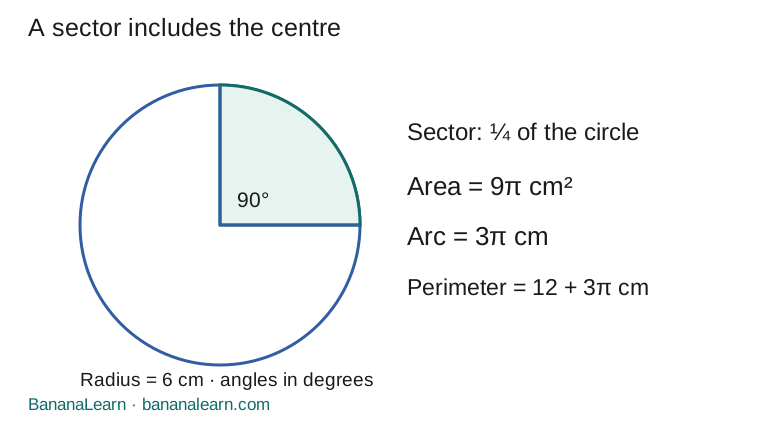
Name the region before choosing a formula
A sector is bounded by two radii and an arc. A segment is bounded by a chord and an arc. A radius joins the centre to the circle; a chord joins two points on the circle. Colour the intended region before writing an area formula, especially when the diagram shows several overlapping lines.
For a circle of radius r, the full area is πr² and the circumference is 2πr. A central angle θ in degrees selects the fraction θ/360 of the full circle. This guide uses degrees throughout. A formula written for radians has a different angle convention and should not be mixed into these calculations.
Derive the sector and arc formulas
A sector with central angle θ has area (θ/360)πr². Its curved arc has length (θ/360)2πr. The area uses square units, while the arc length uses linear units. Comparing units can catch a substitution into the wrong formula before the numerical work begins.
For a 90° sector of radius 6 cm, area=(90/360)π×36=9π cm², while arc length=(90/360)2π×6=3π cm. Do not call 3π its area. The sector is one-quarter of the circle, so these results also follow by taking one-quarter of the full area and circumference.
A sector perimeter includes two straight sides
The perimeter of an isolated sector is its arc length plus two radii. For the 90° sector of radius 6 cm, perimeter=3π+12 cm. Using only the arc omits the two straight sides. For a semicircular region, its perimeter is the semicircular arc plus the diameter, which gives the same two-radius contribution.
A different boundary question may count different edges. If a sector is removed from a circular sheet, trace the boundary of the remaining piece rather than reusing the isolated-sector formula blindly. Shared internal lines do not count as external perimeter unless the question asks for cuts or painted edges separately.
On a phone, swipe across the illustration to read every label.

Find a minor segment by subtraction
For a minor segment associated with a central angle smaller than 180°, subtract the area of the triangle formed by the two radii and chord from the matching sector area. With a 90° angle and radius 6 cm, the triangle is right-angled with perpendicular sides 6 and 6. Its area is ½×6×6=18 cm².
The minor segment area is therefore 9π−18 cm². Keep the expression exact unless a value of π or a rounding instruction is supplied. Since π is a little more than 3, the result is a positive area a little above 9 cm²; a negative answer would signal the subtraction order or formula is wrong.
Worked example: a 60° segment
For radius 8 cm and central angle 60°, the triangle formed by the two radii is equilateral with side 8 cm. Its height is √(8²−4²)=4√3 cm, so its area is ½×8×4√3=16√3 cm². The sector area is (60/360)π×64=32π/3 cm².
Subtract to obtain the minor segment area 32π/3−16√3 cm². This is not one-sixth of the circle minus a triangle of height 8: the altitude is 4√3, not a radius. The height construction explains where the square root comes from and avoids a memorised but mismatched triangle formula.
Major regions and complementary angles
A major sector paired with a minor 90° sector uses angle 270°, so it has three-quarters of the circle’s area. For radius 6 cm that is 27π cm². A major segment is the rest of the circle after the matching minor segment is removed.
For the same 90° chord, the major segment area is 36π−(9π−18)=27π+18 cm². Notice the plus 18 after distributing the subtraction. Do not label a 270° sector as the major segment: the chord and two radii define different boundaries and therefore different regions.
Scale, units and sensible approximations
Doubling a radius while holding the angle fixed doubles arc length but multiplies sector area by four. For example, the 90° sector with radius 12 cm has area 36π cm², four times the 9π cm² result for radius 6 cm. Length and area scale differently.
Use the value of π requested in the problem. If none is requested, an exact expression is usually the clearest mathematical result. Convert all lengths to a common unit before squaring; 50 mm is 5 cm, so a square-centimetre calculation must use 5, not 50. Round once at the end rather than repeatedly during subtraction.
A boundary-first problem-solving routine
Name the shape, identify the centre and radius, mark the central angle and trace the exact boundary. Decide whether the task asks for area, arc length or full perimeter. For a segment, draw the triangle and explain how its height or area is known. Then calculate and check units and positivity.
The practice mixes these decisions deliberately. If a child can substitute into a formula but cannot distinguish a chord from an arc, more substitution drills will not fix the classification problem. Ask for a shaded sketch and a one-sentence description before the calculation. Check the required school scope before treating this as an exhaustive exam chapter.
Plan the region before calculating
Copy this record into a notebook. Fill each blank using your own example or the activity above.
On a phone, swipe across a wide table to see every column.
| Decision | Your note |
|---|---|
| Region | Sector / minor segment / major segment |
| Given lengths and common unit | ___ |
| Central angle in degrees | ___ |
| Triangle calculation if needed | ___ |
| Area or full boundary? | ___ |
| Exact result and requested rounding | ___ |
12 questions with explained answers
Try each question first. Open the explanation to check your reasoning. These are original BananaLearn questions, not official exam questions.
Find the area of a 90° sector of radius 6 cm.
Check answer and reasoning
9π cm²
Take one-quarter of π×36.Find its arc length.
Check answer and reasoning
3π cm
Take one-quarter of circumference 12π.Find the isolated sector’s perimeter.
Check answer and reasoning
12+3π cm
Add both radii to the curved arc.Find the minor segment area for that 90° chord.
Check answer and reasoning
9π−18 cm²
Subtract the right triangle area ½×6×6.Find the area of a 60° sector of radius 8 cm.
Check answer and reasoning
32π/3 cm²
The sector is one-sixth of 64π.Find the equilateral triangle area in that 60° example.
Check answer and reasoning
16√3 cm²
Its height is 4√3, so area=½×8×4√3.Find the associated minor segment area.
Check answer and reasoning
32π/3−16√3 cm²
Subtract the triangle from the corresponding sector.Find the 270° major sector area for radius 6 cm.
Check answer and reasoning
27π cm²
Take three-quarters of the full area 36π.Find the matching major segment area.
Check answer and reasoning
27π+18 cm²
Full area minus minor segment: 36π−(9π−18).What happens to sector area if radius triples and angle stays fixed?
Check answer and reasoning
It becomes nine times as large.
Area is proportional to r²; 3²=9.Is a chord the curved part of a circle?
Check answer and reasoning
No.
A chord is a straight segment joining two points on the circle; the curved part is an arc.A semicircle has radius 7 cm. Give its perimeter using π=22/7.
Check answer and reasoning
36 cm
The arc is πr=22 cm and the diameter is 14 cm.
Choose your next learning step
- Review full circles and units
- Find a triangle height when needed
- Review triangle ratios for later extensions
- Discuss Class 10 Maths learning support
Explore BananaLearn games, learning resources and tutoring. Maths is our priority; English and Science tutoring are also available. Share your current schoolwork when checking teaching fit.
Sources and scope
Explanations, activities, diagrams and practice are original BananaLearn work. Class labels suggest a learning level; school sequences and current textbook editions can differ. Sources checked 2 November 2026.
How we prepare guides · Report a correction
Share the complete guide: https://bananalearn.com/learn/class-10-sector-segment-area.html