What does it mean?
Pythagoras’ theorem links the square areas on the three sides of a right triangle. If c is the side opposite the right angle, a² + b² = c². The formula is conditional: it applies to a right triangle, not to every three-sided drawing.
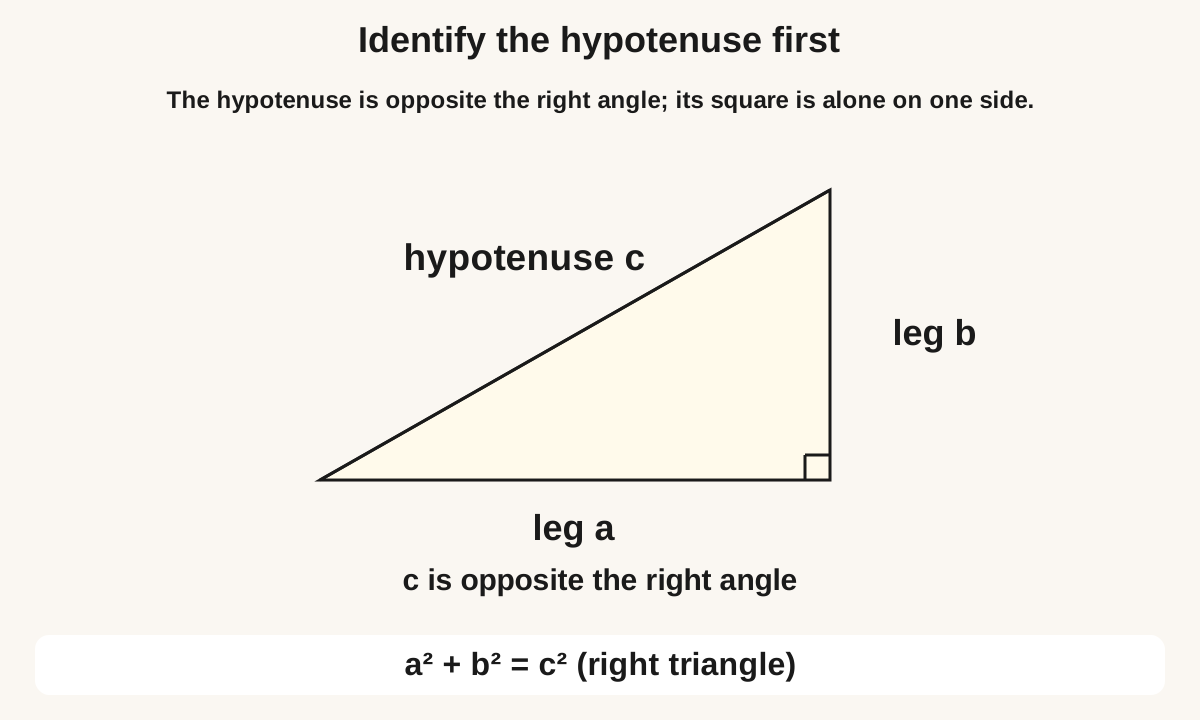
A right triangle has one 90° angle. The hypotenuse is the side opposite that right angle. Pythagoras: if a and b are the legs, and c is the hypotenuse, then a² + b² = c². The area of the square on a plus the area of the square on b equals the area of the square on c. To find c, add the squares of the legs, then take the square root. To find a leg, subtract the known square from c², then take the square root. Units for a length stay as cm, m, and so on. The diagram is not to scale.
Learning goal: Derive and apply the Pythagorean theorem from an area model. The grade is a suggested starting point; school sequences vary. Use the first worked example to check readiness, and Grade 7 triangle angles: missing and exterior angle questions if an earlier idea needs revisiting.
See the idea
Read each diagram with its labels, then follow the worked examples. Practice questions include their own measurements and information.

Enlarge diagram to read the labels
Swipe across the enlarged diagram to read every label.
Enlarge diagram to read the labels
Swipe across the enlarged diagram to read every label.
Choose a method and explain why it works
Identify the right angle and hypotenuse first. If the hypotenuse is missing, add the leg squares and take a square root. If a leg is missing, subtract its partner’s square from the hypotenuse square and take a root. To test a valid triangle for a right angle, put the longest side alone in the square comparison.
Notation: a² + b² = c². c is the hypotenuse, opposite 90°.
Key rule and when to use it
For a right triangle, a² + b² = c², where c is opposite the right angle. The converse tests whether the longest side satisfies this equality.
Why the Pythagoras relationship works
Take four identical right triangles with perpendicular legs a and b and hypotenuse c. Arrange them inside a square of side a + b so that their hypotenuses enclose a central square. The central angles are right angles because the two acute angles of a right triangle sum to 90°.
The outer area is (a + b)². The four triangles occupy 4 × ½ab = 2ab. The remaining square has area c², so c² = (a + b)² − 2ab = a² + b². This is an area argument for right triangles; it does not assert the formula for every triangle.
Worked examples, step by step
Example 1: A right triangle has legs 6 cm and 8 cm. Find the hypotenuse.
- The triangle is stated to be right-angled; the hypotenuse is the side opposite its 90° angle.
- 6² + 8² = 36 + 64 = 100.
- c = √100 = 10 cm.
Answer: 10 cm
Check: 10 is a little longer than 8, as a hypotenuse must be.
Example 2: A right triangle has hypotenuse 13 m and one leg 5 m. Find the other leg.
- Here c is given, not a missing hypotenuse. Rearrange: b² = c² − a².
- 13² − 5² = 169 − 25 = 144.
- b = √144 = 12 m.
Answer: 12 m
Check: 12 is less than 13, so it can be a leg. Adding 5 + 13 would be the wrong structure.
Example 3: A triangle has sides 5 cm, 12 cm and 13 cm. Is it right-angled? If yes, where?
- The longest side is 13 cm, so test 5² + 12² against 13².
- 25 + 144 = 169 and 13² = 169, so they match.
- The triangle is right-angled at the vertex opposite 13 cm.
Answer: yes, opposite 13 cm
Check: 169 equals 169, so the converse applies.
Example 4: Find the distance from (1, 2) to (4, 6) on a centimetre grid.
- This is a grid distance, not a listed triple. Horizontal change = 4 − 1 = 3. Vertical change = 6 − 2 = 4.
- The axes are perpendicular, so 3² + 4² = 9 + 16 = 25.
- Distance = √25 = 5 cm.
Answer: 5 cm
Check: 5 is longer than 4 and 3, as a hypotenuse should be.
Example 5: A square has side 6 cm. Find its diagonal exactly, then round to two decimal places.
- The diagonal divides the square into two right triangles with legs 6 cm and 6 cm.
- d² = 6² + 6² = 72, so d = √72 = 6√2 cm.
- Using √2 ≈ 1.41421356, d ≈ 8.49 cm. Keep the exact form until the final rounding; 8.49² is only approximately 72.
Common mistakes and important boundaries
The answer to a length question needs the square root and length units, not a square area. For the converse, check that the side lengths can form a triangle before interpreting them as one. The sum of the two shorter sides must exceed the longest. A near-right drawing is not proof.
A point to explain
A learner may put the longest-looking side as hypotenuse without a right-angle mark, or add the sides instead of adding squares.
Compare an uncertain attempt with the closest worked example. Look at the meaning of each operation, unit and label before repeating the arithmetic.
Pythagoras’ Theorem and the Right-Triangle Test — practice
Work on paper first. Open each answer afterwards and compare the reasoning. Print the questions with or without the separate answer key; no account is required.
Name: ____________________ Date: __________
In a right triangle, which side is the hypotenuse?
Answer and a way to check
The side opposite the right angle.
Find the 90° mark. The hypotenuse is opposite that mark.
Legs 3 cm and 4 cm. Which working finds the hypotenuse?
Answer and a way to check
3² + 4² = 25, then √25
Square each leg, add, then take the square root.
Right triangle, legs 9 cm and 12 cm. Find the hypotenuse.
Answer and a way to check
15 cm
Square 9 and 12, add, then take the square root.
Right triangle, hypotenuse 10 m, one leg 6 m. Find the other leg.
Answer and a way to check
8 m
Subtract the square of 6 from the square of 10, then take the square root.
A right triangle has shorter sides 7 cm and 24 cm. How long is the side opposite the right angle?
Answer and a way to check
25 cm
Compute 7² + 24², then take the square root.
A sketch looks right-angled, but no right angle is stated or established from the given information. Is appearance alone enough to apply Pythagoras? Explain.
Answer and a way to check
No. A right angle must be given or established, not inferred from appearance.
A right-angle mark is one possible source of evidence, but written givens, perpendicular lines or the converse can also establish a right angle.
Legs 5 cm and 12 cm. A student writes hypotenuse 5 + 12 = 17 cm. What is the mistake?
Answer and a way to check
The student added the lengths instead of adding the squares.
Square each leg first. Adding 5 + 12 skips the squares.
A rectangular gate is 1.5 m high and 2 m wide. A diagonal brace is needed. Find the brace length in metres.
Answer and a way to check
2.5 m
The corner is a right angle. Square 1.5 and 2, add, then take the square root.
When does the converse of Pythagoras tell you a triangle is right-angled?
Answer and a way to check
When a² + b² = c² for the longest side c.
Compare the sum of the two smaller squares with the square of the longest side.
Sides 9 cm, 12 cm and 15 cm. Is the triangle right-angled?
Answer and a way to check
Yes, because 81 + 144 = 225.
Square 9, 12 and 15. Check whether the first two squares add to the third.
Sides 8 cm, 15 cm and 17 cm. Is the triangle right-angled? Answer yes or no.
Answer and a way to check
yes
Compute 64 + 225 and compare with 289.
A triangle has sides 5 cm, 6 cm and 8 cm. Does the converse say it is right-angled? Answer yes or no.
Answer and a way to check
no
25 + 36 = 61, and 8² = 64. The totals are not equal.
Pythagoras’ Theorem and the Right-Triangle Test — answer key
The side opposite the right angle. Find the 90° mark. The hypotenuse is opposite that mark.
3² + 4² = 25, then √25 Square each leg, add, then take the square root.
15 cm Square 9 and 12, add, then take the square root.
8 m Subtract the square of 6 from the square of 10, then take the square root.
25 cm Compute 7² + 24², then take the square root.
No. A right angle must be given or established, not inferred from appearance. A right-angle mark is one possible source of evidence, but written givens, perpendicular lines or the converse can also establish a right angle.
The student added the lengths instead of adding the squares. Square each leg first. Adding 5 + 12 skips the squares.
2.5 m The corner is a right angle. Square 1.5 and 2, add, then take the square root.
When a² + b² = c² for the longest side c. Compare the sum of the two smaller squares with the square of the longest side.
Yes, because 81 + 144 = 225. Square 9, 12 and 15. Check whether the first two squares add to the third.
yes Compute 64 + 225 and compare with 289.
no 25 + 36 = 61, and 8² = 64. The totals are not equal.
Questions students and parents ask
Why do I take the positive square root for a length?
If c² = 100, the algebraic equation has roots ±10, but a side length is positive. The triangle’s hypotenuse is therefore 10 units.
Why can I not add the two shorter lengths directly?
The theorem relates their square areas. In a 3–4–5 triangle, 3 + 4 = 7, but 3² + 4² = 25 = 5².
Is this a complete set of textbook exercise solutions?
No. This guide adapts BananaLearn’s own teaching examples and practice. It is not official NCERT material or a promise of the exact chapter sequence in a particular board, country or textbook edition.
What if the examples are still difficult?
Revisit Grade 7 triangle angles: missing and exterior angle questions. Try the first example with its model, then attempt one fresh question independently. A correct copied answer is not evidence that the method can be used without support.
Help at home
Ask which side is opposite the right angle before any substitution. If the answer is a leg, ask why subtraction rather than addition is required.
Keep one example of the learner’s own working. A repeated difficulty across fresh questions can guide a discussion with their teacher; one short practice sheet does not establish a diagnosis or a full mastery profile.
Connect this idea to the next skill
About this guide
Based on BananaLearn’s Grade 8 course lesson “Squares on a Right Triangle” and its related lesson “When Is It Right-Angled”. The explanations have been adapted for independent reading; course diagrams are reused where they fit the idea, and missing classroom givens are made explicit in questions.
Need another way to understand it?
Bring one question your child found difficult to a free 50-minute session. Tell us their grade, curriculum and time zone so we can discuss a suitable next step.
Request a free session