
Start with the key idea
The three interior angles of a plane triangle add to 180°. An exterior angle formed by extending one side equals the sum of the two non-adjacent interior angles. In an isosceles triangle, angles opposite equal sides are equal.
1. Mark the three interior angles
An interior angle is formed inside the triangle at a vertex. Add all three to obtain 180°. If two are 50° and 60°, the third is 180−50−60=70°. The drawing need not be accurately to scale.
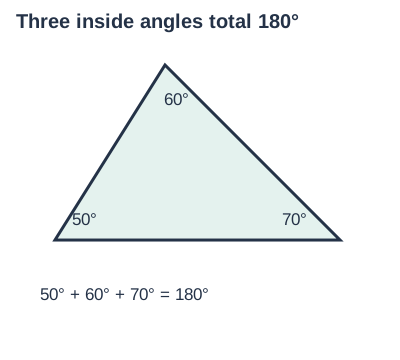
Label what is given before choosing a rule. A number beside an extended side may describe an exterior angle, so it cannot automatically be included in the three-interior-angle sum.
Use different colours for interior and exterior labels when a diagram contains both. The interior at an extended vertex is the angle inside the triangle, even if the exterior label is printed closer to the vertex. Reading labels by their arc or location prevents accidentally replacing one of the three interior angles with its supplement.
2. Connect the sum to a straight angle
Imagine a line through the top vertex parallel to the base. The two base angles can be matched to angles on that line by parallel-line angle relationships. Together with the top angle they fill a straight angle of 180°.
A paper triangle’s cut-off corners can illustrate this relationship, but the geometric explanation comes from the parallel lines. Avoid claiming that measuring one drawing proves every possible triangle.
A straight angle supplies a useful benchmark. If two interior angles total one hundred and twenty degrees, the remaining angle must fill the sixty-degree gap to one hundred and eighty. Thinking of a missing portion of a straight angle helps a learner explain the subtraction rather than treating one hundred and eighty as a number to memorise without context.
3. Use the correct exterior angle
Extend one side of a triangle beyond a vertex. The interior angle there and its adjacent exterior angle form a straight pair, so they add to 180°. If the interior is 60°, the adjacent exterior is 120°.
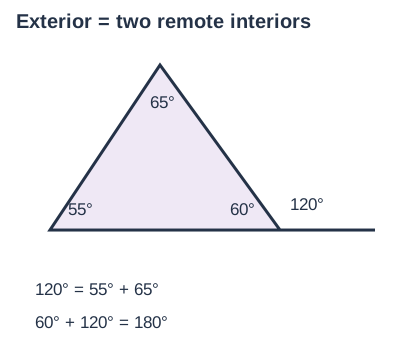
Subtracting the interior-angle equation from the straight-angle equation gives the exterior-angle theorem: the exterior equals the two remote interior angles. Remote means the angles at the other two vertices, not the adjacent interior angle.
An exterior angle is greater than either remote interior angle because it is their sum and both are positive. If a proposed exterior is forty degrees while one remote interior is fifty degrees, the result cannot be right. This inequality provides a quick check before solving the rest of the problem.
4. Match equal sides with opposite equal angles
In an isosceles triangle, the angles opposite its two equal sides are equal. If the angle between the equal sides is 40°, the remaining 140° is shared equally, giving 70° each.
Do not halve whichever number you see. First identify whether a given angle is the vertex angle between the equal sides or one of the equal base angles. A base angle of 40° gives another 40° and a vertex angle of 100°.
Suppose equal sides AB and AC meet at A. The equal angles are at B and C because they lie opposite those equal sides. The angle at A is not automatically equal to them. Put the side marks on the picture and point across the triangle to each opposite angle before forming the equation.
5. Write an equation for labelled expressions
If the interior angles are x, 2 x and 3 x, write x+2 x+3 x=180. Then 6 x=180, so x=30. The actual angles are 30°, 60° and 90°; x is only one of them.
If an angle is written x+10, preserve the whole expression when forming the equation. After solving, substitute back into every angle and check their sum. This catches both arithmetic and interpretation errors.
For angles x, x plus twenty and twice x, write the full sum x + (x + 20) + 2 x = 180. Combining terms gives 4 x + 20 = 180. A pupil who writes 3 x + 20 has counted the angle labels rather than the number of x terms. Expanding the terms first makes that error easier to see.
6. Check whether the proposed triangle can exist
Each interior angle of an ordinary non-degenerate triangle is greater than 0°, and their sum is 180°. Angles 100°, 50° and 40° fail the total; 0°, 80° and 100° collapse the shape despite totalling 180°.
A triangle cannot have two right angles or two obtuse angles because these already use at least 180°. Use these checks before trusting a diagram that looks plausible.
Classify only after checking the actual angle values. A triangle with one ninety-degree angle is right-angled; with all angles below ninety it is acute-angled; with one angle above ninety it is obtuse-angled. The word “isosceles” describes equal sides and can coexist with different angle classifications. A triangle can be both isosceles and right-angled.
More original practice from this guide
Grade 7 triangle angles: missing and exterior angle questions — practice sheet
Try these additional questions on paper before opening an answer. The complete guide PDF includes this practice; no account is needed.
Name: ____________________ Date: __________
Two interior angles are 42° and 73°. Find the third.
Show answer and reasoning
65°. Subtract their sum, 115°, from 180°. Check that all three total 180°.
A right triangle has another angle of 28°. Find its remaining angle.
Show answer and reasoning
62°. A right angle is 90°. The other two share 90°, so 90° − 28° = 62°.
An exterior angle is 136°. One remote interior angle is 58°. Find the other remote angle.
Show answer and reasoning
78°. 136° = 58° + x, giving x = 78°. The adjacent interior angle is 44°.
The unequal vertex angle of an isosceles triangle is 44°. Find each base angle.
Show answer and reasoning
68°. The equal angles share 180° − 44° = 136°. Each is 136° ÷ 2 = 68°.
An equilateral triangle has one side extended. Find the adjacent exterior angle.
Show answer and reasoning
120°. Each interior angle is 60°. The exterior angle next to it is 180° − 60° = 120°.
Can a triangle have angles 95°, 90° and a third positive angle?
Show answer and reasoning
No. The first two already total 185°, more than 180°. No positive third angle can repair that.
The angles are x, 2x and 3x degrees. Find all three.
Show answer and reasoning
30°, 60°, 90°. Six equal x parts total 180°, so x = 30°. Multiply by 1, 2 and 3, then check the total.
An exterior angle is 112°. Find the interior angle beside it, then the sum of the other two interior angles.
Show answer and reasoning
68°; 112°. The adjacent interior angle is 180° − 112° = 68°. The two remote angles sum to the exterior angle, 112°.
Answers to the additional practice
Grade 7 triangle angles: missing and exterior angle questions — worked answer key
65°. Subtract their sum, 115°, from 180°. Check that all three total 180°.
62°. A right angle is 90°. The other two share 90°, so 90° − 28° = 62°.
78°. 136° = 58° + x, giving x = 78°. The adjacent interior angle is 44°.
68°. The equal angles share 180° − 44° = 136°. Each is 136° ÷ 2 = 68°.
120°. Each interior angle is 60°. The exterior angle next to it is 180° − 60° = 120°.
No. The first two already total 185°, more than 180°. No positive third angle can repair that.
30°, 60°, 90°. Six equal x parts total 180°, so x = 30°. Multiply by 1, 2 and 3, then check the total.
68°; 112°. The adjacent interior angle is 180° − 112° = 68°. The two remote angles sum to the exterior angle, 112°.
Choose related practice
Choose the next practice step
Use the questions in this guide to practise this specific skill. If you need another explanation, return to Angles on a straight line: find missing angles with worked examples before trying a fresh problem.
Help a learner explain the method
Help at home: Ask “which angles belong?”
Draw a large triangle, extend one side and label the outside angle. Ask your child to colour the three inside corners one colour and the exterior corner another. Before any arithmetic, ask which angles make a straight line.
If your child chooses the wrong rule, return to the drawing instead of supplying a formula. Try one rotated triangle next. Being able to explain a new orientation is more useful than repeating an identical calculation.
Keep one example of your child’s own working. If the same confusion returns across fresh questions, share that attempt with their teacher and ask which next step fits their current learning.
5 worked examples with reasoning
1. Two interior angles are 48° and 72°. Find the third.
- Known sum=120°.
- Third=180−120=60°.
- Check 48+72+60=180.
2. An exterior angle is 130° and one remote interior is 75°. Find the other remote interior angle and the adjacent interior angle.
- The two remote interiors total 130°.
- The other is 130−75=55°.
- The adjacent interior is 50°.
3. An isosceles triangle has vertex angle 36°. Find each base angle.
- The two equal base angles total 144°.
- Each is 72°.
- Check 36+72+72=180.
4. Angles are x, x+20 and 2 x. Find x and all three angles.
- 4 x+20=180, so x=40.
- Angles are 40°, 60° and 80°.
- Their sum is 180°.
5. Can angles 90°, 90° and 0° form an ordinary triangle?
- The sum is 180°, but one angle is zero.
- The shape would collapse into a line.
- It is not a non-degenerate triangle.
Save the guide or print the practice
Download to save or share
Complete guide with answers (PDF) · Worksheet without answers (PDF) · Worksheet and answer key (PDF)
Try each task before opening its answer. Give an example or reason, not only a label.
14 practice questions with explanations
Try each task before opening its answer. Give an example or reason, not only a label.
Write an answer and your reason before opening the explanation. Check the reasoning as well as the final answer.
- Missing
Two interior angles of a triangle are 40° and 65°. Find the third angle.
Answer and reasoning
75°.
180−40−65=75.
- Right
A right triangle has another interior angle of 35°. Find the remaining angle.
Answer and reasoning
55°.
The two acute angles total 90°.
- Exterior
A triangle has an interior angle of 70°. Find the adjacent exterior angle formed by extending one side.
Answer and reasoning
110°.
They form a straight pair.
- Remote
The two remote interior angles of a triangle are 45° and 80°. Find the exterior angle.
Answer and reasoning
125°.
Add the two remote angles.
- Remote
A triangle has an exterior angle of 120° and one remote interior angle of 50°. Find the other remote angle.
Answer and reasoning
70°.
120−50=70.
- Isosceles
An isosceles triangle has a vertex angle of 80° between its equal sides. Find each base angle.
Answer and reasoning
50°.
(180−80)÷2=50.
- Isosceles
An isosceles triangle has a base angle of 55°. Find the vertex angle between its equal sides.
Answer and reasoning
70°.
180−55−55=70.
- Equilateral
Find each interior angle of an equilateral triangle.
Answer and reasoning
60°.
Three equal angles share 180°.
- Algebra
A triangle has interior angles x°, x° and 2x°. Find x.
Answer and reasoning
45°.
4 x=180.
- Algebra
A triangle has interior angles (x + 10)°, (x + 20)° and (x + 30)°. Find x.
Answer and reasoning
40°.
3 x+60=180.
- Validity
Can 80°, 60°, 50° be triangle interiors?
Answer and reasoning
No.
They total 190°.
- Validity
Can a triangle have two obtuse angles?
Answer and reasoning
No.
Their sum would already exceed 180°.
- Reason
Which two angles make an exterior angle?
Answer and reasoning
The two remote interior angles.
The adjacent interior forms a straight pair instead.
- Check
Should you trust measured angles on a not-to-scale diagram?
Answer and reasoning
No.
Use the stated values and relationships.
Use the ideas without looking at the notes
Circle the three interior angles, mark any extended side and write the rule in words before forming an equation. Check all final angles.
Common questions
Does every triangle total 180°?
Plane Euclidean triangles do; that is the school geometry setting here.
Is an exterior angle one of the three inside angles?
No. It is formed outside by extending a side.
Which angles are equal in an isosceles triangle?
The ones opposite its equal sides.
Can a triangle contain a zero angle?
Not as an ordinary non-degenerate triangle.
Why substitute x back?
The requested angles may be expressions involving x rather than x itself.
Connect your learning
Ask about guided Maths learning if your child needs help explaining these ideas.
About this guide
Original explanations, examples, diagrams and practice by BananaLearn. The grade label indicates the intended learning level; this is not an official textbook extract or exam paper.