
Start with the key idea
Congruent triangles have matching sides and angles and can coincide after a rigid movement. Useful conditions include SSS, SAS, ASA and the right-angle hypotenuse-side condition. Establish a valid condition before using corresponding parts of congruent triangles as a reason.
1. Choose the corresponding vertices first
Writing triangle ABC congruent to triangle PQR declares A matches P, B matches Q and C matches R. Therefore AB matches PQ, BC matches QR and AC matches PR. The order carries mathematical information.
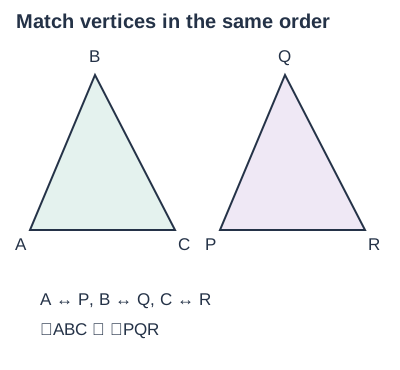
Make a small correspondence table before writing the congruence statement. A rotated or reflected drawing can still represent congruent triangles. Match given equal parts, not whether vertices happen to sit at the top or left.
Use the correspondence to predict the final claim before proving it. If the goal is BC = QR, check that your triangle order places B with Q and C with R. If you write triangle ABC congruent to triangle PRQ instead, BC would match RQ but AB would match PR, so the other givens must also agree.
2. Know what each condition actually requires
SSS requires three corresponding sides equal. SAS requires two corresponding sides and the angle between them equal. ASA requires two corresponding angles and the side between them equal. AAS also determines congruence because the third angle follows from the 180° sum.
AAA establishes equal shape but not equal size: triangles with sides 3, 4, 5 and 6, 8, 10 have the same angles but different lengths. Two sides and a non-included angle do not guarantee congruence in general.
Think about what a construction can still change. Three angles allow a triangle to be enlarged, so AAA leaves size free. Two sides with the included angle fix how the sides open from their common vertex. This helps explain why the location of the angle is part of the SAS requirement rather than an optional detail.
3. Check the included angle in SAS
If AB=PQ and AC=PR, the included angles are A and P. These are the angles where the two named sides meet. An equality of angle B and angle Q would be different information.
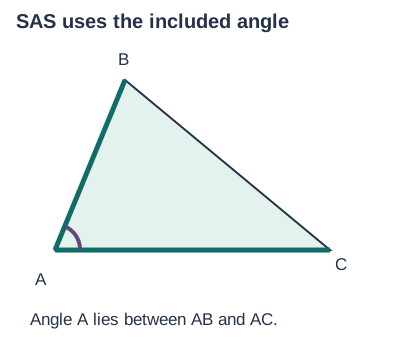
Mark the two equal sides with matching ticks and identify their common vertex. This physical check prevents the common mistake of naming SAS whenever any two sides and any angle are known.
For a concrete audit, AB = PQ and AC = PR supply the two sides. The angle you need is BAC, equal to QPR, because the middle letters name the common vertices. Angle ABC is at B and is not between AB and AC. Writing three-letter angles can make this distinction clearer than single-letter labels.
4. Use the right-triangle condition only when right angles are established
RHS uses a right angle in each triangle, equal hypotenuses and one pair of equal corresponding legs. The hypotenuse is opposite the right angle and is the longest side. It cannot be chosen merely because it looks slanted.
A small square in a diagram or a given perpendicular relationship can establish the right angles. If neither is given nor proved, do not assume a right angle from appearance. Record the reason that the triangle is right-angled.
Suppose both triangles have a hypotenuse of ten centimetres and a corresponding leg of six centimetres. Their remaining legs must each be eight centimetres by the right-triangle side relationship. This offers an intuitive check of why the supplied right-triangle information fixes the shape; it does not remove the need to establish both right angles.
5. Write reasons before the conclusion
A proof can have three equality lines, each with a reason, followed by the congruence condition. Reasons may be given information, a shared side, vertically opposite angles or properties already established in the problem.
After proving congruence, corresponding parts can be concluded equal. Using corresponding parts to prove the triangles congruent would be circular unless another independent argument has already established congruence.
For triangles BAC and DAC, the given equal sides BA and DA meet the shared side AC at A. If angle BAC equals angle DAC, SAS is available. Only after this conclusion may you infer BC = DC. Presenting the equality BC = DC at the beginning would assume the very result the proof is meant to establish.
6. Audit correspondence and avoid hidden assumptions
Read your final statement against every equality used. If AB matches PQ and AC matches PR, a conclusion BC=QR is consistent. Writing BC=PR would mismatch the correspondence.
Separate what the diagram suggests from what the problem gives. Equal-looking sides, a centred point or an apparently bisected angle are not evidence unless a mark, statement or valid deduction supports them. A good proof remains valid when the picture is redrawn.
A concise final proof still needs its reasons. Write “AC = AC, common side” instead of leaving the equality unexplained. Write “angle BAC = angle DAC, given” when that is supplied. The reader should be able to distinguish a given fact from an inference without relying on the picture or guessing your intention.
5 worked examples with reasoning
1. AB=PQ, BC=QR and AC=PR. Prove triangle ABC congruent to triangle PQR.
- The three corresponding side pairs are equal by the givens.
- The matching order is A↔P, B↔Q, C↔R.
- Therefore the triangles are congruent by SSS.
2. AB=AD, AC is shared and angle BAC=angle CAD. Compare triangles BAC and DAC.
- BA=DA is given.
- AC=AC is a common side; included angles BAC and DAC are equal.
- Triangles BAC and DAC are congruent by SAS.
3. Two right triangles have hypotenuses 10 cm and one corresponding leg 6 cm. Are they congruent? Explain.
- Establish that each is right-angled.
- Their hypotenuses and one pair of corresponding legs are equal.
- They are congruent by RHS.
4. Two triangles have angles 40°, 60°, 80°. Must they be congruent?
- Their angles match.
- One could be an enlargement of the other.
- AAA alone gives similarity, not congruence.
5. After triangle ABC is proved congruent to triangle PQR, state the angle matching B.
- The order pairs B with Q.
- Angle B equals angle Q by corresponding parts.
- Use this only after congruence is established.
Save the guide or print the practice
Download to save or share
Complete guide with answers (PDF) · Worksheet without answers (PDF) · Worksheet and answer key (PDF)
Try each task before opening its answer. Give an example or reason, not only a label.
14 practice questions with explanations
Try each task before opening its answer. Give an example or reason, not only a label.
Write an answer and your reason before opening the explanation. Check the reasoning as well as the final answer.
- Condition
Three corresponding equal sides give which condition?
Answer and reasoning
SSS.
All three side pairs are known.
- Condition
Two sides and their included angle?
Answer and reasoning
SAS.
The angle must lie between those sides.
- Condition
Two angles and the included side?
Answer and reasoning
ASA.
The stated side connects the angle vertices.
- Correspondence
If ABC matches PQR, which side matches AC?
Answer and reasoning
PR.
A matches P and C matches R.
- Correspondence
If triangle ABC corresponds to triangle PQR in that order, which angle matches angle C?
Answer and reasoning
R.
Read the order.
- Common
Why can AC=AC appear in a proof?
Answer and reasoning
It is a shared side.
A segment equals itself.
- Right
Where is the hypotenuse?
Answer and reasoning
Opposite the right angle.
Its location follows from the right angle.
- RHS
For two right triangles, do equal hypotenuses alone prove congruence?
Answer and reasoning
No.
A right angle and another corresponding side equality are needed.
- AAA
Does AAA prove congruence?
Answer and reasoning
No.
Size can differ.
- SSA
Does any two sides and any angle guarantee congruence?
Answer and reasoning
No.
A non-included angle can leave ambiguous configurations.
- Reason
Can a side be declared equal because it looks equal?
Answer and reasoning
No.
Use a given mark or valid deduction.
- Order
If A↔R, B↔P, C↔Q, complete ABC≅___.
Answer and reasoning
RPQ.
Preserve the correspondence order.
- Logic
Can corresponding parts be used before congruence is proved?
Answer and reasoning
Not as the justification for that same congruence.
That would be circular.
- AAS
Why can two angles and a non-included corresponding side determine congruence?
Answer and reasoning
The third angle follows from 180°, allowing an ASA argument.
The side and angle correspondences must still match.
Use the ideas without looking at the notes
Make a correspondence table, list each given or proved equality with a reason, name one valid congruence condition and only then conclude matching parts are equal.
Common questions
Does rotation change congruence?
No. Rigid movements preserve lengths and angles.
Why does the vertex order matter?
It identifies which sides and angles correspond.
Can I use a common side as evidence?
Yes. State that the segment is shared.
Why is AAA insufficient?
It fixes shape but permits different sizes.
What is the most useful final check?
Verify that every equality and conclusion follows the same correspondence.
Connect your learning
Ask about guided Maths learning if your child needs help explaining these ideas.
About this guide
Original explanations, examples, diagrams and practice by BananaLearn. The grade label indicates the intended learning level; this is not an official textbook extract or exam paper.