
Start with the key idea
A ratio compares quantities in a stated order. Equivalent ratios scale both parts by the same factor. The unitary method finds the amount for one unit before scaling to the requested number of units, when the rate is constant.
1. State what each ratio part represents
A red-to-blue ratio of 2 : 3 says there are two red parts for every three blue parts. It does not say there are only five counters; 4 red and 6 blue or 8 red and 12 blue have the same ratio.
Order matters. Blue to red is 3 : 2. Write the labels above the ratio before substituting numbers. A reversed ratio describes a different comparison even when the same two numbers appear.
A ratio can be represented by equal-sized boxes. The two red boxes and three blue boxes must all stand for the same amount. Drawing red boxes worth four each and blue boxes worth five each would not represent the stated ratio. The equal-part assumption is the bridge between the visual model and the calculation.
2. Separate part-to-part and part-to-whole
In the ratio 2 : 3, the whole contains five equal parts. The red fraction of the total is 2/5, while the red-to-blue comparison is 2/3. These answer different questions.
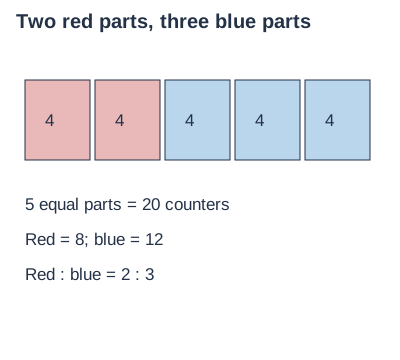
If the total is 20, divide by five to find one part: four counters. Then multiply by two for red and three for blue. Check both conditions: 8 + 12 = 20 and 8 : 12 simplifies to 2 : 3.
A learner may divide the total twenty by three because three is the larger ratio number. That gives the amount for one blue group only if three groups made the entire total, which they do not. Point to all five parts before dividing. The denominator comes from the whole structure, not the largest printed number.
3. Match units before simplifying
To compare 50 cm with 2 m, first convert 2 m to 200 cm. The ratio is 50 : 200 = 1 : 4. Simplifying 50 : 2 would compare incompatible numbers and give the wrong relationship.
Ratios of the same kind of quantity can become unit-free after conversion. A rate such as rupees per notebook compares different kinds of quantities and keeps a meaningful unit. Say whether the result is a ratio or a rate.
Compare 2 litres with 500 millilitres. Converting gives 2,000 : 500 = 4 : 1. The first quantity is four times the second, which agrees with the containers’ capacities. A result of 2 : 500 would incorrectly suggest the first amount was much smaller. A size check can expose the unit error immediately.
4. Use the unitary method for a constant rate
If four identical notebooks cost ₹60 at the same price each, one costs 60 ÷ 4 = ₹15. Seven then cost 7 × 15 = ₹105. The first step finds one unit; the second builds the requested number.
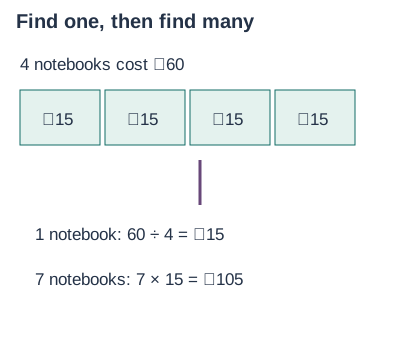
Check the condition. A bulk discount, a fixed delivery charge or differently priced notebooks would change the model. Do not apply a constant-price method merely because the question contains a price and a count.
The one-unit step is a rate statement, not just a number. Write “₹15 per notebook”, not merely “15”. Then seven notebooks times ₹15 per notebook gives ₹105. Carrying the words through the calculation helps identify an accidental division in the second step and makes the method usable in unfamiliar stories.
5. Choose scaling when it is simpler
If three metres of ribbon cost ₹24, six metres cost twice as much, ₹48, at the same price per metre. Direct scaling avoids an unnecessary intermediate calculation. Finding one metre at ₹8 gives the same answer.
For a less obvious quantity, the unitary method is often easier: five metres cost 5 × ₹8 = ₹40. Compare methods so the learner understands the relationship rather than thinking only one procedure is permitted.
A fractional scale factor can also be valid. If six metres cost ₹48, three metres cost half as much, ₹24, under the same rate. If only complete sealed six-metre rolls are sold, however, buying half a roll may not be possible. Distinguish a mathematical rate from the shop’s actual selling constraint.
6. Test the answer against the story
If more notebooks at a fixed positive unit price cost less, something is wrong. Check the direction of change and then divide the total cost by the notebook count to see whether the unit rate is unchanged.
For sharing a total in a ratio, check the total and the simplified ratio. Either check alone can miss an error: 9 and 11 total 20 but do not have ratio 2 : 3. Keep both conditions visible.
For a mixture question, adding an equal number to both quantities usually changes the ratio. Starting with two red and three blue counters, adding one of each gives three to four, not two to three. Multiplying both amounts by the same factor preserves the comparison because every equal part grows together.
More original practice from this guide
Grade 6 ratio and unitary method: word problems explained — practice sheet
Try these additional questions on paper before opening an answer. The complete guide PDF includes this practice; no account is needed.
Name: ____________________ Date: __________
Simplify 15:25.
Show answer and reasoning
3:5. Divide both terms by 5. You have changed the size of a part, not the comparison.
A box has 6 red and 9 blue counters. Write red:all counters in simplest form.
Show answer and reasoning
2:5. There are 15 counters altogether. Red:total = 6:15 = 2:5.
Share 56 cards between A and B in the ratio 3:5.
Show answer and reasoning
A gets 21; B gets 35. Eight equal parts share 56 cards, so one part is 7. Multiply 7 by 3 and by 5.
Six identical pencils cost ₹48. Find the cost of 11 at the same price each.
Show answer and reasoning
₹88. One pencil costs ₹48 ÷ 6 = ₹8. Eleven cost 11 × ₹8 = ₹88.
Simplify the ratio 2 m:50 cm.
Show answer and reasoning
4:1. Convert 2 m to 200 cm, then divide both 200 and 50 by 50.
Juice concentrate:water is 2:5. How much water is needed for 8 cups of concentrate?
Show answer and reasoning
20 cups. Two parts became 8 cups, a scale factor of 4. The five water parts become 5 × 4 = 20 cups.
Can 20 whole stickers be shared exactly in the ratio 2:5 without cutting any? Explain.
Show answer and reasoning
No. Seven equal parts would each contain 20/7 stickers. The shares 40/7 and 100/7 are not whole numbers; rounding changes the ratio.
A delivery has a fixed ₹30 fee plus ₹10 per item. Does doubling the item count double the total bill?
Show answer and reasoning
No. Two items cost ₹50; four cost ₹70, not ₹100. The fixed fee prevents the total bill from being proportional to the item count.
Answers to the additional practice
Grade 6 ratio and unitary method: word problems explained — worked answer key
3:5. Divide both terms by 5. You have changed the size of a part, not the comparison.
2:5. There are 15 counters altogether. Red:total = 6:15 = 2:5.
A gets 21; B gets 35. Eight equal parts share 56 cards, so one part is 7. Multiply 7 by 3 and by 5.
₹88. One pencil costs ₹48 ÷ 6 = ₹8. Eleven cost 11 × ₹8 = ₹88.
4:1. Convert 2 m to 200 cm, then divide both 200 and 50 by 50.
20 cups. Two parts became 8 cups, a scale factor of 4. The five water parts become 5 × 4 = 20 cups.
No. Seven equal parts would each contain 20/7 stickers. The shares 40/7 and 100/7 are not whole numbers; rounding changes the ratio.
No. Two items cost ₹50; four cost ₹70, not ₹100. The fixed fee prevents the total bill from being proportional to the item count.
Choose related practice
Choose the next practice step
Use the questions in this guide to practise this specific skill. If you need another explanation, return to Division: sharing equally and making equal groups before trying a fresh problem.
Help a learner explain the method
Help at home: Build a mixture before using a formula
Use buttons in two colours. Make one group containing two of the first colour and three of the second. Make three identical groups. Ask what changed and what stayed the same: the counts tripled, but the comparison stayed 2:3.
If your child confuses a ratio with a fraction of the whole, ask them to circle the whole collection first. Then label first:second and first:total separately. Finish with a new ratio, such as 1:4, without showing the previous working.
Keep one example of your child’s own working. If the same confusion returns across fresh questions, share that attempt with their teacher and ask which next step fits their current learning.
5 worked examples with reasoning
1. Share 35 counters in the ratio 3 : 4.
- There are 7 parts; one part is 35 ÷ 7 = 5.
- The shares are 15 and 20.
- Check 15 + 20 = 35 and 15 : 20 = 3 : 4.
2. Simplify 75 cm : 1.5 m.
- Convert 1.5 m to 150 cm.
- 75 : 150 = 1 : 2.
- Equal units make the numerical comparison meaningful.
3. Five pens cost ₹45. Find the cost of eight at the same rate.
- One pen costs ₹45 ÷ 5 = ₹9.
- Eight cost ₹72.
- Check 72 ÷ 8 = 9.
4. A mixture has juice to water ratio 1 : 4. What fraction is juice?
- There are five parts altogether.
- One of the five parts is juice: 1/5.
- 1/4 would compare juice with water, not the whole mixture.
5. A taxi charges ₹50 plus ₹10 per kilometre. Does twice the distance cost twice as much?
- At 2 km the cost is ₹70; at 4 km it is ₹90.
- ₹90 is not twice ₹70.
- The fixed charge prevents a constant total-cost-per-kilometre relationship.
Save the guide or print the practice
Download to save or share
Complete guide with answers (PDF) · Worksheet without answers (PDF) · Worksheet and answer key (PDF)
Try each task before opening its answer. Give an example or reason, not only a label.
14 practice questions with explanations
Try each task before opening its answer. Give an example or reason, not only a label.
Write an answer and your reason before opening the explanation. Check the reasoning as well as the final answer.
- Simplify
Simplify 12 : 18.
Answer and reasoning
2 : 3.
Divide both parts by six.
- Order
Reverse red : blue = 4 : 7.
Answer and reasoning
Blue : red = 7 : 4.
Reverse the labels and values together.
- Whole
In 3 : 5, how many parts make the whole?
Answer and reasoning
8 parts.
Add the ratio parts.
- Share
Share 48 in ratio 1 : 3.
Answer and reasoning
12 and 36.
Four parts; each is twelve.
- Fraction
What fraction of a 2 : 7 mixture is the first component?
Answer and reasoning
2/9.
The whole has nine parts.
- Units
Simplify 30 cm : 1.2 m.
Answer and reasoning
1 : 4.
Convert 1.2 m to 120 cm.
- Rate
Six pencils cost ₹42. Cost of one?
Answer and reasoning
₹7.
42 ÷ 6 = 7.
- Rate
At that rate, cost of nine pencils?
Answer and reasoning
₹63.
9 × 7 = 63.
- Scale
Three tickets cost ₹150. Cost of six at the same price?
Answer and reasoning
₹300.
The ticket count doubles.
- Check
Do 10 and 15 share 25 in ratio 2 : 3?
Answer and reasoning
Yes.
They total 25 and simplify to 2: 3.
- Check
Do 11 and 14 share 25 in ratio 2: 3?
Answer and reasoning
No.
The total is right, but the ratio is wrong.
- Compare
Is 2 : 3 equivalent to 4 : 5?
Answer and reasoning
No.
Adding the same amount does not preserve the ratio.
- Conditions
Why mention a constant unit price?
Answer and reasoning
It permits the same rate to be used for the new count.
Discounts or fixed fees can change the relationship.
- Create
Give a ratio equivalent to 5 : 8.
Answer and reasoning
For example, 10 : 16.
Multiply both parts by the same positive factor.
Use the ideas without looking at the notes
Write the ratio labels, find the whole’s number of parts and check both shares. For a unitary problem, write the one-unit rate with its unit and state the constant-rate assumption.
Common questions
Does a ratio always give actual counts?
No. It specifies relative parts; many actual counts can fit.
Why add the parts when sharing a total?
The sum counts all equal parts in the whole.
Can ratios include different units?
Convert matching quantities to the same unit before simplifying their ratio.
Is the unitary method always required?
No. Direct scaling may be simpler when the scale factor is obvious.
When does a constant-rate method fail?
When a fixed fee, discount or changing rate breaks the assumed proportional relationship.
Connect your learning
Ask about guided Maths learning if your child needs help explaining these ideas.
About this guide
Original explanations, examples, diagrams and practice by BananaLearn. The grade label indicates the intended learning level; this is not an official textbook extract or exam paper.