
Start with the key idea
Read a formula as a relationship between quantities. Identify what the question asks, define the symbols, check the conditions and units, then substitute. Use the result in the original problem to check it. This is a revision reference, not a replacement for learning proofs or a complete syllabus checklist.
How to use this sheet
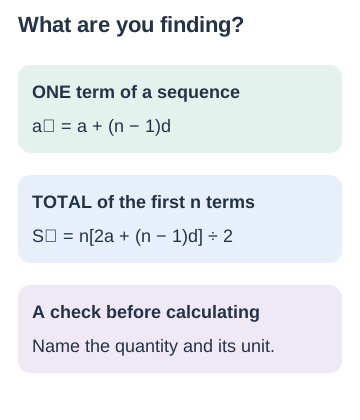
Start with the question, then find its chapter section. Write what you need to find before choosing a formula. If the question asks for a length, an answer in square centimetres signals a mismatch even if the arithmetic is correct.
This guide is organised around topics in the CBSE 2026–27 Grade 10 Maths curriculum checked on 28 October 2026. It includes prerequisite relationships used within those topics. It does not claim to list every theorem, proof, construction or assessed skill. Confirm the requirements for your school and course.
For each example, cover the calculation and name the relationship first. After using the sheet, try the mixed questions without headings that reveal the method. A formula remembered but applied to the wrong quantity will not solve the problem.
Number relationships and quadratic polynomials
For two positive integers, HCF × LCM = their product. For 12 and 18, the HCF is 6 and the LCM is 36: both products are 216. The two-number condition matters; do not extend this identity unchanged to a list of three numbers.
For a quadratic polynomial ax² + bx + c with a ≠ 0 and zeroes α, β: α + β = −b/a and αβ = c/a. These relate zeroes to coefficients; they do not say that the zeroes are b and c. For 2x² − 7x + 3, the sum is 7/2 and product is 3/2. The zeroes 3 and 1/2 satisfy both.
If zeroes are known, a monic quadratic with those zeroes is x² − (sum)x + product. Multiplying the entire polynomial by a nonzero constant preserves its zeroes. Therefore “find a polynomial” need not have a unique answer unless another condition is given.
Pairs of equations and quadratic equations
For a₁x + b₁y + c₁ = 0 and a₂x + b₂y + c₂ = 0, the lines intersect in one point when a₁b₂ − a₂b₁ ≠ 0. This determinant form avoids division by a zero coefficient. When it is zero, inspect whether the equations describe the same line or different parallel lines; do not conclude “no solution” automatically.
Solve a pair using substitution or elimination and check both original equations. For x + y = 9 and x − y = 3, addition gives 2x = 12, so x = 6 and y = 3. A pair that satisfies only one line is not the solution.
For ax² + bx + c = 0, a ≠ 0, let D = b² − 4ac. The quadratic formula is x = (−b ± √D)/(2a). D > 0 gives two distinct real roots; D = 0 gives one repeated real root; D < 0 gives no real roots. The denominator applies to the entire numerator.
For x² − 5x + 6 = 0, D = 25 − 24 = 1 and x = (5 ± 1)/2, giving 3 and 2. Factorisation is also efficient here. Choosing a valid shorter method is useful; a formula sheet does not require using the longest method.
Arithmetic progressions: a term or a sum
For an arithmetic progression with first term a and constant difference d, aₙ = a + (n − 1)d. There are n − 1 gaps between the first and nth terms. The formula requires a constant difference and a positive whole-number term index n.
The sum of the first n terms is Sₙ = n[2a + (n − 1)d]/2, or Sₙ = n(a + l)/2 when l is the nth term. The letter l means last term in this sum, not the number one.
For 6, 9, 12, …, the tenth term is 6 + 9 × 3 = 33. The sum of the first ten is 10(6 + 33)/2 = 195. Label the result “seats in row ten” or “seats in ten rows”; the context helps distinguish them.
Check n = 1: the term formula gives a and the sum formula also gives a. This small-case check catches an accidental nd in place of (n − 1)d.
Coordinate geometry and similar triangles
For A(x₁, y₁) and B(x₂, y₂), AB = √[(x₂ − x₁)² + (y₂ − y₁)²]. The horizontal and vertical changes form a right triangle. From (1, 2) to (4, 6), the changes are 3 and 4, so the distance is 5 units.
If P divides AB internally in the ratio AP:PB = m:n, then P = ((mx₂ + nx₁)/(m+n), (my₂ + ny₁)/(m+n)), with m,n positive. The weights are opposite the corresponding endpoints. The midpoint is the case m = n, giving coordinate averages.
For A(0, 0), B(6, 9) and AP:PB = 1:2, P = (2, 3). It lies one third of the way from A to B, not two thirds. Use the location to check the ratio order.
In similar triangles, corresponding side ratios are equal. Write the correspondence before dividing: if A↔D, B↔E, C↔F, then AB/DE = BC/EF = AC/DF. An attractive diagram does not establish similarity; justify it with an appropriate criterion. A line parallel to one side of a triangle divides the other two sides proportionally.
Trigonometry: label the triangle first
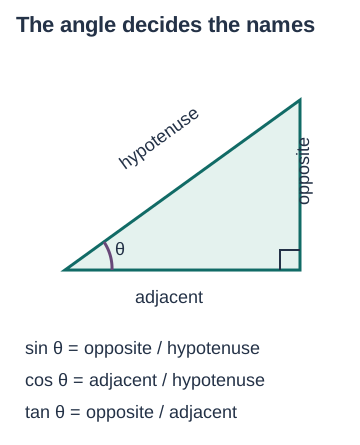
For an acute angle θ in a right triangle: sin θ = opposite/hypotenuse, cos θ = adjacent/hypotenuse, and tan θ = opposite/adjacent. The hypotenuse is opposite the right angle. The other names depend on the chosen θ.
Reciprocal ratios are cosec θ = 1/sin θ, sec θ = 1/cos θ and cot θ = 1/tan θ wherever the denominator is nonzero. The identities sin²θ + cos²θ = 1, 1 + tan²θ = sec²θ and 1 + cot²θ = cosec²θ hold where their expressions are defined. sin²θ means (sin θ)².
Useful exact values: at 30°, sin = 1/2, cos = √3/2, tan = 1/√3; at 45°, sin = cos = 1/√2 and tan = 1; at 60°, sin = √3/2, cos = 1/2 and tan = √3. At 0°, sin = 0 and cos = 1; at 90°, sin = 1 and cos = 0, so tan 90° is undefined. Do not turn division by zero into a large number.
For an elevation problem with horizontal distance 8 m and angle 45°, the rise above eye level is 8 tan 45° = 8 m. Add the observer’s eye height only when the question asks for height from the ground and the setup requires it.
Circles, sectors and tangents
For radius r, circumference is 2πr and circle area is πr². For a sector with central angle θ measured in degrees, arc length is (θ/360) × 2πr and area is (θ/360) × πr². The sector’s perimeter also includes its two radii.
For a 90° sector of radius 6 cm, the arc is 3π cm and the area is 9π cm². The sector perimeter is 12 + 3π cm. Using area as perimeter mixes quantities and units. Use the value of π specified in a question; otherwise exact π can preserve precision.
A minor segment is the region between a chord and its minor arc. Its area is the corresponding minor-sector area minus the triangle area. For a 90° sector of radius 6 cm, the triangle has perpendicular sides 6 and 6, so the segment area is 9π − 18 cm².
A tangent is perpendicular to the radius at the contact point. Tangents from the same external point have equal lengths. These statements supply geometry relationships; they are not formulas for the length of every line that touches a diagram.
Surface areas and volumes: decide which faces count
For a cuboid of length l, breadth b and height h: volume = lbh; total surface area = 2(lb + bh + hl). For a cube of side s: volume = s³ and total surface area = 6s². A missing lid changes the exposed area but not the container’s geometric capacity.
For a right circular cylinder: volume = πr²h, curved surface area = 2πrh and total surface area = 2πr(h + r). For a right circular cone: volume = πr²h/3, slant height l = √(r² + h²), curved area = πrl and total area = πr(l + r). The perpendicular height h and slant height l are different quantities.
For a sphere: volume = 4πr³/3 and area = 4πr². For a hemisphere: volume = 2πr³/3, curved area = 2πr² and total area including its circular base = 3πr². State whether a base is exposed.
For joined solids, add or subtract volumes as the physical situation requires. For exposed surface area, exclude faces hidden at a join. A cylinder joined to a hemisphere of the same radius does not expose the shared circular face. Draw the boundary before adding formula results.
Convert lengths to a common unit first. Area uses squared units and volume cubed units: 1 cm³ = 1 mL and 1000 cm³ = 1 L. Doubling all lengths multiplies area by four and volume by eight; it does not merely double both.
Statistics and probability: name the measure
For values xᵢ with frequencies fᵢ, the mean is Σ(fᵢxᵢ)/Σfᵢ. For grouped intervals, xᵢ is the class midpoint and this gives a grouped-data estimate. Here Σ means add the terms. A mean uses every value or class contribution.
For continuous grouped data, the median estimate is L + [(N/2 − cf)/f]h: L is the lower boundary of the median class, N the total frequency, cf the cumulative frequency before it, f its frequency and h its width. Locate the class containing the N/2 position. This is the median formula, not the mean formula.
For the usual equal-width grouped-data mode estimate: L + [(f₁ − f₀)/(2f₁ − f₀ − f₂)]h, where f₁ is the modal-class frequency and f₀,f₂ are its neighbours. Check that the data and nonzero denominator make this method applicable. Do not select a class by its numerical size instead of its frequency.
For finitely many equally likely outcomes, P(E) = favourable outcomes/total outcomes. Also P(not E) = 1 − P(E). A fair six-sided die has three even outcomes, so P(even) = 3/6 = 1/2. The formula needs equally likely elementary outcomes; two named possibilities need not each have probability one half.
Probability lies between zero and one. A probability of 4/3 indicates an error. A probability of 1/2 does not guarantee exactly one success in every two trials.
5 worked examples with reasoning
1. Find the eighth term and sum of eight terms of 4, 7, 10, … .
- a = 4, d = 3, n = 8.
- a₈ = 4 + 7 × 3 = 25.
- S₈ = 8(4 + 25)/2 = 116. The term and total answer different questions.
2. Solve 2x² − 5x + 2 = 0.
- a = 2, b = −5, c = 2, so D = 25 − 16 = 9.
- x = (5 ± 3)/4 gives 2 or 1/2.
- Substitute both into the original equation; each makes it zero.
3. A cylinder of radius 3 cm and height 7 cm has an open top. Find its exposed area, ignoring thickness.
- Include the curved wall and one circular base.
- Area = 2πrh + πr² = 42π + 9π = 51π cm².
- Using total area for a closed cylinder would add a lid that is not present.
4. Find the median estimate for intervals 0–10, 10–20, 20–30 with frequencies 4, 8, 8.
- N = 20; cumulative frequencies are 4, 12, 20. The tenth observation lies in 10–20.
- L = 10, cf = 4, f = 8, h = 10.
- Median estimate = 10 + [(10 − 4)/8] × 10 = 17.5. This is an estimate from grouped data, not the exact median of unknown raw values.
5. A bag has three red and five blue identical tokens, thoroughly mixed. Find P(not red).
- There are eight equally likely individual tokens under the random-draw model.
- P(red) = 3/8, so P(not red) = 1 − 3/8 = 5/8.
- The two colour names do not make the probabilities equal.
Save the guide or print the practice
Download to save or share
Complete guide with answers (PDF) · Worksheet without answers (PDF) · Worksheet and answer key (PDF)
Try each question before opening its explanation. Show the calculation, evidence or reasoning that supports your answer.
15 practice questions with explanations
Try each question before opening its explanation. Show the calculation, evidence or reasoning that supports your answer.
Write an answer and your reason before opening the explanation. Check the reasoning as well as the final answer.
- Choose
For 3, 7, 11, …, find the sixth term.
Answer and reasoning
23.
a₆ = 3 + 5 × 4. Count five gaps.
- Choose
Find the sum of the first six terms of that sequence.
Answer and reasoning
78.
S₆ = 6(3 + 23)/2.
- Algebra
Find the sum and product of zeroes of 3x² − 8x + 4.
Answer and reasoning
Sum 8/3; product 4/3.
Use −b/a and c/a, retaining the sign of b.
- Algebra
How many real roots does x² + 2x + 5 = 0 have?
Answer and reasoning
No real roots.
D = 4 − 20 = −16.
- Coordinates
Find the distance from (−1, 2) to (2, 6).
Answer and reasoning
5 units.
Changes are 3 and 4; √(9 + 16) = 5.
- Coordinates
Find the midpoint of (2, −4) and (8, 6).
Answer and reasoning
(5, 1).
Average each coordinate separately.
- Trig
In a right triangle, opposite = 6 and hypotenuse = 10 for θ. Find sin θ.
Answer and reasoning
3/5.
sin θ = 6/10; the hypotenuse is used, not the adjacent side.
- Trig
Is tan 90° equal to zero?
Answer and reasoning
No; it is undefined.
sin 90°/cos 90° would divide by zero.
- Circles
Find the area of a 60° sector of radius 3 cm.
Answer and reasoning
3π/2 cm².
(60/360) × 9π = 1.5π.
- Solids
Find the volume of a cone of radius 3 cm and height 4 cm.
Answer and reasoning
12π cm³.
π × 9 × 4 / 3. Slant height is not used for volume.
- Solids
Find the total area of a hemisphere of radius 2 cm.
Answer and reasoning
12π cm².
3πr² includes the circular base.
- Statistics
Values 2 and 5 have frequencies 3 and 2. Find their mean.
Answer and reasoning
3.2.
(2 × 3 + 5 × 2)/5 = 16/5.
- Probability
On a fair die, what is P(number greater than 4)?
Answer and reasoning
1/3.
The favourable outcomes are 5 and 6 out of six.
- Check
A student adds the areas of two joining circular faces when finding the outside area of joined solids. What is wrong?
Answer and reasoning
The joined faces are hidden inside.
Count only the exposed boundary requested.
- Explain
Why does a formula sheet not replace a geometry proof?
Answer and reasoning
A proof must justify why the relationship applies.
A remembered expression alone does not establish the given conditions or the correspondence.
Use the ideas without looking at the notes
Make a three-column revision card: question asks for; relationship and conditions; check. Add one example you previously got wrong. Keep symbols defined beside each formula. Revisit the card with a fresh question rather than copying it repeatedly.
Common questions
Does this include every Grade 10 requirement?
No. It is a broad formula reference with examples, not a complete syllabus or proof guide. Check the official curriculum and your teacher’s instructions.
Should I memorise formulas before understanding them?
Use a model or example to establish what each quantity means, then practise recalling and applying the relationship. Recall and selection are both needed.
Can I use the same sheet for another board?
Many relationships are shared, but topic scope and assessment requirements differ. Check your own course before treating it as a revision checklist.
Why are units part of the answer?
They state the quantity measured and help detect a formula mismatch. A length, an area and a volume use different dimensions.
Is the grouped median formula the same as the mean formula?
No. The median formula estimates a middle position within a class. The mean formula combines frequency-weighted values or midpoints.
Connect your learning
Ask about guided Maths learning if your child needs help explaining these ideas.
About this guide
Original explanations, examples, diagrams and practice by BananaLearn. The grade label indicates the intended learning level; this is not an official textbook extract or exam paper.