
Start with the key idea
For a right-triangle height problem, draw the horizontal distance, vertical rise and line of sight. Label the angle at the observer. Choose sine, cosine or tangent according to the known and unknown sides. Add eye height when the vertical rise starts above the ground.
1. Translate the scene into a right triangle
Draw the ground as horizontal and a tower as vertical when the problem states or implies a level-ground, upright-tower model. Their intersection is a right angle. The sloping line from the observer to the top is the line of sight, not the ground distance.
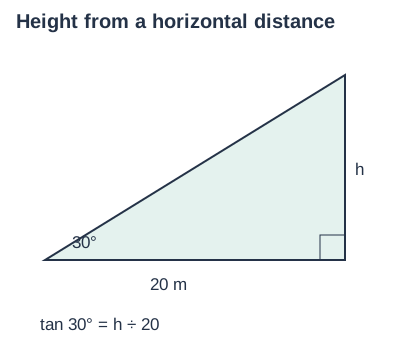
The angle of elevation is measured up from the horizontal through the observer’s eye. It is not measured from the tower. Labelling the angle at the wrong vertex exchanges opposite and adjacent sides and can invert the calculation.
Write the assumptions beside the sketch: level ground, a vertical object and a straight line of sight. A sloping hillside needs a different model; a neat diagram must not silently replace the actual conditions in the question.
2. Choose a ratio from the sides you have
Relative to the marked angle, the opposite side is the vertical rise, the adjacent side is the horizontal distance and the hypotenuse is the line of sight. Tangent connects opposite and adjacent, so it is often useful when a ground distance is known.
If a ladder length is supplied, that is usually the hypotenuse. Sine connects vertical height to ladder length; cosine connects ground distance to ladder length. A ladder of length ten metres at 30° to horizontal reaches 10 sin 30° = 5 m.
Do not choose a formula merely because the story mentions a tower. Circle the two side quantities involved and select the ratio that contains them. This makes the same method work for trees, ramps, ladders and observation points.
3. Keep exact values until the last step
Useful values are tan 30° = 1/√3, tan 45° = 1 and tan 60° = √3. For a rise above a point 20 m away at 30°, h = 20/√3 = 20√3/3 metres. An approximation is about 11.55 m.
Rounding √3 to 1.7 too early changes the final answer unnecessarily. Keep the exact surd through the calculation, then round to the requested precision. If a calculator is used for an angle measured in degrees, its degree mode must match the question.
A quick size check helps. At 45°, rise equals horizontal distance. At an acute angle below 45°, rise is smaller than that distance; above 45°, it is greater. These comparisons can reveal an inverted tangent ratio.
4. Distinguish vertical rise from full object height
Suppose the observer’s eye is 1.5 m above level ground. A horizontal line from the eye meets the tower 1.5 m above its base. The triangle’s opposite side measures only the rise from that horizontal to the top.
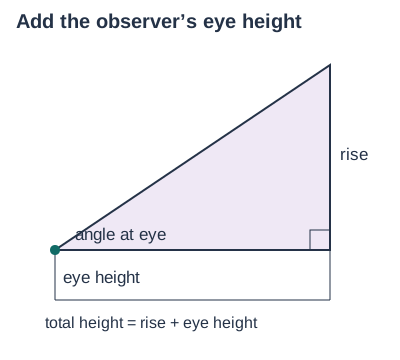
At a distance of 10 m and an angle of 45°, the rise is 10 m. The full tower height is therefore 10 + 1.5 = 11.5 m. Returning 10 m would ignore the eye-height information.
For an observer on a raised platform, identify the reference height in the same way. Add the known height above the object’s base only when the ground levels and vertical measurements support that addition.
5. Convert an angle of depression carefully
An angle of depression is measured down from a horizontal at the observer. For two parallel horizontal reference lines, the angle of depression equals the corresponding angle of elevation along the same line of sight.
From a 20 m high lookout, an object on level ground is seen at 45° depression. In the right triangle, vertical height and horizontal distance are equal, so the object is 20 m horizontally from the base. The sloping sight distance is different.
Draw both horizontals when the equal-angle relationship is unclear. The equality follows from parallel lines, not from assuming every angle in the picture matches. Keep the right angle at the vertical-ground intersection.
6. Use two observations without inventing a distance
At a near point the elevation is 60°; at a point 20 m farther away on the same straight line it is 30°. Let the nearer horizontal distance be x and the height h, assuming both observations are at ground level.
The equations are h = x√3 and h = (x + 20)/√3. Equating them gives 3 x = x + 20, hence x = 10 and h = 10√3 m. Both equations refer to the same height, which is what connects the observations.
Check the geometry before writing x + 20. If the observers stand on opposite sides of the tower, their total separation involves a sum of two distances instead. The words “towards”, “away” and “same side” determine the diagram, not a memorised equation.
5 worked examples with reasoning
1. A tree is 15 m away on level ground and its top is at 45° elevation from ground level. Find its height.
- tan 45° = h/15 = 1.
- h = 15 m.
- Height equals distance because the right triangle has a 45° acute angle.
2. A 10 m ladder makes 30° with horizontal ground. Find the height reached.
- The ladder is the hypotenuse.
- sin 30° = h/10, so h = 5 m.
- Do not use tangent with the ladder length as adjacent.
3. An eye 1.6 m above level ground sees a top at 45° from 12 m away. Find total height.
- Rise above eye level is 12 tan 45° = 12 m.
- Add the eye height: 12 + 1.6 = 13.6 m.
- Check that the observer and object base are on the same ground level.
4. A tower of height 18 m is seen at 60° elevation from ground level. Find horizontal distance.
- tan 60° = 18/d.
- d = 18/√3 = 6√3 m.
- This is about 10.39 m and is smaller than the height.
5. Two ground-level observations on the same side are 20 m apart, with angles 60° nearer and 30° farther. Find tower height.
- Let near distance x; far distance x + 20.
- x√3 = (x + 20)/√3 gives x = 10.
- Height = 10√3 m, about 17.32 m.
Save the guide or print the practice
Download to save or share
Complete guide with answers (PDF) · Worksheet without answers (PDF) · Worksheet and answer key (PDF)
Unless stated otherwise, assume level horizontal ground, vertical objects and observation from ground level. Show a labelled triangle and give units.
14 practice questions with explanations
Unless stated otherwise, assume level horizontal ground, vertical objects and observation from ground level. Show a labelled triangle and give units.
Write an answer and your reason before opening the explanation. Check the reasoning as well as the final answer.
- Ratio
Which ratio connects opposite and adjacent sides?
Answer and reasoning
Tangent.
tan θ = opposite/adjacent.
- Angle
Where is an elevation angle measured from?
Answer and reasoning
The observer’s horizontal.
It is measured upward towards the line of sight.
- Height
From ground level, distance 8 m and elevation 45°. Height?
Answer and reasoning
8 m.
tan 45° = 1.
- Height
Distance 9 m and elevation 60° from ground level. Height?
Answer and reasoning
9√3 m.
Height = distance × tan 60°.
- Distance
Height 12 m and elevation 45°. Horizontal distance?
Answer and reasoning
12 m.
The two legs are equal.
- Distance
Height 10 m and elevation 30°. Horizontal distance?
Answer and reasoning
10√3 m.
10 divided by 1/√3.
- Eye
Rise above eye is 7 m and eye height is 1.4 m. Total?
Answer and reasoning
8.4 m.
Add the two vertical lengths.
- Ladder
A 6 m ladder is at 30° to ground. Height reached?
Answer and reasoning
3 m.
6 × sin 30°.
- Ladder
At 60° to ground, what height does the same 6 m ladder reach?
Answer and reasoning
3√3 m.
6 × sin 60°.
- Depression
A 15 m lookout sees a ground object at 45° depression. Horizontal distance?
Answer and reasoning
15 m.
The matching elevation is 45°.
- Check
At 30°, should rise exceed horizontal distance?
Answer and reasoning
No.
tan 30° is less than one.
- Units
Can you combine a distance in metres and a height in centimetres directly in a ratio?
Answer and reasoning
Convert to matching units first.
A trigonometric ratio compares like units.
- Diagram
Does the line of sight represent the horizontal ground distance?
Answer and reasoning
No.
It is the hypotenuse in this model.
- Assumption
Why should level ground be stated?
Answer and reasoning
It establishes the horizontal-vertical right-triangle model.
Sloping ground changes the geometry.
Use the ideas without looking at the notes
Draw the scene, mark the observer’s horizontal, identify the actual known side and choose a ratio. Check eye height, units and whether the final answer is a vertical or horizontal distance.
Common questions
Do I always use tangent?
No. Choose the ratio from the known side and required side; ladder lengths often involve sine or cosine.
When do I add eye height?
When the triangle measures a rise above eye level and the full object height is required.
Are depression and elevation angles equal?
The corresponding pair is equal when the horizontal reference lines are parallel.
Should I round √3 immediately?
Keep exact values until the final step unless the question specifies an approximation.
Why can two-observer questions have different equations?
Observers on the same side and opposite sides produce different relationships between horizontal distances.
Connect your learning
Ask about guided Maths learning if your child needs help explaining these ideas.
About this guide
Original explanations, examples, diagrams and practice by BananaLearn. The grade label indicates the intended learning level; this is not an official textbook extract or exam paper.