
Start with the key idea
List the topics and fixed commitments before choosing revision blocks. Give each block a specific task and a way to check it, then leave space to adjust. Review what the learner could do independently, rather than treating a completed timetable as proof of learning.
Start with the real topic list and available time
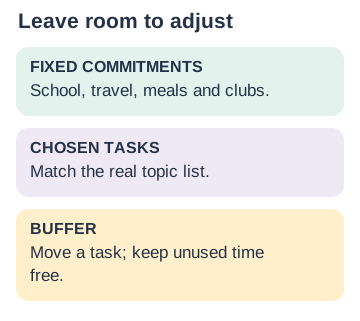
Use the school’s current topic list, assessment dates and teacher guidance. Do not rely on a generic internet syllabus to decide what an upcoming test will include. Write down school, travel, meals, clubs and existing rest time before allocating revision.
Ask the learner to identify topics using work, not confidence alone. “I think I know percentages” is a starting impression. A short suitable question and explanation give better evidence about what to revisit. If the learner has not been taught a topic yet, label it as needing teaching rather than giving it a revision slot and hoping it becomes familiar.
This guide is for organising revision of taught content. For the method inside a block, use turning notes into practice. For everyday homework and play, use the after-school routine guide; an exam plan does not need to govern the entire year.
Write a task, a check and a return point
| Vague entry | Useful task | Evidence at the end |
|---|---|---|
| Maths | Find 10% and 15% of a given amount; explain the relationship. | A correct fresh example with a reason. |
| English | Answer one inference question from a short passage. | An answer with a relevant supporting detail. |
| Science | Explain which variable changed in a familiar fair test. | Identify the change and two things kept the same. |
Add what will happen if the learner gets stuck: use a worked example, ask a specific question or move the task into a support list. “Do it again” is not enough when the concept is unclear. Keep the first plan light enough that you can see which tasks take longer than expected.
Example week: a small plan with room to change
The following is an invented plan for a learner revisiting taught work. The 20-minute blocks are an illustration, not a recommended duration for all ages or exam courses. Adapt the size, content and number of blocks to the learner and school expectations.
| Day | Planned block | Task and check |
|---|---|---|
| Monday | One 20-minute block | Percentages: attempt two examples, check and explain one correction. |
| Tuesday | One 20-minute block | Reading: infer a reason and support it with a detail. |
| Wednesday | No extra revision block | Existing club and family commitments. |
| Thursday | One 20-minute block | Science: explain a fair test using a diagram or actual class notes. |
| Friday | One 20-minute block | Return to percentages with a fresh example; note what is now independent. |
| Weekend | One optional 20-minute buffer | Use only if a task needs moving; otherwise keep it free. |
The four planned blocks total 80 minutes. Using the buffer would make 100 minutes. This arithmetic describes this example only; it is not a target revision dose. The return to percentages is deliberate, but there is no claim that a three-day gap is the ideal spacing for every learner.
A revision task that can be checked
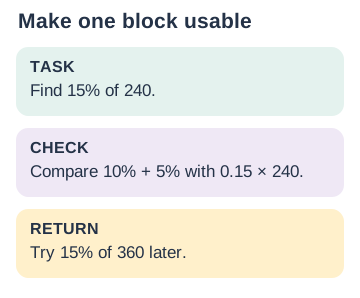
Monday: find 15% of 240. Ten per cent is 24 and five per cent is half of that, 12. Therefore 15% is 24 + 12 = 36. Check another way: 0.15 × 240 = 36.
Friday: find 15% of 360 before looking at the earlier method. Ten per cent is 36, five per cent is 18 and the answer is 54.
If the child finds 15% by dividing by 15, the next step is to revisit what “per cent” means. Do not simply schedule more examples of the same difficulty. Use our percentage-of-an-amount explanation and ask the child to explain the size of their answer.
For Science, the home experiment guide provides a concrete fair-test example. Reading its method is different from conducting the activity: practical work needs the materials, adult supervision and time described there. Do not squeeze an experiment into a revision block designed for explaining notes.
Revise the timetable as well as the subject
At the end of a block, record one of three useful outcomes: completed independently, completed with support, or needs explanation. These are task observations, not permanent labels for the child. A tick for attendance alone cannot show which outcome occurred.
If a block is missed, move the most useful task into the buffer or change the plan. Avoid doubling every following day automatically. Where deadlines are close and the workload is unrealistic, ask the teacher what to prioritise. Keep a visible list of questions that need help so a parent or tutor can use the next conversation well.
Let the learner take part in updating the plan. Ask which task now feels clearer and which still needs a worked example. A timetable earns its place when it makes the next action easier to choose; it should not become another sheet to decorate and then ignore.
Further reading: Milton Keynes City Council: supporting revision and revisiting learning. The scenarios, examples and resources here are original BananaLearn materials.
Topic-based revision planner
Write fixed commitments first. Choose a specific taught task, how to check it and a later return point. Leave unused space for changes.
A completed example
Day / available block: Monday / suitable short block
Topic and task: Find 15% of 240 and explain
How I will check: Compare 10% + 5% with 0.15 × 240
Return / support needed: Friday: 15% of 360 without copying
Opens a separate sheet with the completed example and writing space. Save it as a PDF or print it using your browser. No account is required.
5 worked examples with reasoning
1. Check the example week’s total.
- Four planned 20-minute blocks give 4 × 20 = 80 minutes.
- One optional 20-minute block would make 100 minutes.
- The example illustrates planning, not an age-based revision prescription.
2. Find 15% of 240.
- 10% is 24.
- 5% is half of 24, or 12.
- 15% is 24 + 12 = 36.
3. Use the return task: 15% of 360.
- 10% is 36 and 5% is 18.
- Add them to get 54.
- Try it before looking at the earlier method.
4. A club overruns and Monday’s block is missed.
- Look at the remaining week rather than doubling every day.
- Move the most useful task into available buffer space.
- If the total workload cannot fit, ask the teacher to help prioritise.
5. A block is ticked complete, but all answers needed hints.
- Record completed with support.
- Keep the specific uncertain step on the support list.
- Plan a small fresh attempt with less help.
Save the guide or print the practice
Download to save or share
Complete guide with answers (PDF) · Worksheet without answers (PDF) · Worksheet and answer key (PDF)
These are practice decisions for parents and learners, not an assessment or diagnosis. Compare the suggested response with the explanation and adapt it to the actual task.
14 practice questions with explanations
These are practice decisions for parents and learners, not an assessment or diagnosis. Compare the suggested response with the explanation and adapt it to the actual task.
Write an answer and your reason before opening the explanation. Check the reasoning as well as the final answer.
- Plan
What should be written before revision blocks?
Answer and reasoning
Fixed commitments and the actual topic list.
A plan must fit the real week.
- Task
Improve “Do English”.
Answer and reasoning
Answer one inference question using a supporting detail.
The outcome can be checked.
- Calculation
What is 10% of 240?
Answer and reasoning
24.
Divide by 10.
- Calculation
What is 5% of 240?
Answer and reasoning
12.
Half of 10% is 5%.
- Calculation
What is 15% of 360?
Answer and reasoning
54.
36 + 18 = 54.
- Total
How long are three 20-minute example blocks?
Answer and reasoning
60 minutes.
3 × 20 = 60; this is not a recommended dose.
- Buffer
Must unused buffer time be filled with more work?
Answer and reasoning
No.
It is spare capacity for changes.
- Evidence
Does a completed timetable prove understanding?
Answer and reasoning
No.
Look at independent attempts and explanations.
- Support
How should a never-taught topic be labelled?
Answer and reasoning
Needs teaching.
Do not assume a revision slot supplies instruction.
- Change
What should happen after repeatedly failed guesses?
Answer and reasoning
Return to an explanation or ask for help.
Repeated guessing does not clarify a missing idea.
- Scope
Should an internet chapter list override the teacher’s test scope?
Answer and reasoning
No.
Use the current school instructions.
- Practical
Can a hands-on experiment always fit a short notes-review block?
Answer and reasoning
No.
It needs appropriate materials, supervision and time.
- Review
What three outcomes can a block record?
Answer and reasoning
Independent, with support, or needs explanation.
These describe the task, not permanent labels for the child.
- Create
Write one task, check and return point.
Answer and reasoning
For example: solve one equation; substitute the answer; try a fresh equation on another day.
The return should check the same idea with new numbers.
Use the ideas without looking at the notes
Use this record for one real task: What happened? What help was offered? What could the learner then do? What new example will we use next? Record support honestly and choose one next step.
Common questions
How many hours should my child revise?
There is no universal figure in this guide. Use the learner’s age, workload, assessment requirements and teacher guidance. Begin with a realistic plan and adjust using the actual work.
Should every subject get equal time?
Not necessarily. Use the assessment scope and evidence from attempts to identify needs, while keeping the overall plan manageable. Do not neglect a required subject because it feels comfortable.
What if the whole week changes?
Rebuild from the remaining fixed commitments and the most useful tasks. Preserve rest and ask for prioritisation help if required work cannot reasonably fit.
Connect your learning
Ask about one-to-one learning support if your child needs help explaining these ideas.
About this guide
Original explanations, examples, diagrams and practice by BananaLearn. The grade label indicates the intended learning level; this is not an official textbook extract or exam paper.