
Start with the key idea
Confirm the school’s dates and requirements, check access to materials and choose a small learning starting point from real work. Keep practical preparation separate from academic judgement. This checklist is adaptable to a new term in 2027; it is not a test of school readiness or a universal school calendar.
1. Confirm the details that only the school can supply
Record the first attendance day, arrival time, class or year group, required materials and communication route. Use the school’s current notice rather than last year’s message or a general holiday website. If a detail is still unknown, write the question and the person who can confirm it.
Ask about the actual textbook edition or digital materials before buying replacements. Keep a new-term checklist separate from a shopping list: a working login or a known contact can matter more than an extra workbook. Check what the school supplies and what families are expected to provide.
If the child is moving school or curriculum, confirm placement and current topics directly. Do not assume a new grade label describes the same sequence as the previous school. A concise learning handover can help the receiving teacher understand what has already been taught and what support was used.
2. Test the practical route into learning
Open the school platform on the device the child will use. Check that the account works, the assignment can be found and the learner knows where to ask for help. Adults should handle account recovery and keep passwords private rather than placing them on a public printable checklist.

Check the writing and reading setup with an actual small task. Can the child see a diagram, write a response and find the materials needed? A beautiful workspace is not necessary; a usable routine and access to the right resources are the practical goal.
Agree a place for instructions and completed work. If information arrives through several channels, decide which school-approved source is authoritative. The child should not have to infer whether a forwarded message overrides the teacher’s latest instruction.
3. Use one familiar task to choose a starting point
Invite the child to explain a familiar piece of work from the previous term. Choose something accessible, such as a short reading response or a known maths method. The purpose is to find a useful starting conversation, not to test an entire year before school begins.
For maths, a learner might explain 24 ÷ 6 = 4 using equal groups. For reading, ask about an important event and a supporting detail from a text. If the child needs a reminder, record it honestly and avoid turning one hesitant answer into a judgement about ability.
If a topic has not been taught, label it not yet studied rather than weak. If an old skill is uncertain, use one explanation and a fresh example, then ask the teacher what to prioritise. A pre-term checklist cannot determine a curriculum level or diagnose a learning difficulty.
4. Build a first-week routine with room to change
Map fixed commitments such as school, travel, meals and activities before choosing a homework start point. Ask the child what would make beginning easier: knowing the first task, finding materials in one place or having a clear help route. Use a small agreement rather than a minute-by-minute timetable for every evening.
For example, the first action might be to open the task list, choose one required item and read the instruction. If the work is unclear, the help plan might be to ask an adult to clarify the instruction or contact the school through its approved route. The adult should not complete the assignment to preserve the appearance of a smooth routine.
Review the plan after real school days. A routine designed during a quiet holiday may need adjustment once travel and assignments resume. Keep unused space for changes rather than treating every gap as time that must be filled with extra study.
5. Prepare a useful teacher handover
Choose a few factual notes: what the learner can do independently, a recent difficulty, support that helped and one question. Avoid broad labels such as lazy or brilliant. A specific example is easier for a teacher to act on than a fixed description of the child.
A useful note might say: “She can retell the main event but needs help identifying a sentence that supports an inference. Looking back at the paragraph helps.” Attach an appropriate sample only through the school’s approved private route. Sensitive family or support information should not be included in a publicly shared checklist.
Ask the child what they want the teacher to know, while adults remain responsible for communicating important needs appropriately. The child’s perspective may reveal a practical concern that the adult checklist missed, such as not knowing how to ask for clarification in a new class.
6. Review what actually happened in the first week
Use three questions: What worked? What was difficult? What is the next small change? Separate access problems, unclear instructions, unfamiliar content and routine difficulties. A late assignment caused by a failed login needs a different response from a concept that has not been understood.
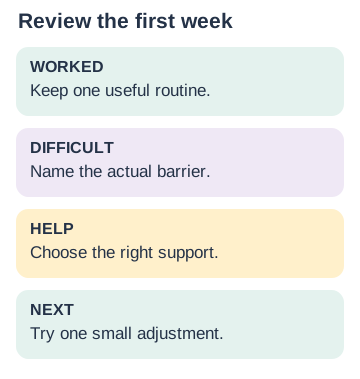
Keep one example of progress, such as finding the task independently or asking a clear question. Also record unresolved issues for the school. Do not judge the whole term from the first few days, and do not dismiss persistent distress or difficulty simply as something the child must get used to.
The printable sheet is a planning aid, not a scorecard for parenting or the learner. Complete the relevant items, leave inapplicable ones out and revise the plan with current school information. The goal is a workable start with a clear route for help.
Our first-week action sheet
Fill this in with the child where appropriate. Keep passwords and sensitive personal information off the sheet. Revisit it after an ordinary school day.
Confirmed attendance date and school source: ____________________
Materials and account access checked: ____________________
One familiar task and support needed: ____________________
First homework action and agreed help route: ____________________
One question for the teacher: ____________________
Review date: ______ Worked: ______ Change next: ______
Save the full guide to keep this record with the explanations. The separate worksheet contains the practice and decision questions; use its answer version to check your reasoning.
5 worked examples with reasoning
1. The new-term date is copied from last year.
- Find the school’s current notice.
- Confirm the attendance day and arrival time.
- Mark the old date as superseded rather than leaving two competing entries.
2. A child cannot access a digital assignment.
- Test the login and approved recovery route.
- Ask the school for help or an authorised alternative.
- Do not interpret the access failure as refusal to learn.
3. A learner hesitates on 24 ÷ 6.
- Ask for an equal-group model.
- Show a similar example if needed.
- Record the reminder and check a fresh suitable task later.
4. A planner contains no room after school travel.
- Write the actual arrival and transition needs.
- Move optional work rather than compressing every activity.
- Review the routine after an ordinary school day.
5. A teacher note says “does not understand reading”.
- Replace the broad claim with an observed task.
- Describe the response and support that helped.
- Ask a specific next-step question.
Save the guide or print the practice
Download to save or share
Complete guide with answers (PDF) · Worksheet without answers (PDF) · Worksheet and answer key (PDF)
Try each situation before reading the suggested response. Give a reason and adapt the decision to the learner and school requirements.
14 practice questions with explanations
Try each situation before reading the suggested response. Give a reason and adapt the decision to the learner and school requirements.
Write an answer and your reason before opening the explanation. Check the reasoning as well as the final answer.
- Calendar
Which source should confirm the first attendance day?
Answer and reasoning
The school’s current communication.
A general or previous-year calendar may be wrong for this child.
- Books
What should be checked before buying a new edition?
Answer and reasoning
The school’s actual required title and edition.
Do not assume every advertised revision book is required.
- Access
What should a device check include?
Answer and reasoning
Opening a real school task and knowing the help route.
A powered-on device alone does not prove access.
- Privacy
Should passwords be written on a shared checklist?
Answer and reasoning
No.
Use an appropriate private account-management method.
- Learning
What does one hesitant answer establish?
Answer and reasoning
Only an observation about that attempt.
It does not determine overall ability.
- Scope
How should a topic not yet taught be labelled?
Answer and reasoning
Not yet studied.
It should not be treated as a failed revision topic.
- Maths
Explain 24 ÷ 6.
Answer and reasoning
Twenty-four can be shared into six equal groups of four, or made into four groups of six.
The interpretation depends on what the question asks.
- Routine
What belongs on the timetable before optional study?
Answer and reasoning
Fixed school, travel and family commitments.
The plan must fit the actual day.
- Start
Name one manageable first homework action.
Answer and reasoning
Open the task list and read one instruction.
A concrete start is easier to act on than “work harder”.
- Help
Should an adult finish unclear homework for the child?
Answer and reasoning
No.
Clarify the task or seek school guidance while preserving learner work.
- Handover
Improve “bad at reading”.
Answer and reasoning
For example: retells events but needs help supporting an inference with a detail.
Describe the task rather than labelling the learner.
- Evidence
What should accompany a claim that a strategy helps?
Answer and reasoning
A specific example of the response with that support.
Keep the level of assistance visible.
- Review
What three questions can guide a first-week review?
Answer and reasoning
What worked, what was difficult and what changes next?
They connect observation with action.
- Purpose
Is this a readiness test?
Answer and reasoning
No.
It is a flexible planning checklist.
Use the ideas without looking at the notes
Confirm school details, test access privately, keep one honest learning sample and agree a manageable first step. Review after real school days. Share specific persistent difficulties through the school’s approved route.
Common questions
Must every box be completed?
No. Use the items relevant to the school and family.
Should we test the entire previous year?
No. A small familiar sample can start a conversation; ask the teacher what needs attention.
Does the 2027 title give a universal return date?
No. Confirm the actual date with the school.
What if the first week is difficult?
Identify the specific barrier, adjust practical arrangements and involve the school for persistent difficulty or distress.
Connect your learning
Ask about one-to-one learning support if your child needs help explaining these ideas.
About this guide
Original explanations, examples, diagrams and practice by BananaLearn. The grade label indicates the intended learning level; this is not an official textbook extract or exam paper.