
Start with the key idea
Build a chapter checklist from your current school syllabus, then record evidence of recall, method and reasoning for each chapter. This guide uses the CBSE 2026–27 Class IX mathematics topic map as a reference and supplies original short checks. It does not replace the full syllabus or establish mastery from one score.
1. Match the checklist to the current syllabus
Write the academic year, board, subject level and textbook edition at the top of your plan. A saved checklist from another year may omit a new topic or include work that your present course treats differently. Chapter numbers alone are a weak match because editions can change their ordering.
The linked CBSE 2026–27 Class IX mathematics document lists number systems; algebra, including sequences and progressions, identities and linear equations; coordinate geometry; plane geometry; mensuration; and statistics and probability. It includes paired linear-equation work and coordinate distance and midpoint work.
Use the official document and your teacher’s chapter list to create the rows, rather than treating the selected questions below as complete chapter coverage. Record the exact chapter title beside each topic family so your revision follows the course you are actually studying.
| Current CBSE chapter | Independent task / next action |
|---|---|
| Number System | Record a dated attempt, difficulty and next step |
| Introduction to Polynomials | Record a dated attempt, difficulty and next step |
| Sequences and Progressions | Record a dated attempt, difficulty and next step |
| Exploring Algebraic Identities | Record a dated attempt, difficulty and next step |
| Linear Equations in Two Variables | Record a dated attempt, difficulty and next step |
| Coordinate Geometry | Record a dated attempt, difficulty and next step |
| Introduction to Euclid’s Geometry: Axioms and Postulates | Record a dated attempt, difficulty and next step |
| Lines and Angles | Record a dated attempt, difficulty and next step |
| Triangles – Congruence Theorems | Record a dated attempt, difficulty and next step |
| 4-gons (Quadrilaterals) | Record a dated attempt, difficulty and next step |
| Circles | Record a dated attempt, difficulty and next step |
| Area and Perimeter | Record a dated attempt, difficulty and next step |
| Surface Area and Volume | Record a dated attempt, difficulty and next step |
| Statistics | Record a dated attempt, difficulty and next step |
| Introduction to Probability | Record a dated attempt, difficulty and next step |
2. Give each chapter three evidence checks
Use three columns: “recall without notes”, “solve independently” and “explain or apply”. A chapter is not secure simply because definitions sound familiar. You might recall an identity but still miss a coefficient when using it in an unfamiliar expression.
For each column, write a short dated example of what you did. “Expanded (2 x + 1)² and checked at x = 1” is more informative than a green tick. Keep a question number or your own example so the evidence can be revisited.
A practical status system is not started, learning, needs another attempt and secure for now. These labels are planning aids, not diagnoses or permanent judgements. Change the status when a fresh attempt supplies new evidence.
3. Check number and algebra with contrasts
Contrast a terminating decimal with a non-terminating repeating decimal and an irrational example. Explain why a fraction of integers with a nonzero denominator is rational. Avoid judging rationality from whether a decimal happens to look long on a calculator display.

For algebra, practise expanding and reversing a pattern. Compare (x + 3)² with x² + 9 and explain the missing mixed term. Test one equation in two variables with an ordered pair, then solve a simple pair of equations to see how a second condition can narrow the possibilities.
Use original examples with manageable numbers first. If arithmetic hides the reasoning, reduce the numbers but keep the mathematical structure. Then return to a harder version so a correct easy answer is not mistaken for complete readiness.
4. Make geometry reasoning visible
On a coordinate grid, name x first and y second, label the scales and verify a plotted point. For points (1, 2) and (5, 2), the distance is four units because only the horizontal coordinate changes. Their midpoint is (3, 2).
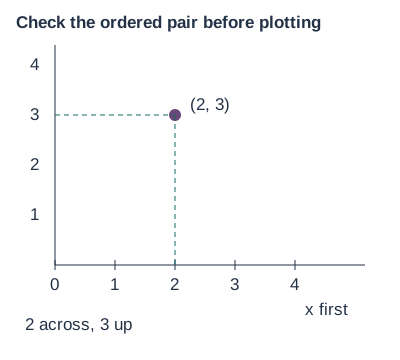
For a proof, list each equality with its reason. Congruence requires a valid condition and consistent correspondence; a shape that merely looks symmetric is not enough. For an angle problem, state the relationship that produces 180° or 360° before calculating.
Separate drawing accuracy from logical support. A sketch can help organise the givens, but a measured-looking angle is not evidence unless measurement is part of the question. Practise explaining why a conclusion survives a differently oriented diagram.
5. Check measurement and data with units and meaning
For mensuration, label what is being measured: an outside boundary, a covered surface or a filled space. A cuboid 5 cm by 4 cm by 3 cm has volume 60 cm³; its surface area is 94 cm². The units keep the two tasks distinct.
For a data set, explain what the mean, median or mode describes rather than only calculating. In 2, 3, 3, 12, the mean is five and the median is three. The high value affects the mean differently from the middle positions.
For probability, define the outcomes and check whether they are equally likely. A fair die has six equally likely faces; two dice do not have equally likely sums. These interpretation checks are useful even when the numerical calculation is short.
6. Turn the checklist into a realistic week
Choose two or three specific gaps rather than scheduling “all algebra” in one sitting. A session can contain a brief recall attempt, one worked comparison, two independent questions and a short error note. Keep enough time to inspect reasoning, not only to finish a page count.
Revisit a missed skill after a gap using a fresh question. If the method now works independently, move the status forward. If the same error returns, choose a simpler representation or ask the teacher to look at the working. Repeating an identical copied solution may hide the difficulty.
Leave a flexible catch-up slot and retain some mixed practice. A chapter-by-chapter plan organises learning, while a mixed set checks whether you can select the method without a chapter heading giving it away. Both kinds of practice provide useful evidence.
5 worked examples with reasoning
1. A student marks identities secure after reading (a + b)². What is a stronger check?
- Give a changed expression such as (2 x + 3)².
- Expand to 4 x² + 12 x + 9 and explain the middle term.
- Check at x = 1: both forms equal 25.
2. Solve x + y = 8 and x − y = 2.
- Add the equations: 2 x = 10, so x = 5.
- Substitute into x + y = 8 to obtain y = 3.
- Check both original equations: 5 + 3 = 8 and 5 − 3 = 2.
3. Find the midpoint of A(1, 2) and B(5, 2).
- The y-coordinate remains 2.
- The halfway x-coordinate is (1 + 5)/2 = 3.
- The midpoint is (3, 2), two units from each endpoint.
4. Find mean and median of 2, 3, 3, 12.
- Mean = 20/4 = 5.
- The two middle values are both 3, so median = 3.
- Explain why one large value lifts the mean without changing the middle values.
5. A learner cannot begin a proof without the model answer. How should the plan respond?
- Mark the proof as needing an independent attempt, rather than complete.
- Start by listing givens and matching vertices; practise one valid condition.
- Return to a fresh diagram and check whether the reasons can be supplied without copying.
Save the guide or print the practice
Download to save or share
Complete guide with answers (PDF) · Worksheet without answers (PDF) · Worksheet and answer key (PDF)
Try each task before opening its answer. Give an example or reason, not only a label.
14 practice questions with explanations
Try each task before opening its answer. Give an example or reason, not only a label.
Write an answer and your reason before opening the explanation. Check the reasoning as well as the final answer.
- Number
Is 0.75 rational? Explain using a fraction.
Answer and reasoning
Yes; 3/4.
It is a ratio of integers with nonzero denominator.
- Number
Is √2 rational?
Answer and reasoning
No.
It cannot be expressed as such a fraction.
- Identity
Expand (x + 4)².
Answer and reasoning
x² + 8 x + 16.
Include the two mixed products.
- Identity
Factorise x² − 25.
Answer and reasoning
(x − 5)(x + 5).
Use the difference of squares.
- Sequence
Continue 4, 7, 10, 13 by two terms.
Answer and reasoning
16, 19.
The constant difference is three.
- Equation
Does (2, 5) satisfy 3 x + y = 11?
Answer and reasoning
Yes.
3 × 2 + 5 = 11.
- Pair
Solve x + y = 6 and x − y = 2.
Answer and reasoning
x = 4, y = 2.
Add to get 2 x = 8, then substitute.
- Coordinates
Find the distance between (1, 4) and (6, 4).
Answer and reasoning
5 units.
Only the horizontal coordinate changes.
- Coordinates
Find the midpoint of (2, 1) and (6, 5).
Answer and reasoning
(4, 3).
Average each coordinate separately.
- Angles
Two triangle angles are 42° and 68°. Find the third.
Answer and reasoning
70°.
180 − 42 − 68.
- Proof
Do three matching angles prove triangles congruent?
Answer and reasoning
No.
They can have different sizes.
- Volume
Find volume of a cuboid 5 cm by 4 cm by 3 cm.
Answer and reasoning
60 cm³.
Multiply the three perpendicular lengths.
- Statistics
Find the median of 1, 4, 5, 8, 12.
Answer and reasoning
5.
It is the middle value in the ordered list.
- Probability
Find P(an odd face) for a fair six-sided die.
Answer and reasoning
1/2.
Three odd faces out of six.
Use the ideas without looking at the notes
For every chapter, record the current syllabus match, a dated independent attempt and the next action. Treat the checklist as evidence for planning, not as a score that defines the learner.
Common questions
Can I use an old chapter checklist?
Compare its titles and scope with the current syllabus first. Do not assume the chapter numbering is unchanged.
Does this page cover every question type?
No. It supplies a planning framework and selected checks, not a complete course.
What counts as secure?
An independent explanation and fresh successful attempts provide better evidence than rereading or copying.
Should I revise one chapter or mix topics?
Use focused practice to repair a gap and mixed practice to check method selection.
What if I have not learned a listed topic yet?
Mark it not studied and follow the school sequence; do not count it as an error.
Connect your learning
Ask about guided Maths learning if your child needs help explaining these ideas.
About this guide
Original explanations, examples, diagrams and practice by BananaLearn. The grade label indicates the intended learning level; this is not an official textbook extract or exam paper.