See the idea
Before you start
Know how to find simple fractions of amounts and convert between percentages and decimals. Identify the reference amount before starting a calculation.
Words used in this guide
- Base amount
- The quantity that counts as 100% in this problem.
- Percentage amount
- The quantity represented by the stated percentage of the base.
- Discount
- An amount taken off a price; it is different from the final price.
Why the method works
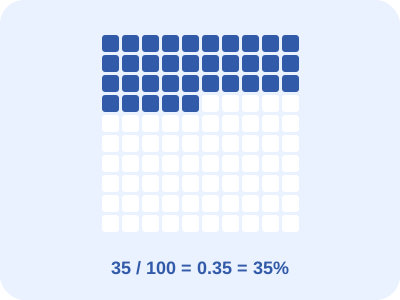
Finding p% of an amount means taking p parts out of every hundred equal parts of that amount. Algebraically, p% of A is (p/100) × A. For mental calculations, build the required percentage from useful parts: 10%, 5%, 1%, 25% or 50%. The base matters. A 20% increase and a later 20% decrease use different bases, so they do not generally cancel.
Use an easy part
10% is one tenth, so 10% of 240 is 24. Then 5% is half of that, or 12. Adding them gives 15% of 240 = 36.
Use multiplication
For any percentage p, calculate p/100 times the amount. For example, 12% of 50 = 12/100 × 50 = 6. Estimate first: 12% is a little more than 10%, so the answer should be a little more than 5.
Distinguish the discount from the new price
A 20% discount on a price of 80 is 16. The new price is 80 − 16 = 64. If a question asks how much is saved, answer 16; if it asks what is paid, answer 64.
Worked examples, step by step
Example 1: Find 15% of 80.
- 10% of 80 is 8. 5% is 4.
- 15% of 80 = 8 + 4 = 12.
Example 2: Find 35% of 240.
- 10% is 24, so 30% is 72. Half of 10% gives 5% = 12.
- 35% = 30% + 5%, so the amount is 72 + 12 = 84.
- Check with 0.35 × 240 = 84.
Example 3: A price of 80 currency units is reduced by 15%. Find the sale price.
- 10% of 80 is 8 and 5% is 4, so the discount is 12.
- Subtract the discount: 80 − 12 = 68 currency units.
- The question asks for the price after the reduction, not only the amount saved.
Example 4: A club grows from 40 members to 50. What is the percentage increase?
- The increase is 10 members. Compare this with the original 40, which is the base.
- 10/40 × 100% = 25%.
- Using 50 as the base would answer a different question. The original amount determines percentage increase.
Common mistakes and how to repair them
“20% means subtract 20.”
20% of 70 is 14, so a 20% discount gives 56. The percentage is a proportion, not a fixed number of currency units.
“Two successive 10% discounts make a 20% discount.”
Starting at 100, the first gives 90 and the second removes 9, leaving 81. The overall discount is 19%.
Check your understanding
Choose an answer for each question. You can check again after reading the explanation.
Worked answers
What is 25% of 60? 15. A quarter of 60 is 15.
A price of 50 has a 10% discount. What is the new price? 45. The discount is 5, so the new price is 45.
Practise independently
Work these out on paper. Include a diagram or a sentence where the question asks you to explain. Open each solution after making an attempt.
3. Find 18% of 150.
Show the reasoning
10% is 15 and 8% is 12, giving 27. Equivalently, 0.18 × 150 = 27.
4. Find 12.5% of 64.
Show the reasoning
12.5% = 1/8, so 64 ÷ 8 = 8.
5. A price of 120 is increased by 5%. Find the new price.
Show the reasoning
5% of 120 is 6; the new price is 126.
6. A group has 24 learners and 25% are absent. How many attend?
Show the reasoning
Six are absent because 24 ÷ 4 = 6. Therefore 18 attend.
If a method still feels uncertain, revisit the closest worked example, then try a fresh problem. A correct answer copied from a solution tells you less than an explanation you can give independently.
Learn it → Try it → Explain it
Take your next practice break
Explore the practice arcade and choose a game whose topic you recognise. Keep using the questions in this guide to practise this specific skill.
Explore the practice arcade →Free guest play has question, level and time limits. Sign in to continue or save progress. A game score is not a mastery assessment.
Questions students and parents ask
Can I find 1% first?
Yes. Divide by 100, then multiply by the required percentage number. It works for any percentage, although another method may be quicker.
Can the answer be larger than the starting amount?
Yes, for percentages above 100. For example, 150% of 20 is 30.
Why did my answer use the wrong units?
The percentage has no physical unit, but the amount does. A percentage of a length is a length; a percentage of a price is a price.
Help at home: Separate “saved” from “paid”
Invent a price of 60 and a discount of 25%. Ask for a sketch of four equal parts, the discount amount, and then the final price.
If your child answers 15 when asked what to pay, the percentage calculation may be correct; revisit the wording rather than reteaching division.
Give a new amount and ask for an estimate first. Ask “What counts as 100% here?” before every increase or decrease problem.
Keep the conversation focused on the reasoning you can hear or see. One short activity cannot establish lasting mastery or diagnose a learning difficulty.
Would a teacher help with the next step?
Bring one example your child found difficult to a free 50-minute session. Tell us their grade, curriculum and time zone when you enquire.
Request a free session