
Start with the key idea
Choose one taught topic, attempt a question without copying the method, then check and explain any error. Use the result to choose the next activity. Rereading can clarify a gap, but include a fresh attempt so you can see what your child can now do.
Choose something the learner should be able to do
“Revise Maths” is difficult to finish and difficult to check. “Solve a two-step equation and verify the answer” describes an observable task. Ask your child to use the current school topic list and teacher guidance; revision should match what has actually been taught and what the assessment expects.
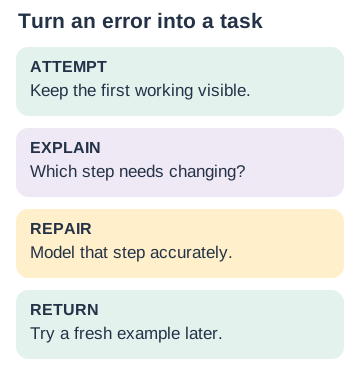
Keep this conversation collaborative. A parent can help find materials, listen to an explanation and check against an answer without pretending to know every subject. If the method or marking requirement is uncertain, record a question for the teacher. Do not create a new marking rule from an internet example.
For a child who needs first teaching, return to a suitable explanation. An unsuccessful attempt at unfamiliar work does not show that a revision method has failed. Our remembering guide covers revisiting learning more generally; this page focuses on using errors to plan a revision session.
Worked Maths example: an error that tells you what to practise
Task: solve 3x + 5 = 20.
Incorrect attempt: 3x = 20 + 5, so x = 25/3.
Repair: subtract 5 from both sides: 3x + 5 − 5 = 20 − 5, so 3x = 15. Divide both sides by 3: x = 5.
Check: 3 × 5 + 5 = 20. The answer satisfies the original equation.
The issue is the operation used to keep the equation balanced. Writing “careless mistake” would not tell the learner what to change. A useful note is: “When removing +5, subtract 5 from both sides; then check by substitution.”
Fresh attempt: solve 4y + 3 = 19. Subtract 3 from both sides to get 4y = 16, so y = 4. The check is 4 × 4 + 3 = 19. Cover this solution before trying. If the balance idea still needs teaching, use the one-step-equations foundation guide if it matches the learner’s course.
English example: improve evidence, not answer length
Amal reached the bus stop and opened her bag. She checked the small pocket twice, then ran back towards the house. Her bus pass was still on the kitchen table.
Question: why did Amal return to the house? A supported answer is that she needed to collect the bus pass she had left on the table. “She hates buses” is not supported. “She went home because it was raining” introduces information that is absent from the passage.
If a learner gives an unsupported reason, ask them to underline the detail that answers the question. The next task should practise linking a claim to evidence, not simply writing a longer paragraph. This is an original short practice passage; an actual exam may require a different response length or marking structure.
For another attempt, use the book-swap story and explained questions. Choose an inference question, answer it first and then compare the evidence. Familiarity with the previous answer alone is not evidence of transfer.
Sort the error into a next action
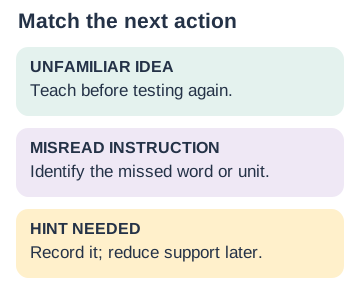
| What happened | Next action |
|---|---|
| The idea was unfamiliar. | Use teaching or a worked explanation before more independent questions. |
| The idea was understood but a step was forgotten. | Explain the step, practise it and revisit a new example later. |
| The question was misread. | Identify the exact instruction or unit that was missed. |
| The answer lacked evidence. | Find a relevant detail and explain how it supports the answer. |
| The answer worked but only with hints. | Record the support and attempt a similar task with less help. |
A single error can have several causes. Ask the learner what they were thinking rather than assigning a category from the mark alone. Keep the original attempt visible beside the correction so the change is clear.
Finish with a manageable next session
Choose one or two mistakes worth revisiting, not every error ever made. Write a precise next task and put it in the revision timetable. A later question should be similar enough to practise the idea but different enough that the learner cannot simply repeat the correction.
Keep answer keys out of view during an independent attempt, then use them for feedback. Where a school task allows notes or particular tools, practise under those conditions too. Explain when an activity is a learning exercise and when it is a timed assessment rehearsal.
Stop if the learner is repeatedly guessing without understanding. More of the same question is unlikely to clarify a missing explanation. Bring the actual attempt and corrected example to the teacher so the next conversation can focus on the obstacle.
Further reading: Milton Keynes City Council: supporting revision. The scenarios, examples and resources here are original BananaLearn materials.
Revision: error to next action
Record a small number of useful errors. Keep the original attempt and use a new question to check the repair.
A completed example
Task / attempt: 3x + 5 = 20; rewrote 3x + 5 = 20 as 3x = 20 + 5
What went wrong: Used the wrong inverse operation
Repair to explain: Subtract 5 from both sides, then divide by 3
New attempt: 4y + 3 = 19 gives y = 4
Opens a separate sheet with the completed example and writing space. Save it as a PDF or print it using your browser. No account is required.
5 worked examples with reasoning
1. Repair the invalid step 3x + 5 = 20 → 3x = 20 + 5.
- Subtract 5 from both sides to get 3x = 15.
- Divide both sides by 3 to get x = 5.
- Check: 3 × 5 + 5 = 20.
2. Try a fresh equation 4y + 3 = 19.
- Subtract 3 to obtain 4y = 16.
- Divide by 4: y = 4.
- Check in the original equation before comparing answers.
3. An inference answer says Amal hates buses.
- The passage gives no evidence for that preference.
- Locate the bus pass left on the kitchen table.
- Use that detail to explain why she returned home.
4. A pupil copies a correct worked solution.
- Copying can help follow a model, but does not show independent use.
- Cover it and attempt a suitably similar new task.
- Record whether the learner needs a hint.
5. A planned topic has never been taught.
- Label it as needing teaching.
- Use a suitable explanation or seek help.
- Do not treat repeated unsuccessful guessing as revision.
Save the guide or print the practice
Download to save or share
Complete guide with answers (PDF) · Worksheet without answers (PDF) · Worksheet and answer key (PDF)
These are practice decisions for parents and learners, not an assessment or diagnosis. Compare the suggested response with the explanation and adapt it to the actual task.
14 practice questions with explanations
These are practice decisions for parents and learners, not an assessment or diagnosis. Compare the suggested response with the explanation and adapt it to the actual task.
Write an answer and your reason before opening the explanation. Check the reasoning as well as the final answer.
Read this passage before the related questions
Amal reached the bus stop and opened her bag. She checked the small pocket twice, then ran back towards the house. Her bus pass was still on the kitchen table.
- Calculate
Solve 2a + 4 = 14.
Answer and reasoning
a = 5.
Subtract 4, then divide 10 by 2; check 2 × 5 + 4 = 14.
- Check
Does x = 5 satisfy 3x + 5 = 20?
Answer and reasoning
Yes.
Substitution gives 15 + 5 = 20.
- Repair
What is wrong with removing +5 by adding 5?
Answer and reasoning
It does not undo the addition.
Use subtraction on both sides.
- Evidence
What supports Amal returning home?
Answer and reasoning
Her bus pass was still on the kitchen table.
That is relevant evidence in the passage.
- Evidence
Is “It was raining” supported in Amal’s passage?
Answer and reasoning
No.
The passage gives no weather information.
- Plan
Improve the task label “Revise Maths”.
Answer and reasoning
Solve a two-step equation and check by substitution.
A task should have an observable outcome.
- Support
How should a correct answer after two hints be recorded?
Answer and reasoning
Correct with support.
Do not count it as an independent response.
- Reread
Is rereading always useless?
Answer and reasoning
No.
It can clarify information; add an attempt or explanation to check use.
- Unknown
What if you are unsure whether the marking scheme accepts an answer?
Answer and reasoning
Record the question for the teacher.
Do not invent an examination rule.
- Follow-up
Should the next question be exactly the same as the corrected one?
Answer and reasoning
Use a new but related example.
This helps distinguish understanding from repeating the answer.
- Overload
Must every error become today’s task?
Answer and reasoning
No.
Choose a manageable number worth revisiting.
- Reason
Why keep the original wrong attempt?
Answer and reasoning
It shows the step that changed.
The correction is easier to explain beside it.
- Timing
Does one successful session prove lasting recall?
Answer and reasoning
No.
A later fresh attempt gives additional evidence.
- Write
Create an error-to-action note for a missed unit.
Answer and reasoning
For example: I calculated centimetres but wrote metres; label the quantity and convert before answering.
Name the specific repair rather than writing be careful.
Use the ideas without looking at the notes
Use this record for one real task: What happened? What help was offered? What could the learner then do? What new example will we use next? Record support honestly and choose one next step.
Common questions
Is rereading notes a waste of time?
No. It can help you find or clarify information. Follow it with a suitable attempt or explanation so you can see whether the learner can use the idea.
Should parents mark everything?
Use reliable answers and the teacher’s guidance where available. If you are unsure, flag the question rather than inventing a marking scheme. The learner should take part in checking.
How many questions should we do?
Choose enough to inspect the specific skill without extending work aimlessly. A few explained attempts can reveal a gap; the appropriate amount depends on the task and the learner.
Connect your learning
Ask about one-to-one learning support if your child needs help explaining these ideas.
About this guide
Original explanations, examples, diagrams and practice by BananaLearn. The grade label indicates the intended learning level; this is not an official textbook extract or exam paper.