
Start with the key idea
Status checked 28 October 2026: a confirmed Class 10 subject-by-subject 2027 timetable was not located in the official CBSE listings reviewed for this guide. No 2027 exam dates are asserted here. Use the official links below for updates and the relative revision planner to prepare now. School instructions and the latest official notice take precedence.
1. Separate confirmed information from a prediction
Use CBSE’s official examination-circular page to check a date sheet. Confirm that the document concerns Class 10, the correct examination year and the relevant examination session. A previous year’s schedule or another class’s notice cannot establish your dates.
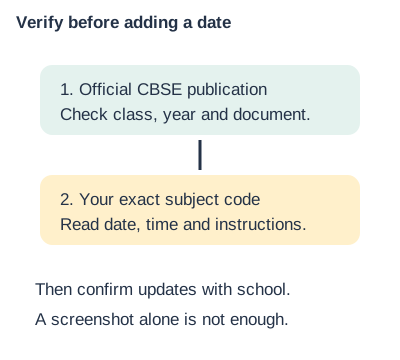
The status above reports what was found during the stated check, not a promise that no later document exists. Check the current official listing again before making travel or study commitments. When a schedule appears, retain its publication or revision date alongside your saved copy.
Do not fill a timetable with dates inferred from last year, a coaching-site countdown or an unattributed social image. Early planning can be useful without pretending to know the schedule. This page intentionally provides a plan based on weeks and topics until verified dates are available.
2. Build a subject record before a calendar
List the subjects and exact subject codes registered through the school. Ask the school to resolve any uncertainty rather than choosing a similarly named subject from a timetable. Record the prescribed curriculum and current sample-paper source for each subject.
The official 2026–27 curriculum and Class 10 sample-paper pages are linked below. Use their documents to check scope and question format. A sample paper is practice material, not a list of guaranteed board questions or proof of the final timetable.
For each subject, keep three separate fields: topics assigned, evidence from independent work and next revision task. This prevents the planner becoming only a list of chapter names. If the school has not finished a topic, record it as pending teaching instead of silently treating it as mastered.
3. Prioritise from evidence rather than fear
Try a short mixed set or a recent school task without help. Classify difficulties as missing knowledge, choosing a method, calculation or writing, and time management. A low result can have several causes; the next action should address the actual one.
For example, a learner who knows a science concept but labels a diagram unclearly needs a label-and-explanation task. A learner who cannot choose a formula needs model selection practice. Giving both learners the same extra chapter to reread may waste effort.
Choose a manageable number of priorities for one week. Keep secure topics in brief spaced review while reserving longer blocks for the gaps. An anxious feeling is worth discussing, but it is not by itself a reliable ranking of which chapter needs the most study time.
4. Plan useful blocks and leave a buffer
A sample forty-minute block can contain five minutes of recall, twenty-five minutes of active practice and ten minutes of checking. Adapt the length to the learner and school workload. The important feature is producing and reviewing work, not completing a fixed number of minutes.
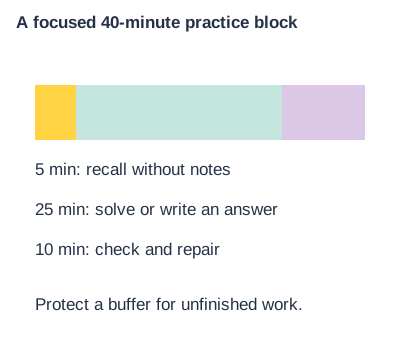
Suppose six such blocks are available in a week. That is 240 minutes. Assign four to priority topics, one to mixed retrieval and one as a buffer or catch-up block. Do not fill every minute with new learning and then treat an unfinished task as a failed plan.
Write the output beside each block: solve four varied equations, label and explain one circuit or write and improve one paragraph. “Do Maths” is too vague to check. End with one specific correction to revisit, and leave realistic space for rest and existing commitments.
| Block | Specific output | Evidence and next action |
|---|---|---|
| Priority 1 | Write a manageable task here | Record the independent result and next step |
| Priority 2 | Write a manageable task here | Record the independent result and next step |
| Priority 3 | Write a manageable task here | Record the independent result and next step |
| Priority 4 | Write a manageable task here | Record the independent result and next step |
| Mixed recall | Write a manageable task here | Record the independent result and next step |
| Buffer / catch-up | Write a manageable task here | Record the independent result and next step |
5. Add official dates when they are verified
Once a date sheet is confirmed, transfer each of your registered subjects carefully. Check the subject code, date, start time and document instructions. Ask the school about reporting arrangements and any details that cannot be established from the public document.
Work backwards from each confirmed exam. Put an early mixed check far enough ahead to repair gaps, then reserve the final period for review rather than starting unfamiliar material. Keep later subjects active during the earlier exam period with shorter blocks where practical.
If a revised notice appears, update the calendar and identify which study blocks are affected. Do not assume a change to one subject shifts all the others. Preserve the latest source link and verification date so a parent and learner are working from the same information.
6. Review learning, not only completed hours
At the end of a week, compare the planned output with actual independent work. A completed block counts as time spent, but successful recall or improved reasoning supplies the learning evidence. Record both honestly.
A useful error log has the question type, the original mistake, the reason, the corrected method and a fresh attempt date. Avoid copying a whole answer key into it. A short explanation such as “used the new price as the percentage base” is easier to act on than several pages of rewritten work.
If the plan repeatedly overruns, reduce or split the tasks and check whether teaching help is needed. The goal is a sustainable routine with visible next steps. The worksheet below tests planning decisions and includes a weekly record; it is not a prediction of marks or examination questions.
5 worked examples with reasoning
1. You have six forty-minute study blocks this week. Reserve one for a buffer. How much planned subject-practice time remains?
- Total time is 6 × 40 = 240 minutes.
- One forty-minute buffer leaves 200 minutes for the other five blocks.
- Keep the buffer genuinely available rather than counting it twice.
2. A learner gets eight of ten questions right but repeats the same fraction error twice. What should happen next?
- Identify the common misconception in the two errors.
- Use a fraction model and a fresh related question.
- The total score alone does not identify the next teaching step.
3. A forwarded schedule omits the year and subject codes. Should it be entered as confirmed?
- No: the document cannot yet be matched to the learner’s examination.
- Locate the official CBSE notice and confirm the relevant details.
- Until then, keep the planner relative to weeks rather than invented dates.
4. A planned forty-minute task takes seventy minutes. How should next week change?
- Check whether the task was too large or a prerequisite was missing.
- Split the task into smaller outputs and protect a buffer.
- Do not automatically remove rest or add thirty minutes to every day.
5. An official revision notice changes one registered subject’s date. What should you update?
- Verify the revised notice and that exact subject code.
- Change the affected calendar entry and associated revision blocks.
- Check other entries individually; do not assume all dates moved.
Save the guide or print the practice
Download to save or share
Complete guide with answers (PDF) · Worksheet without answers (PDF) · Worksheet and answer key (PDF)
Try each task before opening its answer. Give an example or reason, not only a label.
14 practice questions with explanations
Try each task before opening its answer. Give an example or reason, not only a label.
Write an answer and your reason before opening the explanation. Check the reasoning as well as the final answer.
- Source
A 2026 timetable appears in a search for 2027. Does it confirm 2027 dates?
Answer and reasoning
No.
The examination year must match.
- Source
A screenshot shows dates but no source. What is the next step?
Answer and reasoning
Find and verify the official CBSE document.
An unattributed screenshot is not enough.
- Match
Which school-held information helps distinguish similarly named subjects?
Answer and reasoning
The registered subject code.
Match the code as well as the name.
- Update
Should a saved date sheet be checked for later revision notices?
Answer and reasoning
Yes.
The latest applicable official instructions take precedence.
- Minutes
Five study blocks last forty minutes each. Find the total time.
Answer and reasoning
200 minutes.
5 × 40.
- Buffer
Of six forty-minute blocks, one is reserved as a buffer. How many minutes remain assigned to the other blocks?
Answer and reasoning
200 minutes.
240 − 40.
- Output
Improve the task “revise science”.
Answer and reasoning
For example: draw a circuit, label its components and explain the meter connections.
A concrete output can be checked.
- Evidence
Does reading a solved answer prove independent recall?
Answer and reasoning
No.
Try a fresh question without the answer visible.
- Gap
A learner repeatedly chooses the wrong formula but calculates correctly. What should practice target?
Answer and reasoning
Recognising the model and quantities.
More arithmetic alone misses the difficulty.
- Scope
Does a sample paper guarantee the exact questions in the board exam?
Answer and reasoning
No.
It supports practice with the published format.
- Sequence
A topic has not been taught yet. How should the planner label it?
Answer and reasoning
Pending teaching or not studied.
Do not treat it as a demonstrated failure.
- Repair
What should an error log record besides the correct answer?
Answer and reasoning
The reason for the error and a fresh attempt.
Correction should support a transferable method.
- Change
A notice changes one subject date. Must every other date change?
Answer and reasoning
No.
Check each relevant entry against the notice.
- Review
What should you compare at the weekly review?
Answer and reasoning
Planned outputs, completed work, independent evidence and next actions.
Hours alone do not show what was learned.
Use the ideas without looking at the notes
Weekly record: subject and code; specific task; planned block; completed evidence; error to repair; next attempt. Date-sheet record: official URL; document date; last checked; confirmed subjects and times.
Common questions
Are the 2027 dates confirmed on this page?
No. A confirmed Class 10 subject timetable was not located in the official listings reviewed on 28 October 2026; check the latest official notices.
Can I start revision before the date sheet?
Yes. Use a relative weekly plan with concrete tasks and buffers.
Where should timetable changes be checked?
Use CBSE’s official examination notices and confirm applicable instructions with the school.
Does this page predict exam questions?
No. It provides original planning guidance and links to official curriculum and sample-paper sources.
Is forty minutes the required study length?
No. It is an example block; adapt it to the learner, tasks and school commitments.
Connect your learning
Ask about subject tutoring if your child needs help understanding a topic.
About this guide
Original explanations, examples, diagrams and practice by BananaLearn. The grade label indicates the intended learning level; this is not an official textbook extract or exam paper.