
Start with the key idea
Use the school’s confirmed calendar, then add family commitments, rest and a small selection of learning activities. Keep tentative dates visibly unconfirmed. This page is a planning template, not an official 2027 holiday list or a promise that all Indian schools close on the same dates.
1. Build the calendar from school information
Start with the school’s published academic calendar or a direct confirmation from the school office. Record term breaks, reopening dates and any school-specific attendance instructions. Indian schools can differ by state, board, location and institution; do not assume one nationwide vacation schedule.
For each date, record the source, when you checked it and whether it is confirmed or tentative. If the 2027 calendar has not been announced, leave the relevant dates blank or clearly marked pending. A previous-year pattern can suggest a question to ask, but should not be presented as a confirmed future date.
Distinguish public observances, bank holidays and school closures. They are different categories of information. Even a familiar annual occasion does not by itself establish the school’s attendance arrangements, celebration timing or length of the surrounding break.
2. Add fixed commitments before optional activities
Write travel, family visits, appointments and any required school work before planning optional learning. Include preparation and recovery time where the family needs it. A travel day should not automatically carry the same task load as an ordinary day at home.

Keep responsibilities visible without expecting the child to manage adult logistics. Adults confirm bookings, transport and supervision. The learner can help choose activities and gather suitable reading or practice materials, but should not be responsible for resolving uncertain official dates.
Use a simple status column: fixed, optional or awaiting confirmation. This helps the family change a plan without losing track of what truly must happen. Do not fill every blank square simply because the planner has space.
3. Choose a small menu of learning activities
Select activities that fit a real purpose: read and discuss a story, practise a known maths idea, prepare a school project or explore a question. Keep required school assignments distinct from optional ideas so the learner knows what is expected and what can be chosen.
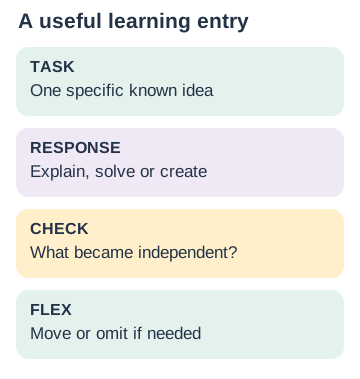
For example, a maths option could be planning a short journey’s elapsed time. A reading option could be explaining why a character changed a plan. A writing option could be drafting a short paragraph with a clear main idea. These activities need not become a full school day at home.
If the child has a specific learning difficulty in current work, ask the teacher which small prerequisite to practise. Avoid choosing a whole new grade’s syllabus merely because the holiday seems long. New content needs teaching; repeated worksheets are not a substitute for explanation.
4. Use a flexible three-day example
Imagine a family has three ordinary days at home between commitments. On Day A, the child reads a chosen passage and discusses one supported inference. On Day B, they try a familiar maths task and explain a check. On Day C, they choose either a short writing activity or a return to a question that remained unclear.
This is a sample structure, not a required three-day programme. Each activity can be adjusted or omitted according to school work, age, access and family circumstances. The useful feature is that every chosen activity has a clear purpose and stopping point.
A completion note should describe what happened: “Explained the character’s reason using a sentence from the story” or “Needed a reminder to align decimal places”. A tick alone does not show what was learned. Do not turn the record into a public ranking or a judgement of the family’s holiday.
5. Plan for changes without doubling the workload
If a visit moves or a child is unwell, update the calendar and choose what remains useful. Optional tasks can be dropped. Required school work may need a revised plan or a conversation with the teacher if the available time is no longer realistic.
Avoid automatically moving every missed activity to the next day. That can create a growing backlog unrelated to the learning goal. Ask which one task has the clearest purpose and whether support is needed to complete it. Keep rest and family commitments in the revised plan.
Use a short weekly or occasional review: what was enjoyable, what became clearer and what should change? The review itself should be manageable. A plan is useful when it helps decisions; it should not become another demanding assignment.
6. Prepare the return without rushing the final evening
Before school resumes, confirm the reopening date and practical arrangements again. Check required work, books, login access and any notices received during the break. Resolve missing information with the school rather than relying on a forwarded message whose source is unclear.
Keep one example of learning and one question to carry forward. If the child found a topic difficult, share the original attempt and the support tried. A teacher can use that evidence more readily than a claim that the holiday revision was either perfect or a disaster.
The printable planner is deliberately adaptable. Use actual dates once confirmed, choose the relevant tasks and leave space for changes. It supports family organisation and learning conversations; it is not an official calendar, medical routine or guaranteed academic-improvement programme.
Our dated holiday planning sheet
Repeat the date line for each relevant day on a blank calendar. Do not fill unannounced dates from guesswork. Keep required work separate from optional choices.
School break: ______ Reopening: ______ Source/date checked: ______
Date: ______ Fixed commitment: ______ Status: confirmed / pending
Required school task and deadline: ____________________
Optional learning choice and stopping point: ____________________
Rest or flexible space we are protecting: ____________________
If plans change, we will move or omit: ____________________
Return-to-school checks and date: ____________________
Save the full guide to keep this record with the explanations. The separate worksheet contains the practice and decision questions; use its answer version to check your reasoning.
5 worked examples with reasoning
1. A 2026 calendar is the only document available.
- Use it only to identify what to ask the school.
- Mark 2027 dates pending.
- Do not present last year’s dates as confirmed future closures.
2. A travel day already contains several commitments.
- Keep the required logistics visible.
- Move or omit optional study.
- Choose a light accessible activity only if it fits the day.
3. A planner says “do maths”.
- Name a specific known task, such as explaining decimal addition.
- Add a way to check it with a fresh example.
- Give it a realistic stopping point.
4. Two optional activities were missed.
- Review whether both still serve a purpose.
- Keep the most useful one or omit them.
- Do not automatically double tomorrow’s work.
5. The school reopens soon and a task is incomplete.
- Check the actual requirement and remaining work.
- Make a manageable plan or contact the teacher if needed.
- Keep the learner’s work their own rather than completing it for them.
Save the guide or print the practice
Download to save or share
Complete guide with answers (PDF) · Worksheet without answers (PDF) · Worksheet and answer key (PDF)
Try each situation before reading the suggested response. Give a reason and adapt the decision to the learner and school requirements.
14 practice questions with explanations
Try each situation before reading the suggested response. Give a reason and adapt the decision to the learner and school requirements.
Write an answer and your reason before opening the explanation. Check the reasoning as well as the final answer.
- Source
What should establish the school’s holiday dates?
Answer and reasoning
The school’s current confirmed calendar or instruction.
A general list may not match the institution.
- Status
How should an unannounced 2027 break be recorded?
Answer and reasoning
Pending or unconfirmed.
Do not convert a guess into a date claim.
- Category
Are bank holidays automatically school closures?
Answer and reasoning
No.
The categories have different purposes.
- Record
What should be kept beside a date?
Answer and reasoning
Source, date checked and confirmation status.
This makes later changes easier to verify.
- Priority
What goes into the planner before optional study?
Answer and reasoning
Fixed family commitments and required school work.
The learning plan must fit the real calendar.
- Ownership
Who confirms travel bookings and official arrangements?
Answer and reasoning
The responsible adults.
Children can participate without carrying adult logistics.
- Task
Improve “read more”.
Answer and reasoning
For example: read a chosen passage and explain one character’s decision with evidence.
A specific response gives the activity a purpose.
- Task
Improve “revise maths”.
Answer and reasoning
For example: solve one known problem, explain the method and try a fresh version.
The plan includes a learning check.
- Evidence
What does a tick alone fail to show?
Answer and reasoning
What was understood and how much help was used.
Completion and independent learning differ.
- Change
Must every missed optional task be carried forward?
Answer and reasoning
No.
Choose what remains useful and manageable.
- Scope
Should an entire new grade be assigned automatically?
Answer and reasoning
No.
New content needs appropriate teaching and a reason for selection.
- Privacy
Must a child’s work be posted publicly?
Answer and reasoning
No.
The planner can remain a private family resource.
- Return
Name two practical checks before reopening.
Answer and reasoning
For example, attendance date and access to required materials.
Resolve uncertainty before the final evening.
- Review
What can a useful holiday review record?
Answer and reasoning
One idea that became clearer and one next question.
This supports continuity without ranking the holiday.
Use the ideas without looking at the notes
Confirm school dates and record their sources. Add fixed commitments, distinguish required from optional work and choose specific learning tasks. Leave space for change and recheck reopening arrangements.
Common questions
Where is the official 2027 date list on this page?
This page does not provide one. Use the school’s confirmed calendar and relevant official notices.
Should every day include formal study?
This guide does not prescribe that. Choose a manageable plan around school requirements and family life.
Can we use the template outside India?
The planning method is adaptable, but use the actual local school calendar and requirements.
What if the school changes a date?
Update the source and status, then revise commitments and optional activities accordingly.
Connect your learning
Ask about one-to-one learning support if your child needs help explaining these ideas.
About this guide
Original explanations, examples, diagrams and practice by BananaLearn. The grade label indicates the intended learning level; this is not an official textbook extract or exam paper.