
Start with the key idea
A useful science diagram communicates a structure, a path or a relationship. Practise drawing the key parts from memory, label them precisely and explain what the diagram shows. This revision guide includes original circuit and lens models plus checks for biological and chemical representations; it is not a prediction of exam questions.
1. Decide what the diagram must explain
Read the command before drawing. “Label”, “complete”, “show the direction” and “explain using a diagram” ask for different evidence. A picture that is attractive but lacks the required labels or arrows may not communicate the intended answer.
Start with a simple structure large enough to label clearly. Use a ruler for circuit wires, optical axes and straight label lines. Keep labels outside crowded shapes, and make each line end at the exact part rather than at a vague nearby region.
After drawing, write one sentence explaining the relationship shown. For a lens, describe the image position and nature; for a circuit, describe how the instrument is connected. This makes revision about understanding rather than copying outlines.
2. Trace the circuit before naming the instruments
An ammeter measures current through a path and is placed in series in that path. A voltmeter measures potential difference between two points and is connected across the component. In the model here, it connects to the two ends of the resistor.
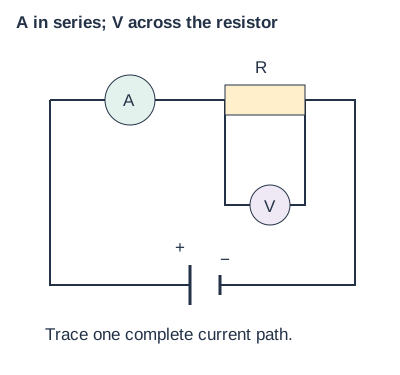
Follow the main loop from the positive terminal of the cell through the ammeter and resistor and back to the negative terminal. Check that every intended wire joins the component terminal. A near miss in a drawing can accidentally represent an open circuit.
Conventional current direction in the external circuit is from positive to negative; electron movement in a metal is opposite. These are different conventions, so an arrow needs a label. This is a paper-diagram exercise, not an instruction to experiment with household mains electricity.
3. Build a ray diagram from two valid rays
Draw the principal axis, lens, optical centre and focal points first. For a convex lens in the thin-lens school model, a ray parallel to the axis refracts through the far focus. A ray through the optical centre continues approximately straight.
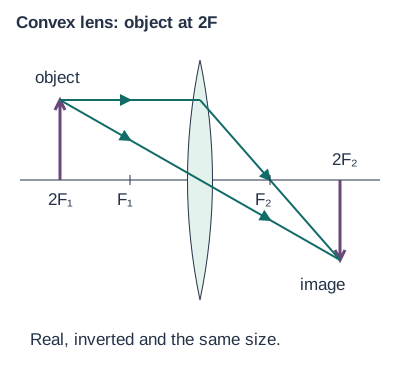
For an object at twice the focal distance, these rays meet at twice the focal distance on the other side. The image is real, inverted and the same size. Its arrow should be below the axis when the object arrow points above it.
Put arrowheads in the direction light travels. Dashed backward extensions are used to locate a virtual image; they are not actual light rays travelling backwards. Never move the image arrow to where you remember it belongs if the drawn rays do not support that location.
4. Link biological labels to their functions
When revising a neuron, identify the cell body, dendrites, axon and terminal branches. In the usual simplified school model, information is received towards the dendrites and cell body, conducted along the axon and passed on at its terminals. Keep that functional path distinct from a decorative outline.
For a stomatal diagram, distinguish the pore from the guard cells around it. The pore is an opening, not a cell. Changes in guard-cell turgor alter the opening; merely memorising two curved shapes misses the function the diagram is meant to show.
For organ-system diagrams, choose the level of detail required by the question. A flow diagram of a pathway is not a substitute for an anatomical drawing when named structures are requested. Conversely, extra anatomical detail may hide a simple required direction of flow.
5. Count particles and bonds in chemical representations
In a simple covalent-bond diagram, first count the relevant valence electrons and identify the shared pairs. For methane, carbon forms four single covalent bonds with four hydrogen atoms. Every line in the usual structural formula represents a shared pair of electrons.
Do not confuse the electron-dot representation with a scale drawing of atomic distances. Its purpose is to show bonding electrons. A molecular formula, structural formula and electron-dot diagram communicate related information in different formats.
When revising an apparatus diagram, label the substances, containers and any direction of gas flow that the question requires. Check whether a delivery tube actually connects the named vessels. Copying a familiar arrangement without considering the experimental purpose can introduce an incorrect connection.
6. Use a draw–check–explain cycle
Cover the model and draw from memory. Compare it against a short checklist: correct structure, correct connections, accurate labels, meaningful arrows and one explanatory sentence. Mark the specific omission instead of giving yourself only a general “good” or “bad” score.
Try a changed case next. After a convex-lens diagram for an object at twice the focal distance, predict what changes when the object is moved farther away. After a circuit diagram, explain what changes if the voltmeter is incorrectly placed in series. Transfer reveals whether the pattern is understood.
Use your current school topic list and official syllabus for scope. The linked CBSE 2026–27 document distinguishes curriculum and assessment details; this selected skills guide does not label every pictured topic a guaranteed examination question. Confirm any exclusions or later changes with the school.
5 worked examples with reasoning
1. A diagram places both A and V in series with a resistor. What should be repaired?
- Keep the ammeter in the series path.
- Reconnect the voltmeter to the two ends of the resistor.
- Explain: it compares the potential at those two points.
2. A convex-lens object is at 2 F. Describe and locate its image.
- Use a parallel ray refracting through the far focus and a central ray.
- Their intersection lies at 2 F on the opposite side.
- The image is real, inverted and equal in size.
3. A student draws light rays towards the object from the image. What is unclear?
- The ray arrows contradict the intended direction of travel.
- For this setup, arrows should run from the object towards and through the lens.
- Backward dashed extensions, when needed for virtual images, should be distinguished from actual rays.
4. A label “stoma” points to one guard cell. How should it be corrected?
- The stoma refers to the pore or opening.
- Point the pore label to the space between the guard cells.
- Label the guard cells separately and explain their role in changing the opening.
5. A methane structural diagram shows carbon bonded to only three hydrogens. What is missing?
- Methane has molecular formula CH₄.
- Draw four C–H single bonds, one to each hydrogen.
- Each single bond represents one shared electron pair.
Save the guide or print the practice
Download to save or share
Complete guide with answers (PDF) · Worksheet without answers (PDF) · Worksheet and answer key (PDF)
Try each task before opening its answer. Give an example or reason, not only a label.
14 practice questions with explanations
Try each task before opening its answer. Give an example or reason, not only a label.
Write an answer and your reason before opening the explanation. Check the reasoning as well as the final answer.
- Circuit
Should an ammeter be in series or parallel with the measured current path?
Answer and reasoning
Series.
The current to be measured passes through it.
- Circuit
Where should a voltmeter connect when measuring a resistor’s potential difference?
Answer and reasoning
Across its two ends.
It compares the potentials of those points.
- Circuit
What can a small gap in a wire represent?
Answer and reasoning
An open circuit.
The intended continuous path is broken.
- Direction
What is conventional current direction in the external circuit?
Answer and reasoning
From positive to negative.
This convention differs from electron movement in a metal.
- Lens
What happens to a ray parallel to the axis through a convex lens in the school model?
Answer and reasoning
It refracts through the far principal focus.
Use this ray rule to locate an image.
- Lens
What happens to a ray through the optical centre of a thin lens?
Answer and reasoning
It continues approximately straight.
This is the central-ray approximation used in school diagrams.
- Lens
An object is at 2 F of a convex lens. State image position.
Answer and reasoning
At 2 F on the other side.
Two valid rays intersect there.
- Lens
An upright object is at 2F of a convex lens. State the image orientation and relative size.
Answer and reasoning
Inverted and equal-sized.
The image arrow is below the axis for an upright object arrow.
- Representation
What do dashed backward ray extensions represent?
Answer and reasoning
Construction lines used to locate a virtual image.
They do not show light travelling backwards.
- Biology
Is the stomatal pore itself a guard cell?
Answer and reasoning
No.
It is the opening between guard cells.
- Biology
Name the long conducting part of a neuron.
Answer and reasoning
The axon.
It carries the signal away from the cell body in the simplified model.
- Chemistry
How many C–H single bonds does methane have?
Answer and reasoning
Four.
Its formula is CH₄.
- Chemistry
What does one line in a simple covalent structural formula represent?
Answer and reasoning
One shared electron pair.
It denotes a single covalent bond.
- Revision
Why redraw a diagram without looking at the model?
Answer and reasoning
To check whether the structure and relationships can be recalled independently.
Recognising a copied image is easier than reconstructing it.
Use the ideas without looking at the notes
Draw from memory, check structure and labels, then explain the science. Repeat with one changed condition so the diagram remains useful beyond a memorised picture.
Common questions
Should I memorise every line exactly?
Learn the required structures and scientific relationships; your drawing need not be an artistic copy.
Can a label line end near a part?
Make it end clearly at the intended part so there is no ambiguity.
Are all ray lines real paths of light?
No. Dashed backward extensions are construction lines used for virtual images.
Is this a complete list of diagrams for the exam?
No. Use the current syllabus, your textbook and school instructions to confirm coverage.
How do I know whether I understand a diagram?
Explain its function and solve a changed case without copying the model.
Connect your learning
Ask about guided Science learning if your child needs help explaining these ideas.
About this guide
Original explanations, examples, diagrams and practice by BananaLearn. The grade label indicates the intended learning level; this is not an official textbook extract or exam paper.