
Start with the key idea
Revise grammar through meaning and sentence editing: identify the subject, choose an agreeing verb, keep time clear and connect ideas accurately. This original mixed worksheet is intended for Class 6 practice; check the school’s current topic list because it is not an official textbook exercise or complete syllabus.
1. Begin with a complete idea
A simple statement needs a subject and something said about that subject. In “The children carried the boxes”, the children are the subject and carried the boxes tells what they did. A sentence can also describe a state: “The room is quiet” is complete even though no physical action occurs.
A fragment such as “Because the bus was late” leaves the reader waiting for the result. Complete it with a main clause: “Because the bus was late, we waited by the gate.” The word because connects a reason to another idea; it does not make the fragment complete by itself.
Read a sentence for meaning before correcting punctuation. A capital letter and full stop cannot supply a missing idea. When editing, ask who or what the sentence is about, what is being said and whether the reader has enough information to follow it.
2. Match the verb to the subject
In the simple present, a singular third-person subject commonly takes a verb ending in s: “Mina walks.” A plural subject uses the base form: “Mina and Dev walk.” Forms of be require their own choices, such as the child is and the children are.
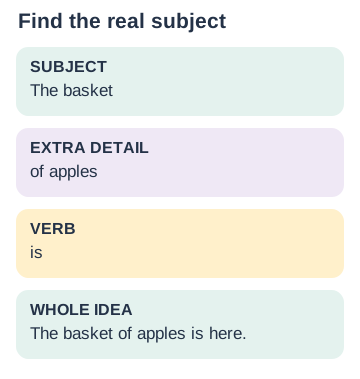
Do not let a nearby noun replace the real subject. In “The box of pencils is open”, box is singular; of pencils adds information about the box. The verb is therefore is. In “The pencils in the box are sharp”, pencils is plural, so are agrees.
For this revision sheet, focus on clear singular and plural subjects. Some collective nouns and specialised constructions vary with meaning and English variety; do not extend a simple rule to every possible sentence. Use the school’s guidance for cases outside the examples here.
3. Keep tense connected to the intended time
Choose a verb form that matches what the sentence means. “Yesterday, Riya walked to the library” describes a completed past event. “Riya walks to the library every Saturday” describes a regular action. “Riya is walking to the library now” describes an action in progress.
A time word helps, but the whole sentence matters. In a short account of one past event, changing to present without a reason can confuse the reader: “We opened the box and find a note” should be “We opened the box and found a note” for that intended sequence.
Not every verb follows the regular ed pattern. Go becomes went and find becomes found in the simple past. When unsure, check a reliable dictionary or the taught verb list rather than inventing a form such as goed.
4. Make references clear
Use a or an according to the following sound, not simply the first written letter. “An hour” begins with a vowel sound because the h is silent; “a useful tool” begins with a consonant-like y sound. The article the often points to a particular item that the reader can identify in context.
Pronouns should have a clear reference. “Maya told Sara that she had won” can be ambiguous: she might mean Maya or Sara. If the intended winner is Sara, write “Maya told Sara, ‘You have won’” or “Maya told Sara that Sara had won.” Choose the version that fits the situation.
Do not replace every repeated noun with a pronoun automatically. Clear meaning matters more than avoiding repetition at any cost. When two possible people or objects are nearby, repeating the name can make a sentence easier to understand.
5. Choose descriptions and links that match the idea
An adjective describes a noun in a phrase such as a careful painter. An adverb can describe a verb: “The painter worked carefully.” The choice depends on the job the word is doing, not merely whether it ends in ly. For example, fast can function as an adjective or an adverb.
A conjunction links ideas. Use because for a reason, but for a contrast and so for a result when those relationships fit. “It was raining, so we stayed inside” connects a situation with its result; “It was raining, but we went outside” introduces a contrasting action.
Prepositions describe relationships such as place or time. “The book is under the chair” and “The book is beside the chair” describe different positions. In an editing task, use the supplied context rather than choosing a preposition solely because it forms a familiar phrase.
6. Revise in a useful order
First check whether the sentence says the intended thing. Then check the subject and verb, time references, pronouns and connecting words. Finish with capitals and punctuation. This order prevents polishing a sentence whose meaning is still unclear.
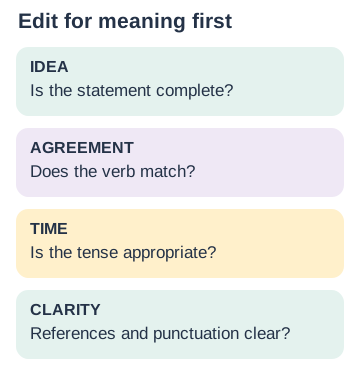
Try the worksheet before opening the explanations. For questions with several possible answers, compare the reasoning rather than insisting on identical wording. A valid sentence should preserve the requested meaning and use the target feature correctly.
After correcting an error, create a fresh sentence using the same feature. Changing “The box of pencils are open” to is is a correction; explaining why box controls the verb and using a new example shows more understanding. Ask the teacher about patterns that remain unclear.
My grammar error log
Keep the original attempt. Explain one useful correction before making a fresh sentence; do not copy every rule on the page.
Original sentence: ____________________
What I intended to say: ____________________
Feature to check (agreement, time, reference or punctuation): ____________________
Corrected sentence and reason: ____________________
A different sentence using the same feature: ____________________
Save the full guide to keep this record with the explanations. The separate worksheet contains the practice and decision questions; use its answer version to check your reasoning.
5 worked examples with reasoning
1. Correct “The basket of apples are on the table.”
- Identify the subject head: basket.
- Basket is singular, even though apples is plural.
- Use “The basket of apples is on the table.”
2. Complete “Because the bus was late”.
- The words give a reason but not a complete main statement.
- Add a main clause such as “we waited by the gate”.
- Write “Because the bus was late, we waited by the gate.”
3. Choose a or an before hour.
- Listen to the first sound, not only the first letter.
- Hour begins with a vowel sound.
- Use “an hour”.
4. Repair a past sequence: “We opened the box and find a note.”
- Both events belong to the same completed past sequence.
- The past form of find is found.
- Write “We opened the box and found a note.”
5. Make the winner clear in “Maya told Sara that she had won.”
- Decide who the intended winner is.
- If Sara won, name Sara or use direct speech addressed to her.
- For example: Maya told Sara that Sara had won.
Save the guide or print the practice
Download to save or share
Complete guide with answers (PDF) · Worksheet without answers (PDF) · Worksheet and answer key (PDF)
Answer all twenty original grammar tasks. For rewriting questions, preserve the requested meaning. Open responses may have several correct answers; explain the target feature where asked.
20 practice questions with explanations
Answer all twenty original grammar tasks. For rewriting questions, preserve the requested meaning. Open responses may have several correct answers; explain the target feature where asked.
Write an answer and your reason before opening the explanation. Check the reasoning as well as the final answer.
- Agreement
Choose is or are: The bag of marbles ___ heavy.
Answer and reasoning
is.
Bag is the singular subject head.
- Agreement
Choose runs or run: The two children ___ to the gate.
Answer and reasoning
run.
The subject is plural.
- Agreement
Choose has or have: My sister ___ a blue notebook.
Answer and reasoning
has.
My sister is singular.
- Sentence
Complete: Although the path was muddy, ___.
Answer and reasoning
For example: we reached the garden safely.
A main clause completes the concessive opening; other sensible completions work.
- Sentence
Is “The room is quiet” a complete statement?
Answer and reasoning
Yes.
It has a subject and says something complete about it.
- Past
Complete: Yesterday, Arun ___ to the shop. Use go.
Answer and reasoning
went.
Went is the simple past of go.
- Past
Correct: We saw the bird and takes a photograph.
Answer and reasoning
We saw the bird and took a photograph.
Both events are in the intended past sequence.
- Present
Choose walks or is walking: She ___ to school every day.
Answer and reasoning
walks.
Every day describes a regular action here.
- Progressive
Complete: They ___ reading now. Use a form of be.
Answer and reasoning
are.
The plural subject takes are in this present-progressive construction.
- Article
Choose a or an: ___ hour.
Answer and reasoning
an.
Hour begins with a vowel sound.
- Article
Choose a or an: ___ useful idea.
Answer and reasoning
a.
Useful begins with a consonant-like y sound.
- Pronoun
Rewrite “Ali told Ben that he was late” to make Ben the late person.
Answer and reasoning
For example: Ali told Ben that Ben was late.
Repeating the name removes the ambiguous reference.
- Adjective
Choose careful or carefully: She is a ___ reader.
Answer and reasoning
careful.
The adjective describes the noun reader.
- Adverb
Choose careful or carefully: She read the instructions ___.
Answer and reasoning
carefully.
The adverb describes how she read.
- Link
Join with a reason: We stayed inside. It was raining.
Answer and reasoning
We stayed inside because it was raining.
Because introduces the reason.
- Link
Join with contrast: The bag was small. It held all the books.
Answer and reasoning
The bag was small, but it held all the books.
But marks the contrast.
- Position
A pencil is directly below the desk. Complete: It is ___ the desk.
Answer and reasoning
under.
The supplied position is below.
- Punctuation
Add capitals and punctuation: where is riyas bag
Answer and reasoning
Where is Riya’s bag?
Use a capital for the opening and name, a possessive apostrophe and a question mark.
- Edit
Correct: The boxes on the shelf is dusty.
Answer and reasoning
The boxes on the shelf are dusty.
Boxes is the plural subject.
- Create
Write a new sentence with a singular subject followed by an of phrase and an agreeing verb.
Answer and reasoning
For example: The packet of seeds is on the bench.
Packet is singular; the plural noun inside the of phrase does not change the agreement.
Use the ideas without looking at the notes
Check the complete idea, subject–verb agreement, intended time, clear references and logical links. Choose a or an by sound. Correct an error with a reason, then write a new sentence that uses the same feature.
Common questions
Is this an official NCERT worksheet?
No. These are original BananaLearn questions for mixed Class 6 practice.
Must open answers match the model exactly?
No. Check whether the sentence is grammatical and preserves the required meaning.
Does every sentence need an action verb?
No. A sentence can describe a state, such as “The room is quiet.”
What should follow correcting a mistake?
Explain the reason and try a new sentence using the same feature.
Connect your learning
Ask about one-to-one learning support if your child needs help explaining these ideas.
About this guide
Original explanations, examples, diagrams and practice by BananaLearn. The grade label indicates the intended learning level; this is not an official textbook extract or exam paper.