Start with the school’s actual course
ICSE Class 9 Maths syllabus: a parent’s map
A Class 9 learner in the 2026–27 session is normally preparing toward the ICSE 2028 cohort. The official 2028 Mathematics document includes compound interest, logarithms and simultaneous equations; these are important differences from a generic Class 9 page.
Source and scope. CISCE Mathematics syllabus for examination year 2028 (Class IX cohort). Confirm the examination year on your school’s syllabus before using a revision list. This is a skill summary, not a replacement for the official syllabus and its exclusions.
Real numbers and surds
Represent rational/irrational values, simplify surds and justify irrationality results.
Compound interest
Model annual/half-yearly compounding, growth and depreciation with the correct periods.
Expansions and factorisation
Work with squares/cubes and polynomial factors; reverse an expansion to check.
Simultaneous equations
Frame and solve numerical pairs using appropriate algebraic methods.
Indices and logarithms
Use exponent laws and translate between exponential and logarithmic notation with valid conditions.
Geometry
Congruence, midpoint and Pythagoras results, parallelograms, constructions, area and circle properties.
Statistics and mensuration
Represent data and calculate specified averages, areas and volumes.
Trigonometry and coordinates
Use right-triangle ratios and coordinate methods within the official scope.
What to check before starting harder work
Turn a correct answer into a convincing solution
Manipulate signed/fractional expressions, solve linear equations, interpret coordinates and use angle facts.
Separate a calculation error from a reasoning gap. A student who chooses the correct theorem but makes an arithmetic slip needs a different response from one who assumes two unmarked sides are equal.
Use a blank sheet and let your child show a method. Record the first point where help is needed: reading the question, choosing a representation, carrying out a calculation or explaining the answer. That observation makes a tutoring conversation more specific than “Maths is weak”.
Two examples that reveal the reasoning
These are original teaching examples, not copied textbook answers or predictions of an exam question.
Worked example 1
Two prices, two equations
Two notebooks and three pens cost ₹ 84. One notebook and two pens cost ₹ 48. Find each price.
Work it through. Let n and p be prices. 2n + 3p = 84 and n + 2p = 48. Double the second equation: 2n + 4p = 96. Subtract the first: p = 12. Substitute n + 24 = 48, so n = 24. Check 48 + 36 = 84.
What to notice: Two independent relationships determine the two prices; one equation alone would not.
Worked example 2
A midpoint gives a shorter parallel segment
In triangle ABC, D and E are the midpoints of AB andAC. If BC = 14 cm, what is DE?
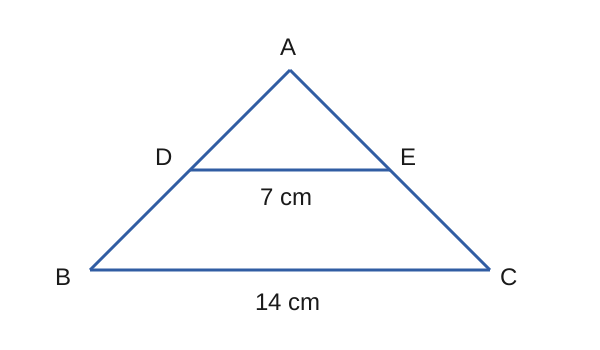
Swipe across the diagram to see the full explanation.
Work it through. The segment joining the midpoints of two sides is parallel to the third side and half its length. Therefore DE = 7 cm. The midpoint information is essential: a segment merely drawn parallel is not automatically half the third side.
What to notice: State the theorem and identify the two midpoint conditions before substituting a length.
A short Class 9 Maths check, with explained answers
Try these before opening the answers. Use drawings or working; speed is not the aim. This samples a few skills and is not a full syllabus test.
Solve x+y=11 and x−y=3.
Show answer and reasoning
x=7,y=4; add equations, then substitute.
Factorise x²−25.
Show answer and reasoning
(x−5)(x+5); difference of squares.
Simplify 2⁵ ÷ 2².
Show answer and reasoning
2³ = 8; same nonzero base.
Write 2³=8 in logarithmic form.
Show answer and reasoning
log₂8=3; the logarithm is the exponent.
Find the amount on ₹ 1,000 after 2 years at 5% compounded annually.
Show answer and reasoning
₹ 1,102.50; 1,000 × 1.05².
A right triangle has legs 5 cm and 12 cm. Find its hypotenuse.
Show answer and reasoning
13 cm; √(25+144).
Use the result to choose the next step
- Correct answer and clear explanation: change the numbers or context and check transfer.
- Correct method, calculation slip: practise the specific operation and use an estimate or inverse check.
- Unsure how to begin: return to an object, drawing or simpler example of the same idea before assigning more questions.
A short check cannot diagnose a learning condition or establish full mastery. Keep the actual working to discuss with the school teacher or tutor.
A focused learning sequence you can adapt
Choose one priority from the school chapter and the practice above. These are four learning steps, not a promise that every learner finishes in four lessons.
- Step 1. Build a topic map for the correct course and examination cohort.
- Step 2. Repair one prerequisite before attempting a multi-step problem.
- Step 3. Write a reason beside each algebraic or geometric step.
- Step 4. Use mixed retrieval and analyse errors by type, then retest the specific skill.
After each step, keep one independent attempt and one note about the help needed. Move on when the explanation holds up in a changed example; revisit the prerequisite when it does not.
Go deeper into the relevant concepts
Use the lesson that matches the difficulty you observed. These topic guides may carry another grade label because a prerequisite can be introduced or revisited at different times in different schools.
- Polynomials zeros
- Linear equations in two variables
- Congruent triangles proof steps
- Maths chapter revision checklist
Explore Maths practice games for extra practice. A game score is one piece of information; pair it with a spoken or written explanation.
When one-to-one ICSE Maths tuition may help
Bring the current textbook, one independently attempted question and the school’s next topic. A tutor can use the working to separate a prerequisite gap from a new topic that simply needs clearer explanation.
- Individual attention: one child and one teacher in a 50-minute online class.
- First session: request a free 50-minute session and discuss the teaching fit and next priorities.
- Ongoing plan: agree the topics, schedule and how progress will be reviewed before committing.
- Prices: check the current pricing page. Packs are 16, 32 or 64 or more classes of 50 minutes; they are not purchased hours.
Maths is our priority. English and Science tutoring are also available; ask about the relevant school course. Availability and curriculum fit are confirmed before ongoing lessons.
Tell us where Class 9 Maths gets difficult
Include ICSE, Class 9, the textbook or chapter and a question your child found difficult. Add your time zone if you live overseas.
Request a free Class 9 sessionQuestions parents ask
Does my child need tuition for every ICSE Class 9 topic?
Not necessarily. Start with the school’s current chapter and ask your child to explain a question without prompts. If the difficulty is confined to one prerequisite, a focused plan may be more useful than repeating every chapter.
Will you follow our school textbook?
Share the book title, edition and chapter list. CISCE provides a framework or syllabus, while schools can use different books and sequences. Agree the relevant topics with the tutor before continuing.
How do we judge whether the first session helped?
Keep one question your child needed help with. Later, try a similar question with changed numbers and ask for an explanation. Look for more independent reasoning, not only a higher score on a familiar exercise. One session does not establish mastery.
What happens before we pay for ongoing classes?
Request the free 50-minute first session. Discuss the topic, teaching fit and available time. Ask for the next learning priorities and confirm the current paid plan on the pricing page. Class packs count 50-minute classes, not hours.
Can we join from outside India?
Share your country, local time zone, school curriculum and preferred times. Availability and curriculum fit must be confirmed. For CBSE or ICSE schools overseas, include the class and textbook; for another curriculum, use the international tutoring page.
Curriculum sources and how to use this guide
Curriculum checked 30 October 2026. CISCE Mathematics syllabus for examination year 2028 (Class IX cohort). Confirm the examination year on your school’s syllabus before using a revision list.
Open the official CISCE curriculum document.
BananaLearn’s examples, explanations and practice are original. School-issued instructions and the official examination syllabus take precedence. How we prepare learning guides.