Start with the school’s actual course
ICSE Class 4 Maths syllabus: a parent’s map
CISCE’s Class 4 framework extends numbers to six digits and includes fractions, measurement and patterns. We connect that wider number range to meaningful comparisons, then check the written methods required by the school.
Source and scope. CISCE primary/upper-primary framework, first published in 2016 and currently hosted by CISCE. This is a school framework, not one prescribed textbook or a newly issued 2026 chapter list. This is a skill summary, not a replacement for the official syllabus and its exclusions.
Six-digit numbers
Read Indian place-value notation, expand, compare and construct numbers; explain each zero.
Roman numerals
Work with the school-prescribed range; the framework introduces I, V and X with values through 39.
Arithmetic and applications
Choose and check operations in multi-step money and measurement stories.
Fractions
Represent halves, quarters and related fractions; compare equal parts of the same whole.
Geometry
Use properties and measurements to explain shape classifications rather than visual guesses.
Measurement and time
Compare units, solve everyday length/mass/capacity questions and interpret durations.
Data handling
Read and create pictographs and bar graphs with clear labels.
Patterns
Explain a growing or shrinking rule and verify it with more than one term.
What to check before starting harder work
Make the picture match the calculation
Recall or build multiplication facts; explain place value and remainders; recognise equal shares.
Ask what the answer measures. A remainder can be left over, shared further or require another whole container. The calculation alone does not decide which interpretation is useful.
Use a blank sheet and let your child show a method. Record the first point where help is needed: reading the question, choosing a representation, carrying out a calculation or explaining the answer. That observation makes a tutoring conversation more specific than “Maths is weak”.
Two examples that reveal the reasoning
These are original teaching examples, not copied textbook answers or predictions of an exam question.
Worked example 1
Same digits, different value
A library record shows 2,04,305 books. What is the value of 4? How would the number change if 4 moved one place left?
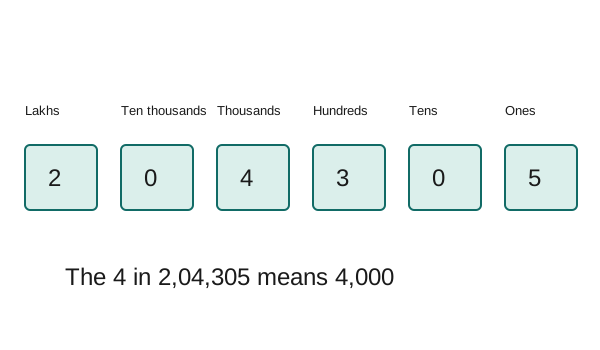
Swipe across the diagram to see the full explanation.
Work it through. The 4 is in the thousands position, so its value is 4,000. One place left would give it a value of 40,000. A digit’s face value is still 4, but its contribution to the number depends on position.
What to notice: Read the Indian grouping aloud before calculating with a large number.
Worked example 2
Ribbon bought in lengths
A display needs 6 strips of ribbon, each 35 cm long. A roll is 2 m long. Is one roll enough?
Work it through. Six strips need 6 × 35 = 210 cm. Convert the roll to 200 cm before comparing. It is 10 cm too short, even though 2 looks smaller than 35 for a different reason. Comparing measurements requires a common unit.
What to notice: A useful check is the estimate: six lengths a little over 30 cm should need a little over 180 cm.
A short Class 4 Maths check, with explained answers
Try these before opening the answers. Use drawings or working; speed is not the aim. This samples a few skills and is not a full syllabus test.
Expand 3,06,042.
Show answer and reasoning
3,00,000 + 6,000 + 40 + 2.
Compare 2,90,500 and 3,09,050.
Show answer and reasoning
3,09,050 is greater; compare lakhs first.
Write XXIX as an ordinary number.
Show answer and reasoning
29:XX is 20 andIX is 9.
Seven packets contain 24 stickers each. Find the total.
Show answer and reasoning
168 stickers; 7 × 24.
Convert 4 m 8 cm to centimetres.
Show answer and reasoning
408 cm; 4 m is 400 cm.
A bar chart uses steps of 10. A bar reaches the third step above zero. What value is shown?
Show answer and reasoning
30; count the scale value, not just the number of steps.
Use the result to choose the next step
- Correct answer and clear explanation: change the numbers or context and check transfer.
- Correct method, calculation slip: practise the specific operation and use an estimate or inverse check.
- Unsure how to begin: return to an object, drawing or simpler example of the same idea before assigning more questions.
A short check cannot diagnose a learning condition or establish full mastery. Keep the actual working to discuss with the school teacher or tutor.
A focused learning sequence you can adapt
Choose one priority from the school chapter and the practice above. These are four learning steps, not a promise that every learner finishes in four lessons.
- Step 1. Choose one current school topic and a prerequisite to revisit.
- Step 2. Draw a labelled model before using a written procedure.
- Step 3. Check the result with an inverse operation or an estimate.
- Step 4. Use a new context with the same relationship and record the method used independently.
After each step, keep one independent attempt and one note about the help needed. Move on when the explanation holds up in a changed example; revisit the prerequisite when it does not.
Go deeper into the relevant concepts
Use the lesson that matches the difficulty you observed. These topic guides may carry another grade label because a prerequisite can be introduced or revisited at different times in different schools.
Explore Maths practice games for extra practice. A game score is one piece of information; pair it with a spoken or written explanation.
When one-to-one ICSE Maths tuition may help
Bring the current textbook, one independently attempted question and the school’s next topic. A tutor can use the working to separate a prerequisite gap from a new topic that simply needs clearer explanation.
- Individual attention: one child and one teacher in a 50-minute online class.
- First session: request a free 50-minute session and discuss the teaching fit and next priorities.
- Ongoing plan: agree the topics, schedule and how progress will be reviewed before committing.
- Prices: check the current pricing page. Packs are 16, 32 or 64 or more classes of 50 minutes; they are not purchased hours.
Maths is our priority. English and Science tutoring are also available; ask about the relevant school course. Availability and curriculum fit are confirmed before ongoing lessons.
Tell us where Class 4 Maths gets difficult
Include ICSE, Class 4, the textbook or chapter and a question your child found difficult. Add your time zone if you live overseas.
Request a free Class 4 sessionQuestions parents ask
Does my child need tuition for every ICSE Class 4 topic?
Not necessarily. Start with the school’s current chapter and ask your child to explain a question without prompts. If the difficulty is confined to one prerequisite, a focused plan may be more useful than repeating every chapter.
Will you follow our school textbook?
Share the book title, edition and chapter list. CISCE provides a framework or syllabus, while schools can use different books and sequences. Agree the relevant topics with the tutor before continuing.
How do we judge whether the first session helped?
Keep one question your child needed help with. Later, try a similar question with changed numbers and ask for an explanation. Look for more independent reasoning, not only a higher score on a familiar exercise. One session does not establish mastery.
What happens before we pay for ongoing classes?
Request the free 50-minute first session. Discuss the topic, teaching fit and available time. Ask for the next learning priorities and confirm the current paid plan on the pricing page. Class packs count 50-minute classes, not hours.
Can we join from outside India?
Share your country, local time zone, school curriculum and preferred times. Availability and curriculum fit must be confirmed. For CBSE or ICSE schools overseas, include the class and textbook; for another curriculum, use the international tutoring page.
Curriculum sources and how to use this guide
Curriculum checked 30 October 2026. CISCE primary/upper-primary framework, first published in 2016 and currently hosted by CISCE. This is a school framework, not one prescribed textbook or a newly issued 2026 chapter list.
Open the official CISCE curriculum document.
BananaLearn’s examples, explanations and practice are original. School-issued instructions and the official examination syllabus take precedence. How we prepare learning guides.