
Start with the key idea
A factor of a positive whole number divides it exactly, leaving no remainder. A multiple of a number is the result of multiplying it by a whole number. Factor pairs multiply to the target number. This guide lists positive factors and positive multiples unless a question explicitly includes zero.
1. Use one array to see both relationships
An array arranges objects in equal rows and columns. Four rows with six tiles in each row contain 24 tiles. There are no spare tiles, so both four and six divide 24 exactly. They are factors of 24.
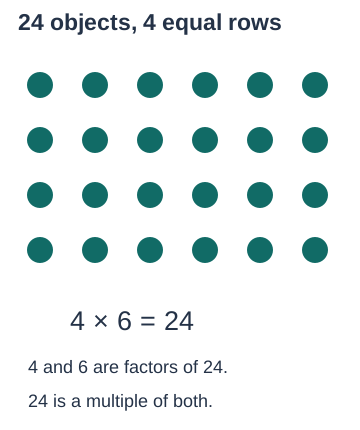
Read the relationship backwards as well: 24 is four groups of six, so 24 is a multiple of six. It is also six groups of four, so it is a multiple of four. “Factor” and “multiple” describe how the numbers are related; they are not permanent labels attached to a number.
A number can be a factor in one relationship and a multiple in another. Six is a factor of 24 and a multiple of three. Always finish the phrase: “a factor of…” or “a multiple of…”.
2. Find every positive factor using pairs
Start with 1 × 24. Test the next whole numbers in order: 2 × 12, 3 × 8 and 4 × 6 all work. Five does not divide 24 exactly. When you reach 6 × 4, you have returned to a pair already recorded.
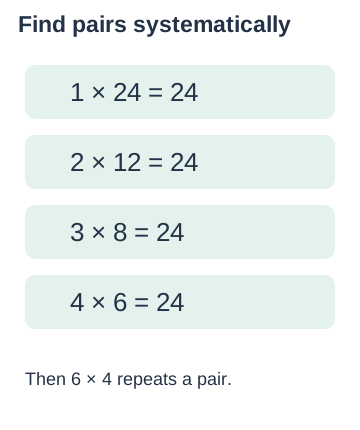
Collect both numbers from every pair and write them in order: 1, 2, 3, 4, 6, 8, 12 and 24. A tidy list makes it easier to spot a repeated number or a missing partner.
For a square number such as 36, the pair 6 × 6 contributes the factor six only once to the factor list. Its positive factors are 1, 2, 3, 4, 6, 9, 12, 18 and 36. Do not write six twice just because it appears twice in that multiplication.
You can stop once the tested small factor would pass its partner. A rectangle turned around does not create a new pair. This is more reliable than guessing a few times-table facts and assuming the list is complete.
3. Generate multiples by equal jumps
To list positive multiples of six, calculate 6 × 1, 6 × 2, 6 × 3 and so on: 6, 12, 18, 24, 30, 36. Each number is six more than the previous one. You can keep going; there is no largest positive multiple.
A positive whole number has a finite list of positive factors because none can exceed the number itself. Its multiples keep increasing. That contrast can help you decide which list a question needs.
Zero is also a multiple under the whole-number definition, because 6 × 0 = 0. Many school tasks ask for the first positive multiples and begin at six. Read the wording and state the convention instead of treating zero as automatically wrong.
Multiples do not have to be larger than the original number: six itself is the first positive multiple of six. Similarly, the number itself is one of its factors. Equal values are allowed.
4. Find what two lists have in common
The positive factors of 18 are 1, 2, 3, 6, 9 and 18. The positive factors of 24 are 1, 2, 3, 4, 6, 8, 12 and 24. Their common factors are the values in both lists: 1, 2, 3 and 6.
The greatest common factor is six. It can answer a packing problem: 18 red counters and 24 blue counters can be split into at most six identical packs with no leftovers. Each pack then has three red and four blue counters.
For common multiples, compare equal-jump lists. Multiples of four are 4, 8, 12, 16, 20, 24; multiples of six are 6, 12, 18, 24. The least positive common multiple is 12.
Common factors divide both starting quantities. Common multiples can be reached by multiplying both starting numbers. A repeated-events problem may need a common multiple, while identical packs without leftovers often need a common factor. Check the story rather than relying on one keyword.
5. Classify numbers by how many positive factors they have
A prime number is a whole number greater than one with exactly two positive factors: one and itself. Seven is prime because only one and seven divide it exactly. A composite number greater than one has more than two positive factors; twelve is composite because 2 × 6 is another factor pair.
One is neither prime nor composite. It has only one positive factor, so it does not satisfy either definition. Two is prime even though it is even: its only positive factors are one and two.
Parity and primality answer different questions. Being odd does not prove a number prime: 21 has factors three and seven. Rather than assuming this is every learner’s misconception, ask them to show a factor-pair check for the particular number.
Use small division checks systematically. For numbers in this guide, arrays and multiplication facts are enough. Large-number prime tests are a later topic, and a long list of examples is not a proof for every number.
6. Choose a representation that answers the question
If you need all factors, sketch rectangles or record factor pairs. If you need a sequence of multiples, show repeated jumps or a multiplication list. If you need common values, place the two lists side by side and circle the overlap.
For a learner who mixes up the words, keep one fact visible: 4 × 6 = 24. Read two full sentences from it, then change the example to 5 × 7 = 35. This checks whether the relationship transfers beyond one remembered answer.
Before finishing, divide to test a claimed factor and multiply to test a claimed multiple. For example, 24 ÷ 5 leaves a remainder, so five is not a factor of 24. But 25 = 5 × 5, so 25 is a multiple of five.
5 worked examples with reasoning
1. List the positive factors of 20.
- Pair 1 with 20, 2 with 10 and 4 with 5. Three does not divide 20 exactly.
- Write both partners in order: 1, 2, 4, 5, 10, 20.
- Check that every listed value divides 20 without a remainder.
2. Find the first five positive multiples of 7.
- Multiply seven by 1, 2, 3, 4 and 5.
- The results are 7, 14, 21, 28 and 35.
- Each step adds seven; start at seven because the question says positive.
3. Find the greatest common factor of 16 and 24.
- Factors of 16: 1, 2, 4, 8, 16.
- Factors of 24: 1, 2, 3, 4, 6, 8, 12, 24.
- The common values are 1, 2, 4 and 8. The greatest is 8.
4. One bell sounds every 4 minutes and another every 6 minutes. They sound together now. When do they next coincide?
- List positive times after now: 4, 8, 12… and 6, 12…
- The first shared time is 12 minutes.
- The time now is zero; the question asks for the next positive time.
5. Is 27 prime?
- Test for a factor pair other than 1 × 27.
- 3 × 9 = 27, so there are additional positive factors.
- It is composite. Being odd did not settle the question.
Save the guide or print the practice
Download to save or share
Complete guide with answers (PDF) · Worksheet without answers (PDF) · Worksheet and answer key (PDF)
Try each question before opening its explanation. Show the calculation or picture that supports your answer, and include units where needed.
16 practice questions with explanations
Try each question before opening its explanation. Show the calculation or picture that supports your answer, and include units where needed.
Write an answer and your reason before opening the explanation. Check the reasoning as well as the final answer.
- Pairs
List the positive factors of 12.
Answer and reasoning
1, 2, 3, 4, 6, 12.
The pairs are 1 × 12, 2 × 6 and 3 × 4.
- Pairs
List the positive factors of 15.
Answer and reasoning
1, 3, 5, 15.
The distinct pairs are 1 × 15 and 3 × 5.
- Pairs
List the positive factors of 25.
Answer and reasoning
1, 5, 25.
The pair 5 × 5 contributes five only once to the list.
- Multiples
Write the first four positive multiples of 9.
Answer and reasoning
9, 18, 27, 36.
Multiply nine by 1, 2, 3 and 4.
- Multiples
Is 42 a multiple of 6?
Answer and reasoning
Yes.
42 = 6 × 7.
- Compare
Is 6 a factor of 42?
Answer and reasoning
Yes.
42 ÷ 6 = 7 with no remainder.
- Compare
Is 8 a factor of 30?
Answer and reasoning
No.
8 × 3 = 24 and 8 × 4 = 32; neither equals 30.
- Common
Find the common positive factors of 12 and 18.
Answer and reasoning
1, 2, 3 and 6.
Each of those values divides both numbers exactly.
- Common
Find the least positive common multiple of 3 and 5.
Answer and reasoning
15.
Positive multiples first overlap at 15.
- Prime
Is 1 prime?
Answer and reasoning
No.
It has one positive factor, whereas a prime has exactly two.
- Prime
Is 2 prime?
Answer and reasoning
Yes.
Its only positive factors are one and two.
- Prime
Is 35 prime?
Answer and reasoning
No; it is composite.
5 × 7 = 35 gives a factor pair beyond one and itself.
- Story
Arrange 18 tiles into equal rows with no leftovers. Can each row have 4 tiles?
Answer and reasoning
No.
Four does not divide 18 exactly; four rows of four use 16 and leave two.
- Story
Pack 12 red and 18 blue beads into as many identical packs as possible. How many packs?
Answer and reasoning
6 packs.
Six is the greatest common factor. Each pack has two red and three blue beads.
- Reason
Is zero a multiple of five?
Answer and reasoning
Yes, if whole-number multiples including zero are allowed.
5 × 0 = 0. A list of positive multiples begins at five.
- Create
Give a number that is both a factor of 24 and a multiple of 3.
Answer and reasoning
For example, 6.
Six divides 24 and equals 3 × 2. Three, twelve and twenty-four also work.
Use the ideas without looking at the notes
Use one multiplication fact to write two relationship sentences. Then find all factor pairs of a new target and generate five positive multiples of another number. Explain why one list ends and the other can continue.
For a story, name what your answer counts. Check whether the quantity must divide the starting amounts or be reached by repeated groups. That decision is more useful than memorising a list of trigger words.
Common questions
Can a number be both a factor and a multiple?
Yes. Six is a factor of 24 and a multiple of three. Always name the number it is related to.
Is a number a factor of itself?
Every positive whole number divides itself exactly, so yes. It is also its own first positive multiple.
Why is one not prime?
One has only one positive factor. A prime number is greater than one and has exactly two.
Are there infinitely many factors?
A positive whole number has finitely many positive factors. It has infinitely many positive multiples.
Should zero be listed among multiples?
It is a whole-number multiple. If the question specifies positive multiples, omit zero and begin with the number itself.
Connect your learning
Ask about guided Maths learning if your child needs help explaining these ideas.
About this guide
Original explanations, examples, diagrams and practice by BananaLearn. The grade label indicates the intended learning level; this is not an official textbook extract or exam paper.