Start with the meaning
Suggested starting level: Grade 5. Be able to read an analogue or digital clock, count in fives and use 60 minutes = 1 hour. England’s time objectives develop across Years 4–5; this guide combines those prerequisite and application skills rather than claiming one exact textbook chapter.

What does elapsed time mean?
Elapsed time is the duration between a starting moment and an ending moment. A clock time such as 3:25 pm tells you when something happens; a duration such as 40 minutes tells you how long it lasts. Write the two clock times first, then name the duration you are trying to find.
There are three different question types: find how long an activity lasted; find when it ends; or find when it began. Underline what is missing before calculating. Adding the start and end times does not find a duration.
Use friendly jumps on a timeline
Jump from the start to the next whole hour, count complete hours, then jump to the finish. For 10:45 am to 12:20 pm, the jumps are 15 minutes, 1 hour and 20 minutes. Combine the minutes to get 1 hour 35 minutes.
A timeline is a record of your jumps, not a scale drawing unless the question says so. Check that each landing time is later than the previous one and that the final landing is exactly the stated finish. You can choose different jumps and still reach the same total.
Convert hours and minutes without decimals
Multiply the hours by 60 before adding minutes: 2 hours 15 minutes = 2 × 60 + 15 = 135 minutes. To go back, make complete groups of 60. For 150 minutes, two groups use 120 minutes, leaving 30; the duration is 2 hours 30 minutes.
1 hour 30 minutes is not 1.30 hours. Half an hour is 30 minutes, so its decimal form is 0.5 hour. You do not need decimal hours for these questions; use h and min to make the units unmistakable.
Read noon, midnight and the next day
12 noon is 12:00 pm; 12 midnight is 12:00 am. In 24-hour time, noon is 12:00 and midnight at the start of a day is 00:00. For pm times after noon, add 12 to the hour: 2:15 pm becomes 14:15. For 12:30 am, use 00:30.
If an activity crosses midnight, split it at midnight and add the two durations. Do not assume a next-day finish just because its clock number is smaller: the question must tell you the day or provide enough context. Real international travel can involve time zones; the practice here uses one time zone.
Use subtraction only after organising the units
For 15:10 minus 13:45, one hour must become 60 minutes. Rewrite the ending time as 14 hours 70 minutes for this subtraction: 70 − 45 = 25 minutes and 14 − 13 = 1 hour. The elapsed time is 1 hour 25 minutes.
This regrouped form is working, not a valid clock display. A timeline gives the same result: 13:45 to 14:00 is 15 minutes, then to 15:00 is 1 hour, then 10 minutes more. Use the method you can explain and check.
Timetable questions may ask for more than one duration
A journey can contain travelling time and waiting time. If a bus arrives at 09:20 and the next departs at 09:50, the wait is 30 minutes. If the whole journey runs 08:35–10:25, its total duration is 1 hour 50 minutes, including that wait.
Read whether the question asks for total elapsed time, time spent moving, or the wait. Only remove waiting time when the question asks for travelling time alone. Label each answer so the reader knows which duration it describes.
Worked examples, step by step
Example 1: A lesson runs from 9:35 am to 10:20 am. How long is it?
- 9:35 to 10:00 is 25 minutes.
- 10:00 to 10:20 is 20 minutes.
- 25 + 20 = 45 minutes. Check: starting at 9:35 and moving 45 minutes reaches 10:20.
Example 2: A film starts at 10:45 am and ends at 12:20 pm. Find its duration.
- 10:45 to 11:00 is 15 minutes.
- 11:00 to noon is 1 hour; noon to 12:20 is 20 minutes.
- Add the jumps: 1 hour and 35 minutes, or 95 minutes. Crossing noon does not add an extra hour.
Example 3: Practice begins at 4:50 pm and lasts 1 hour 25 minutes. When does it end?
- Add one hour to reach 5:50 pm.
- Add 10 minutes to reach 6:00, then the remaining 15 minutes to reach 6:15.
- The end is 6:15 pm. Check the duration back to 4:50: 10 + 60 + 15 = 85 minutes.
Example 4: A class finishes at 18:10 after 50 minutes. When did it start?
- Work backwards: 18:10 minus 10 minutes is 18:00.
- There are 40 minutes still to subtract. 18:00 minus 40 minutes is 17:20.
- Start time: 17:20, or 5:20 pm. Add 50 minutes to check that it ends at 18:10.
Example 5: A coach leaves at 22:40 and arrives at 01:15 the next day. How long is the journey?
- 22:40 to midnight is 1 hour 20 minutes.
- Midnight to 01:15 is 1 hour 15 minutes.
- Total: 2 hours 35 minutes. This assumes one time zone and no change of clocks.
Common mistakes and useful repairs
Subtracting the digits as if time were decimal
10:20 − 9:35 is not 0.85 hours. Hours group in sixties. Use a timeline or regroup one hour as 60 minutes.
Losing the day when crossing midnight
Write “next day” beside the finish. Split at 00:00 so that both durations move forwards.
Answering with a clock time instead of a duration
“10:20 am” answers when. “45 minutes” answers how long. Re-read the question before writing the unit.
Try before revealing
Quick understanding check
Read the check answers
100 minutes. One hour contributes 60 minutes; 60 + 40 = 100.
25 minutes. Ten minutes reach noon; another 15 reach 12:15. Total 25 minutes.
Grade 5 elapsed time — practice sheet
Work on paper before opening an answer. Print this question sheet with or without a separate worked key; no account is needed.
Name: ____________________ Date: __________
Convert 2 hours 20 minutes into minutes.
Show answer and reasoning
140 minutes. 2 × 60 + 20 = 140.
Convert 185 minutes into hours and minutes.
Show answer and reasoning
3 hours 5 minutes. Three full hours use 180 minutes, leaving 5.
A game runs from 14:15 to 14:55. Find its duration.
Show answer and reasoning
40 minutes. The hour stays the same, so subtract 55 − 15.
Find the duration from 08:48 to 10:05.
Show answer and reasoning
1 hour 17 minutes. 12 minutes to 09:00, then 1 hour to 10:00 and 5 minutes more.
A class starts at 11:35 am and lasts 55 minutes. When does it finish?
Show answer and reasoning
12:30 pm. 25 minutes reach noon; the remaining 30 reach 12:30.
A lesson ends at 17:05 and lasts 45 minutes. Find the start.
Show answer and reasoning
16:20. Subtract 5 minutes to 17:00, then 40 to 16:20.
A trip starts at 23:25 and finishes at 00:50 the next day. Find its duration.
Show answer and reasoning
1 hour 25 minutes. 35 minutes to midnight plus 50 minutes after midnight = 85 minutes.
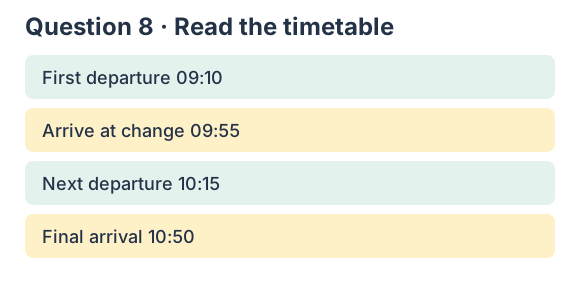
A train leaves at 09:10, arrives at 09:55, waits until 10:15, then arrives at its final stop at 10:50. Find the total duration and the waiting time.
Show answer and reasoning
Total 1 hour 40 minutes; wait 20 minutes. 09:10 to 10:50 is 100 minutes. The wait is 09:55 to 10:15, or 20 minutes; time moving is 80 minutes.
A child says 1 hour 45 minutes is 145 minutes. Explain and correct the error.
Show answer and reasoning
105 minutes. The child joined the digits. One hour equals 60 minutes, so 60 + 45 = 105.
A club session lasts 80 minutes, followed by a 15-minute break and 25 minutes of reading. If it begins at 15:40, when does reading finish?
Show answer and reasoning
17:40. 80 + 15 + 25 = 120 minutes, exactly 2 hours. Add this to 15:40.
Grade 5 elapsed time — worked answer key
140 minutes. 2 × 60 + 20 = 140.
3 hours 5 minutes. Three full hours use 180 minutes, leaving 5.
40 minutes. The hour stays the same, so subtract 55 − 15.
1 hour 17 minutes. 12 minutes to 09:00, then 1 hour to 10:00 and 5 minutes more.
12:30 pm. 25 minutes reach noon; the remaining 30 reach 12:30.
16:20. Subtract 5 minutes to 17:00, then 40 to 16:20.
1 hour 25 minutes. 35 minutes to midnight plus 50 minutes after midnight = 85 minutes.
Total 1 hour 40 minutes; wait 20 minutes. 09:10 to 10:50 is 100 minutes. The wait is 09:55 to 10:15, or 20 minutes; time moving is 80 minutes.
105 minutes. The child joined the digits. One hour equals 60 minutes, so 60 + 45 = 105.
17:40. 80 + 15 + 25 = 120 minutes, exactly 2 hours. Add this to 15:40.
Choose the next practice step
Use the questions in this guide to practise this specific skill. If you need another explanation, compare the closest worked example with your own drawing before trying a fresh problem.
Help at home: Let your child choose the jumps
Use a real activity such as a journey or club session. Write its start and finish, then ask your child to draw their own timeline. There is no need to insist on one jump pattern if all jumps are correct.
If they can read the clock but cannot calculate duration, practise the minutes to the next hour first. If they confuse am and pm, sort a few familiar daily events before attempting next-day problems.
Keep one example of your child’s own working. If the same confusion returns across fresh questions, share that attempt with their teacher and ask which next step fits their current learning.
Questions students and parents ask
What is the easiest way to calculate elapsed time?
For beginners, count forward to the next hour, then use whole-hour and minute jumps. This keeps the meaning visible and avoids regrouping errors.
Can I subtract the end time from the start time?
For a forward duration, subtract the start from the end after accounting for the day. Split at midnight if it makes the calculation easier.
Why does one hour become 60 rather than 100 minutes?
Clock units use 60 minutes per hour. Decimal place-value rules still apply to ordinary numbers, but a time written as hours and minutes uses two different units.
Is this an NCERT worksheet?
No. It is original BananaLearn practice with a suggested Grade 5 starting level. Match it to your child’s school objectives rather than assuming an exact exercise match.
Should my child use 12-hour or 24-hour time?
Either can work if am/pm and the day are clear. 24-hour time is especially useful for timetables, but it does not remove the need to track the next day.
About this resource
BananaLearn created these explanations, diagrams and practice questions. They are not reproduced textbook or past-exam questions. School sequences differ; use the prerequisites to choose a starting point. Read how we prepare learning guides.
Curriculum and teaching references used to check scope:
Bring the sticking point to a teacher
For 1-on-1 support, bring one question your child found difficult to a free 50-minute session. Tell us their grade, curriculum and time zone so we can discuss a suitable next step.
Request a free session