Start with the meaning
Know how to add lengths, multiply whole numbers and recognise a rectangle. This guide uses rectangles and squares; it does not teach circle area or the area of arbitrary polygons.
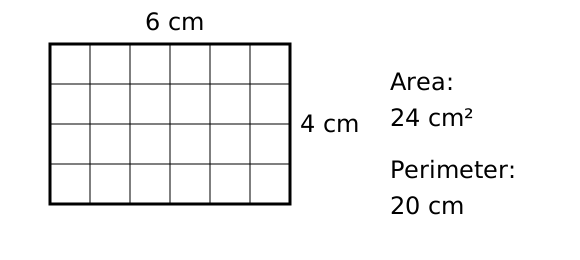
Trace the boundary for perimeter
Imagine a thin string going once around the outside edge. For a rectangle of length six centimetres and width four centimetres, add 6 + 4 + 6 + 4 = 20 cm.
Opposite sides of a rectangle are equal, so P = 2 × (length + width). This formula is a short way to count all four sides, not a rule for every shape.
Cover the inside for area
Cover the same rectangle with 1 cm by 1 cm squares. Six squares fit along each row and there are four rows, giving 6 × 4 = 24 square centimetres.
Area uses square units because each counted tile has both length and width. Multiplying two lengths in centimetres produces cm². Perimeter remains a length in cm.
Equal perimeter does not guarantee equal area
A 6 by 4 rectangle has perimeter 20 and area 24. An 8 by 2 rectangle also has perimeter 20, but its area is 16. Use the same length units for both.
This counterexample is enough to disprove the claim that equal perimeter always means equal area. Drawing both on squared paper makes the difference visible.
Read the context and match units
Fencing usually follows a boundary; floor covering occupies a surface. Draw what the material must cover rather than deciding only from a keyword. A border strip with width, for example, may itself have an area.
Convert dimensions to the same unit before using a formula. A 2 m by 50 cm rectangle can be treated as 2 m by 0.5 m, giving area 1 m² and perimeter 5 m.
See it, then explain it
Two illustrated examples, explained step by step
Same fence, different areas: which park gives more space?
Swipe across the diagram to see each part.
- Trace park 1: 5 + 1 + 5 + 1 = 12 m. Its area is 5 × 1 = 5 m².
- Trace park 2: 4 + 2 + 4 + 2 = 12 m. Its area is 4 × 2 = 8 m².
- Compare the spaces: 8 − 5 = 3 m² more in park 2, with the same boundary length.
Perimeter measures the boundary; area measures the surface enclosed. Equal boundary lengths do not force equal surfaces. The unit squares in the diagrams have the same scale, so you can compare the covered space directly.
Save this illustration on Pinterest · Download the illustrated summary
Grass or fencing? Measure the part you need
Swipe across the diagram to see each part.
- Count five unit squares in each of three rows: 5 × 3 = 15 m² of grass.
- Add the four sides: 5 + 3 + 5 + 3 = 16 m of fencing.
- Label the answers: square metres for surface area, metres for boundary length.
Draw what the material covers before choosing a calculation. If the fence has a 1 m gate, subtract that gap from the 16 m boundary to buy 15 m of fencing; the grass area stays 15 m². The equal numbers here still describe different quantities.
Save this illustration on Pinterest · Download the illustrated summary
Worked examples, step by step
Example 1: A rectangle is 9 cm long and 3 cm wide. Find perimeter and area.
- Perimeter counts all edges: 9 + 3 + 9 + 3 = 24 cm.
- Area counts unit squares: 9 × 3 = 27 cm².
- Use length units for the boundary and square units for the surface.
Example 2: A rectangle has area 35 cm² and width 5 cm. Find its length.
- Area = length × width, so length × 5 = 35.
- Length = 35 ÷ 5 = 7 cm.
- Check 7 × 5 = 35 cm². The answer is a length, not an area.
Example 3: A square has perimeter 28 m. Find its area.
- Four equal sides total 28 m, so each side is 28 ÷ 4 = 7 m.
- Area is 7 × 7 = 49 m².
- Do not square the perimeter. Find the side length first.
Choose a formula, match the units, and handle a composite shape
Area and perimeter answer different questions. Before calculating, mark the surface you want to cover or trace the boundary you want to measure. For the formulas below, l means rectangle length, w means rectangle width and s means square side length. All lengths in one calculation must use the same unit.
| Shape or task | Method | What the answer measures |
|---|---|---|
| Rectangle area | A = l × w | Covered surface, in square units |
| Rectangle perimeter | P = 2 × (l + w) | Total boundary length |
| Square area and perimeter | A = s × s; P = 4 × s | Surface and boundary respectively |
| Missing rectangle length | l = A ÷ w | A length, not an area |
Changing a length unit changes two dimensions in an area. Since 1 m = 100 cm, a 1 m by 1 m square contains 100 × 100 = 10,000 square centimetres. Therefore 1 m² = 10,000 cm², not 100 cm². Convert side lengths first when that makes the calculation easier to follow.
Worked example: An 8 m by 5 m rectangular garden has a 3 m by 2 m corner removed. Find the remaining area.
- Start with the whole rectangle: 8 × 5 = 40 m².
- The removed corner covers 3 × 2 = 6 m². Subtract it once: 40 − 6 = 34 m².
- Check by splitting the remaining L-shape into a 5 m by 5 m rectangle and a 3 m by 3 m rectangle: 25 + 9 = 34 m².
For this corner cut-out, the perimeter remains 26 m: the removed 3 m and 2 m outside edges are replaced by a 3 m and a 2 m inside edge. Do not extend that result to every cut-out. A notch cut into the middle of one side can increase the perimeter; trace the actual boundary.
Try a fresh example, then explain your check
A rectangle is 250 cm long and 2 m wide. Find its area in m² and perimeter in m.
Show answer and reasoning
250 cm = 2.5 m. Area = 2.5 × 2 = 5 m²; perimeter = 2 × (2.5 + 2) = 9 m.
A square has area 49 cm². Find its perimeter.
Show answer and reasoning
A side is 7 cm because 7 × 7 = 49. Its perimeter is 4 × 7 = 28 cm. Do not multiply the area by four.
A 6 m by 4 m lawn needs edging except for a 1.5 m opening. How much edging is needed?
Show answer and reasoning
The complete boundary is 2 × (6 + 4) = 20 m. The opening needs no edging, so buy 20 − 1.5 = 18.5 m, before any allowance for joins or waste.
Questions about choosing and checking a method
Can two shapes have the same area but different perimeters?
Yes. A 6 cm by 2 cm rectangle and a 4 cm by 3 cm rectangle each cover 12 cm². Their perimeters are 16 cm and 14 cm. Equal area does not determine a unique boundary length.
When is subtracting a smaller rectangle a valid area method?
It works when the larger rectangle is exactly the required shape plus the removed rectangle, with no gaps or overlaps. Label the missing rectangle dimensions from the drawing; do not estimate them from how the picture looks.
Common mistakes and useful repairs
Multiplying to find every perimeter
Multiplication can shorten a sum of equal sides, but perimeter is still the total boundary length. For a rectangle, length × width finds area.
Assuming a larger area always means a larger perimeter
A 4 by 4 square has area 16 and perimeter 16. A 1 by 10 rectangle has smaller area 10 but larger perimeter 22, using matching units.
Try before revealing
Quick understanding check
Read the check answers
cm². Area measures a two-dimensional surface in square units.
16 cm. 5 + 3 + 5 + 3 = 16 cm.
Area and perimeter: the difference, examples and practice — practice sheet
Work on paper before opening an answer. Print this question sheet with or without a separate worked key; no account is needed.
Name: ____________________ Date: __________
Find the perimeter of an 8 cm by 5 cm rectangle.
Show answer and reasoning
26 cm. 2 × (8 + 5) = 26.
Find its area.
Show answer and reasoning
40 cm². 8 × 5 = 40 unit squares.
A square has side 6 m. Find perimeter and area.
Show answer and reasoning
24 m and 36 m². Four six-metre sides give 24 m; six rows of six squares give 36 m².
A rectangle has area 48 cm² and width 6 cm. Find its length.
Show answer and reasoning
8 cm. 48 ÷ 6 = 8.
A rectangle has perimeter 30 cm and length 9 cm. Find its width.
Show answer and reasoning
6 cm. The two lengths use 18 cm, leaving 12 cm for two equal widths.
Find the area of a rectangle 3 m long and 40 cm wide.
Show answer and reasoning
1.2 m². Convert 40 cm to 0.4 m, then 3 × 0.4 = 1.2.
Give two rectangles with perimeter 16 cm but different areas.
Show answer and reasoning
For example, 5 by 3 and 6 by 2. Both perimeters are 16 cm. Areas are 15 cm² and 12 cm².
A 7 m by 4 m garden needs fencing with a 1 m gap for a gate. How much fence?
Show answer and reasoning
21 m. Full perimeter is 22 m. Subtract the one-metre opening; the gate is not part of the fence length requested.
Area and perimeter: the difference, examples and practice — worked answer key
26 cm. 2 × (8 + 5) = 26.
40 cm². 8 × 5 = 40 unit squares.
24 m and 36 m². Four six-metre sides give 24 m; six rows of six squares give 36 m².
8 cm. 48 ÷ 6 = 8.
6 cm. The two lengths use 18 cm, leaving 12 cm for two equal widths.
1.2 m². Convert 40 cm to 0.4 m, then 3 × 0.4 = 1.2.
For example, 5 by 3 and 6 by 2. Both perimeters are 16 cm. Areas are 15 cm² and 12 cm².
21 m. Full perimeter is 22 m. Subtract the one-metre opening; the gate is not part of the fence length requested.
Keep practising · suggested Grade 5
Worksheets and revision: Area & perimeter
Practise measuring boundaries, covering surfaces, matching units and comparing shapes.
Two worksheet pages, 12 questions and separate worked answers. Try the questions before checking. Downloads are PNG images; the ZIP contains the complete image pack.


Download the complete image pack
Worked answer sheets: Answers 1

Open the 12 additional questions and worked solutions
Open each question after you have attempted it. Refer to the matching worksheet diagram where indicated.
1. Count the squares
Find the area and perimeter of a grid four squares wide and three squares tall. Each square is 1 cm by 1 cm.
Use the labelled diagram on the matching worksheet, or the dimensions in the question.
Show worked solution
Area = 4 × 3 = 12 cm². Perimeter = 2 × (4 + 3) = 14 cm.
2. A rectangular park
A park measures 7 m by 3 m. Find its area and perimeter.
Use the labelled diagram on the matching worksheet, or the dimensions in the question.
Show worked solution
Area = 7 × 3 = 21 m². Perimeter = 2 × (7 + 3) = 20 m.
3. A square flowerbed
A square has side length 5 m. Find its area and perimeter.
Use the labelled diagram on the matching worksheet, or the dimensions in the question.
Show worked solution
Area = 5 × 5 = 25 m². Perimeter = 4 × 5 = 20 m.
4. A missing side
A rectangle has area 35 cm² and width 5 cm. Find its length.
Use the labelled diagram on the matching worksheet, or the dimensions in the question.
Show worked solution
Length = 35 ÷ 5 = 7 cm.
5. Fence the park
A 6 m by 3 m park needs fencing except for a 2 m gate. Find the fencing length.
Use the labelled diagram on the matching worksheet, or the dimensions in the question.
Show worked solution
Perimeter = 2 × (6 + 3) = 18 m. Fencing = 18 − 2 = 16 m.
6. Match the units
A rectangle measures 3 m by 200 cm. Find its area in m² and perimeter in m.
Use the labelled diagram on the matching worksheet, or the dimensions in the question.
Show worked solution
200 cm = 2 m. Area = 3 × 2 = 6 m². Perimeter = 2 × (3 + 2) = 10 m.
7. An L-shaped garden
Use the worksheet diagram: overall width 6 m, height 4 m, top strip height 2 m and horizontal inset 3 m. Find the area.
Use the labelled diagram on the matching worksheet, or the dimensions in the question.
Show worked solution
Top rectangle: 6 × 2 = 12 m². Lower rectangle: (6 − 3) × (4 − 2) = 6 m². Total = 18 m².
8. Same fence, more space
Park 1 is 5 m by 1 m. Park 2 is 4 m by 2 m. Both perimeters are 12 m. Compare the areas.
Use the labelled diagram on the matching worksheet, or the dimensions in the question.
Show worked solution
Park 1: 5 m². Park 2: 8 m². Park 2 has 3 m² more area.
9. Draw a rectangle
Draw a rectangle with area 12 cm². Find its perimeter.
Use the labelled diagram on the matching worksheet, or the dimensions in the question.
Show worked solution
One example is 4 cm by 3 cm, with perimeter 14 cm. A 6 cm by 2 cm rectangle also works and has perimeter 16 cm.
10. Spot the mistake
Use the two parks to explain why same perimeter does not guarantee same area.
Use the labelled diagram on the matching worksheet, or the dimensions in the question.
Show worked solution
Both perimeters are 12 m, but their areas are 5 m² and 8 m². Equal boundary lengths do not guarantee equal inside space.
11. Tile a floor
How many 1 m² tiles cover a 5 m by 4 m floor?
Use the labelled diagram on the matching worksheet, or the dimensions in the question.
Show worked solution
Area = 5 × 4 = 20 m². You need 20 whole 1 m² tiles.
12. Design challenge
Find rectangular side lengths for area 24 m² and perimeter 22 m.
Use the labelled diagram on the matching worksheet, or the dimensions in the question.
Show worked solution
8 m and 3 m work: 8 × 3 = 24 m² and 2 × (8 + 3) = 22 m.
No registration is needed to download. Suggested grades describe readiness and are not a claim of alignment to every curriculum.
Build a park with area and fencing targets
In Park Planner, build a shape to meet the area and fencing targets. Before submitting, explain which measurement counts the space inside and which follows the boundary.
Try Park PlannerGuest play has level, question and time limits. Sign in to continue or save progress. A game score is not a mastery assessment.
Help at home: Use string and squared paper
Draw a rectangle on squared paper. Trace the boundary with string, then count the squares inside. Ask which measurement changes if the rectangle is stretched into a longer, thinner shape.
Make two rectangles with the same perimeter and count their areas. If your child confuses units, have them label one boundary segment and one unit square before calculating.
Keep one example of your child’s own working. If the same confusion returns across fresh questions, share that attempt with their teacher and ask which next step fits their current learning.
Questions students and parents ask
Why is area in square centimetres?
Each unit being counted is a square with sides of one centimetre. The unit describes surface coverage rather than a single length.
Does length times width work for every shape?
No. It gives rectangle area. Other shapes need a justified formula or a decomposition into shapes whose areas you can find.
About this resource
BananaLearn created these explanations, diagrams and practice questions. They are not reproduced textbook or past-exam questions. School sequences differ; use the prerequisites to choose a starting point. Read how we prepare learning guides.
Curriculum and teaching references used to check scope:
Bring the sticking point to a teacher
For 1-on-1 support, bring one question your child found difficult to a free 50-minute session. Tell us their grade, curriculum and time zone so we can discuss a suitable next step.
Request a free session