Your child can apply a derivative rule but cannot explain what the answer measures. Calculus becomes easier to discuss when a slope, a rate and an accumulated change are connected to the same situation.
BananaLearn offers one-to-one online Calculus tutoring for school and introductory single-variable coursework. Support can address limits, differentiation, integration and their applications. Share the course specification, including AP AB or BC, IB pathway or school board where relevant, so the plan matches the required level.
Name the input, output and derivative units before applying a rule.
Applications of differentiation
Motion, related rates, optimisation and graph analysis as required.
Define variables, use the domain and interpret critical points.
Integration and accumulation
Antiderivatives, definite integrals, signed area and the Fundamental Theorem of Calculus.
Separate net change from a total that counts both directions positively.
Applications of integration
Area between curves, volumes or other specified applications.
Set up the quantity and interval before evaluating an integral.
Differential equations
Slope fields, initial conditions and elementary models where taught.
Explain what a proposed solution and initial value mean.
Additional AP BC content
Parametric/polar/vector-valued functions and sequences/series, plus other BC-specific topics.
Use the BC specification; an AB revision list is not complete BC coverage.
Course-specific expectations
Notation, permitted technology, justification and assessment-year requirements.
Bring the school or exam specification so support addresses the actual task.
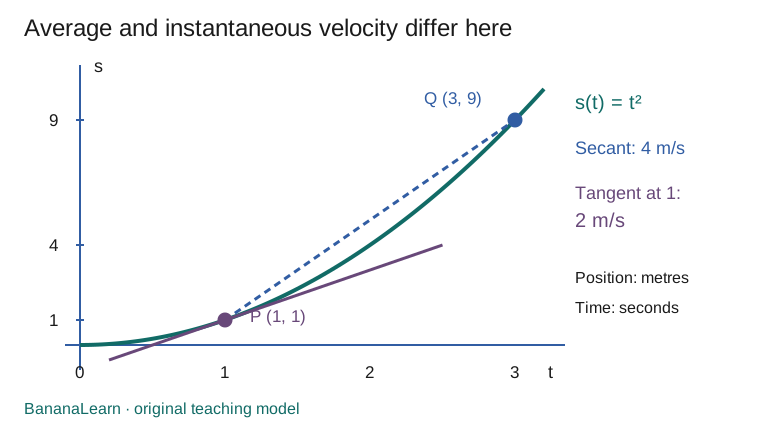
An interval slope and a tangent slope differ
On a small screen, swipe across the graph to read every label.
For s(t) = t², the secant from t = 1 to 3 has slope 4 while the tangent at t = 1 has slope 2.
Choose the right Calculus course and level
School Calculus, AP Calculus AB, AP Calculus BC and IB DP Mathematics have different content boundaries and assessment expectations. Include the full course name and intended exam year when enquiring. This page introduces the teaching approach and foundational ideas; it is not a substitute for any complete official course specification.
College Board describes eight commonly taught units for AB and ten for BC. BC includes additional parametric, polar and vector-valued work and infinite sequences and series, with further differences inside shared units. Its current pages also flag May 2027 exam-format changes. Check the linked official guidance rather than rely on an older practice-test timing.
Keep a function value and a limit separate
A limit describes what outputs approach as inputs approach a location. The rule may be undefined at that location, or its assigned value may differ from the nearby behaviour. Continuity requires the function to be defined there and the relevant limit to equal that value.
For (x² − 1)/(x − 1), factoring shows nearby outputs follow x + 1 when x ≠ 1. The limit as x approaches 1 is 2 even though the original expression is undefined at 1. Cancelling a factor helps compute the limit; it does not define the missing point.
Give derivative rules a visible meaning
The derivative is a limiting rate of change. On a graph it is a tangent slope; in a motion example it can describe velocity. Its units are output-units per input-unit. Calculating it and evaluating the original function produce different quantities.
Connect a symbolic result with an estimate from nearby points. A slope from t = 1 to t = 3 averages over an interval; the derivative at t = 1 concerns the instant at its start. The first illustration compares these ideas before the worked calculation below.
Set up applications before calculating
In an optimisation task, identify the variable, feasible domain and quantity to be optimised. Then derive the function and compare relevant candidates. A derivative equal to zero is a candidate condition, not a complete justification of a maximum or minimum.
In a rate problem, label units and distinguish signed direction from magnitude. In a related-rates task, quantities can vary together with time; differentiating a relationship correctly still requires the right values at the specified instant. Start from the situation rather than search for an isolated formula.
Explain what an integral adds up
A definite integral accumulates signed contributions. Regions below the horizontal axis contribute negatively. If the requested quantity is total distance rather than displacement, negative velocity must contribute positive distance over that part of the interval.
An antiderivative is a family of functions before an initial condition is supplied. A definite integral over specified bounds is a number with context-dependent units. Keep these roles separate, and use a graph or simple area model to check the sign and scale of an answer.
Plan practice around reasoning and retention
Use a worked example to identify the method, then change the function or context for an independent attempt. Ask the student to explain conditions and units and to check whether the answer is plausible. Include questions that need interpretation as well as differentiation or integration.
A later mixed task tests whether the student can choose a method without a heading announcing it. Parents can keep an early attempt, a corrected explanation and a fresh independent sample. Discuss what changed and what still requires prompts at the agreed review point.
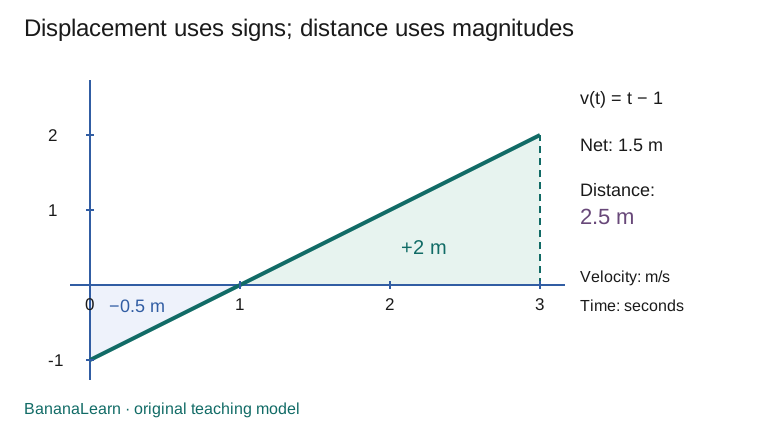
Signed change differs from total distance
On a small screen, swipe across the graph to read every label.
For v(t) = t − 1 over 0 to 3, displacement is 1.5 m while total distance is 2.5 m.
Five worked examples: method, meaning and checks
These original examples show selected teaching ideas. They do not represent an entire syllabus or official exam paper.
1. A missing point can still have a limit
Find the limit of (x² − 1)/(x − 1) as x approaches 1. For x ≠ 1, factor and cancel: (x − 1)(x + 1)/(x − 1) = x + 1. The nearby outputs therefore approach 2.
The original expression at x = 1 is still undefined. If a new function assigns the value 2 there, it fills the hole continuously; assigning 7 there would leave the limit unchanged but break continuity.
Check the reasoning: Ask separately: what is the limit, what is the assigned value, and do they agree? That prevents a correct limit from being mistaken for a defined function value.
2. Average velocity and instantaneous velocity
An illustrative position is s(t) = t² metres for t ≥ 0 seconds. From t = 1 to t = 3, the average velocity is (9 − 1)/(3 − 1) = 4 m/s.
At t = 1, use the difference quotient: [(1 + h)² − 1]/h = 2 + h for h ≠ 0. As h approaches zero, this tends to 2, so the instantaneous velocity is 2 m/s. The position at that time is 1 metre.
Check the reasoning: The values 1 m, 2 m/s and 4 m/s answer three distinct questions: position, instantaneous velocity and interval-average velocity.
3. The chain rule follows a nested function
Differentiate y = (3x² + 1)⁴. Let the inner expression be u = 3x² + 1. The outer rate is 4u³ and the inner derivative is 6x.
Multiply them: dy/dx = 24x(3x² + 1)³. At x = 1 this is 24 × 4³ = 1536. Leaving out 6x would differentiate the outer power without accounting for how its input changes.
Check the reasoning: For y = (3x + 1)⁴ the inner derivative would be 3. Identify the actual inner rule each time instead of copying a coefficient from a similar example.
4. Net change and total distance
Let v(t) = t − 1 m/s for 0 ≤ t ≤ 3 seconds. Velocity is negative from 0 to 1 and positive from 1 to 3. The signed triangular areas are −1/2 metre and +2 metres.
Displacement is −1/2 + 2 = 1.5 metres. Total distance is 1/2 + 2 = 2.5 metres. The antiderivative t²/2 − t also gives net change 1.5 when evaluated from 0 to 3.
Check the reasoning: To calculate distance with integration, split at t = 1 and integrate the magnitude of velocity on each piece. The ordinary integral of velocity gives displacement, not distance automatically.
5. Check an optimisation candidate in context
A rectangle has perimeter 20 units. If one side is x, the other is 10 − x, so area A(x) = x(10 − x) for 0 < x < 10. Differentiate: A′(x) = 10 − 2x. The stationary point is x = 5.
Since A″(x) = −2 throughout the interval, the function is concave down and this point is the maximum. Equivalently, A(x) = 25 − (x − 5)² cannot exceed 25. The optimal rectangle is a 5-by-5 square with area 25 square units.
Check the reasoning: For a different feasible interval or a closed interval, check its allowed endpoints and other candidates as appropriate. “Set the derivative to zero” is one step in the argument.
Try eight questions, then check the reasoning
Work on paper before opening each answer. Mark whether you needed a hint and which step was unclear; a total score alone will hide that information.
1. Find the limit of (x² − 4)/(x − 2) as x approaches 2.
4. For x ≠ 2, factor the numerator and simplify to x + 2. The original expression remains undefined at 2; the limit uses nearby values.
2. Differentiate 3x² − 4x + 7.
6x − 4. Apply the power rule to 3x², the constant multiple rule to −4x and the fact that a constant has derivative zero.
3. Find the slope of y = x³ at x = 2.
12. The derivative is 3x²; evaluate it at 2. The point’s height is 8, which is a different quantity.
4. Differentiate (2x + 1)³.
6(2x + 1)². Differentiate the outer cube and multiply by the inner derivative 2.
5. Evaluate the definite integral of 2x from 0 to 3.
9. Use the antiderivative x² and subtract its bound values: 3² − 0². The positive graph also encloses a triangle of base 3 and height 6, giving area 9.
6. Find an antiderivative of 6x².
2x³ + C. Differentiating 2x³ gives 6x². Any constant C has derivative zero, so the antiderivative is a family.
7. For v(t) = t − 2 on 0 ≤ t ≤ 4, find displacement and total distance.
Displacement is 0 and total distance is 4. Two triangles have equal areas 2 below and 2 above the time axis. Their signed sum is zero; their magnitudes add to 4.
8. If f′(x) > 0 throughout an interval, what does that say about f there?
Under the usual differentiability assumptions, f is increasing on that interval. It does not require f(x) itself to be positive; a rising graph may lie below the horizontal axis.
Common mistakes worth discussing
Substituting into an undefined quotient
A 0/0 expression signals that direct substitution has not determined the limit. Factorisation, another valid method or more analysis may be needed; 0/0 is not the number zero.
Dropping the inner derivative
For a composite function, multiply by the inner rate. Compare the result with a simpler case to check that every layer is represented.
Forgetting the integration constant
An indefinite integral describes a family. A given value or initial condition may determine its constant; a definite integral has specified bounds instead.
Calling every integral an unsigned area
A definite integral counts signed contributions. For total geometric area or distance, identify sign changes and use magnitudes appropriately.
A practical plan for the first discussion and later review
Name the course and difficulty. Bring the course specification, current chapter and one attempted question. Include exam year, AP AB/BC or IB pathway if applicable.
Connect a model with the calculation. Use a graph, table or physical quantity before applying the symbolic method. Explain the derivative or integral units.
Solve and justify a changed task. Change a condition, function or requested quantity. Ask the student to set up the problem and interpret the result independently.
Review later mixed work. Compare independent examples and the prompts needed. Decide whether to revisit a prerequisite, improve explanation or add a more demanding application.
Keep a simple learning record
Current school topic and the question attempted.
The first step the student could not explain.
One corrected explanation in the student’s own words.
A fresh independent attempt, date and prompts needed.
The skill to revisit at the next agreed review.
Use initials or a private notebook if sharing examples; sensitive school records are not needed for an initial enquiry.
Questions parents and students ask
Do you teach both differential and integral Calculus?
Yes. Support can address limits, differentiation, integration and applications. Share the actual syllabus so the depth and methods match the student’s course.
Can you help with AP Calculus AB or BC?
Yes. Name AB or BC and the exam year. BC contains additional content and depth; the current College Board description is the reference for exam-specific preparation.
Is this page a complete AP or IB course?
No. It is a tutoring guide with selected original teaching examples. Official specifications and the school’s sequence determine complete coverage. The linked IB page separates AA/AI, SL/HL and assessment cohorts.
What if algebra is causing the Calculus errors?
Identify the exact prerequisite in the current task. Targeted work on factorisation, functions or trigonometry can run alongside the school chapter; an entire earlier course need not automatically be repeated.
Can lessons use a graphing calculator?
Where appropriate, discuss the tool allowed by the school or exam. The student still needs to justify the setup and interpret its output. Confirm current exam rules with the official provider.
How can parents judge whether lessons are useful?
Ask to compare an early attempt and later fresh work, including the explanation, method choice and prompts needed. Agree a review point rather than rely on completed-page counts or a guaranteed grade.
Course-scope references checked 2 November 2026. All explanations, questions, graphs and invented models on this page are original BananaLearn material. The linked books and official specifications are references, not copied lesson content.
Tell us the course, school year, current topic and country/time zone. For AP or another examination course, include the assessment year and pathway. Describe one difficult task and the preferred lesson windows so we can discuss a useful starting point and availability.