What does it mean?
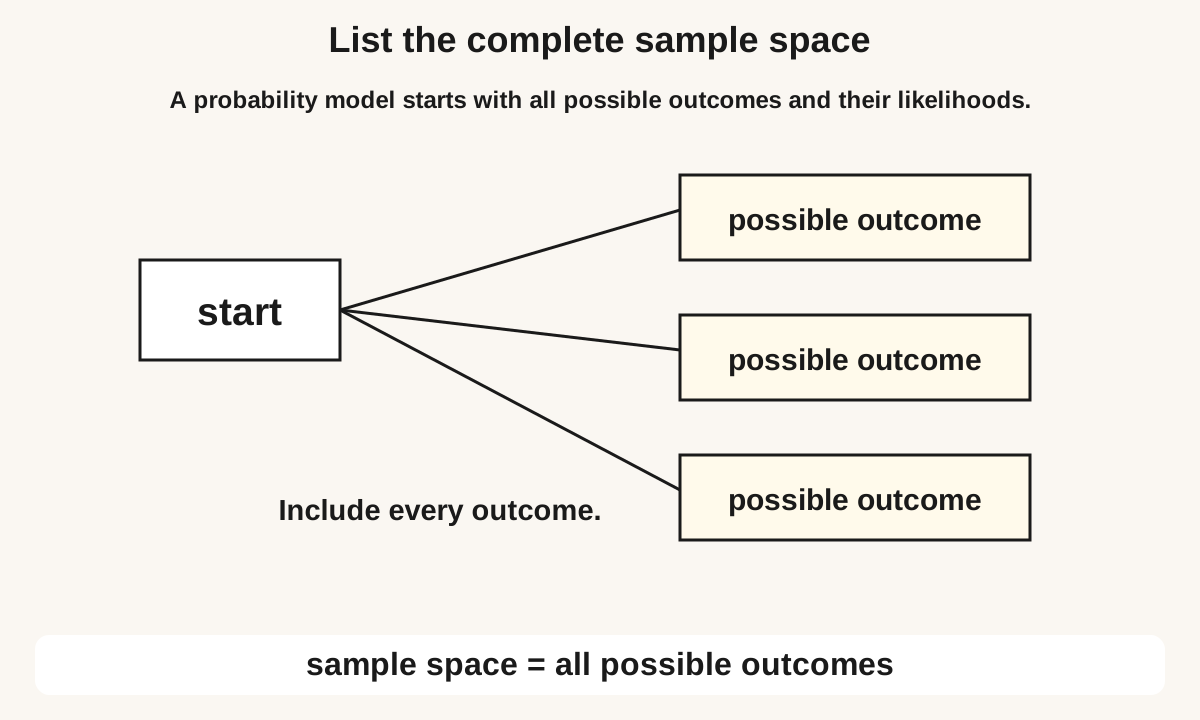
A sample space lists the possible outcomes of a random process. With two labelled coins, HT and TH are different outcomes because the head belongs to a different coin. With two dice, outcomes are ordered pairs, giving 6 × 6 = 36 possibilities under the fair independent model.
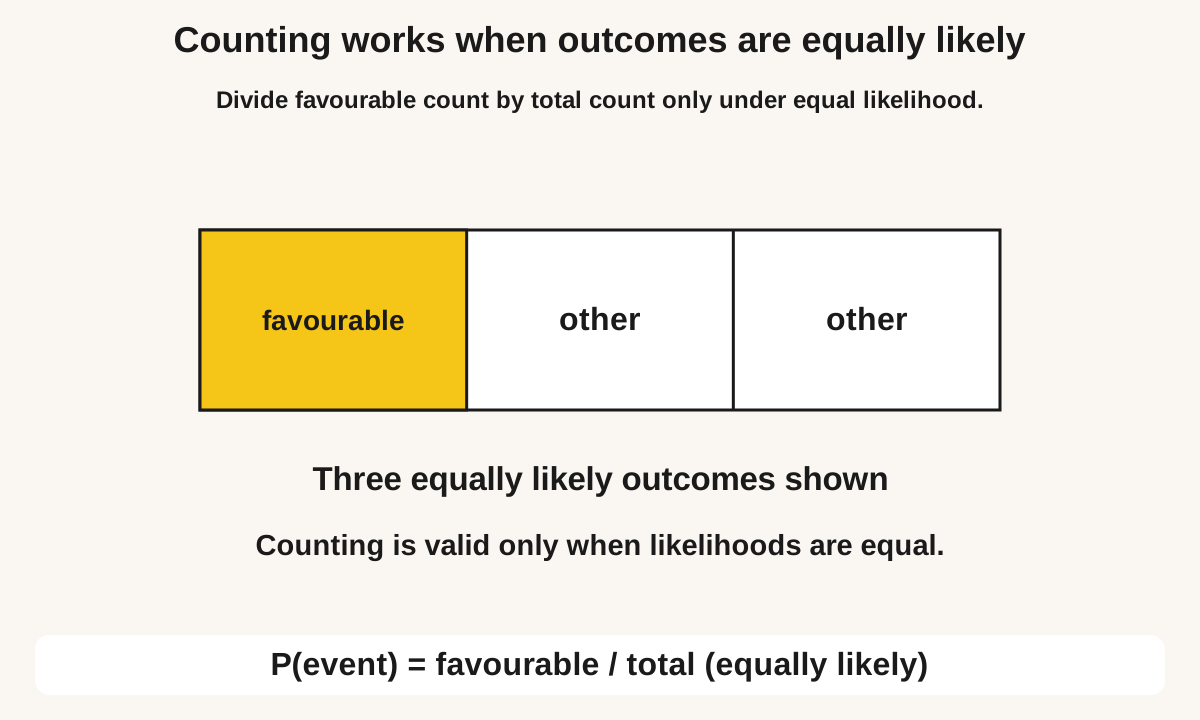
A sample space is the list of possible outcomes. If every outcome is equally likely, P(event) = (number of favourable outcomes) / (number of outcomes in the sample space). Two fair coins have four outcomes: HH, HT, TH, TT. Exactly one head is HT or TH, so 2/4 = 1/2. A fair die has {1,2,3,4,5,6}. Two dice have 36 ordered pairs. The sum 7 occurs in six of those pairs, so P(sum 7) = 6/36 = 1/6. Theoretical probability is the model from the sample space, not a count from a short experiment. Complements and two-way tables come later.
Learning goal: Construct sample spaces and calculate theoretical probability. The grade is a suggested starting point; school sequences vary. Use the first worked example to check readiness, and Fractions if an earlier idea needs revisiting.
See the idea
Read each diagram with its labels, then follow the worked examples. Practice questions include their own measurements and information.
Enlarge diagram to read the labels
Swipe across the enlarged diagram to read every label.
Enlarge diagram to read the labels
Swipe across the enlarged diagram to read every label.
Choose a method and explain why it works
Use a systematic list, grid or tree so that no outcome is missed or counted twice. Mark the outcomes satisfying the event, then divide their count by the total only when the listed outcomes are equally likely. For repeated trials, state independence: one result must not change the next trial’s probabilities.
Notation: P(event) = n(favourable) / n(sample space). Two coins: 4 outcomes. Two dice: 36 outcomes.
Key rule and when to use it
Count ordered pairs for two independent trials. Two fair dice give 6 × 6 = 36 equally likely pairs; the 11 possible totals are not equally likely.
Worked examples, step by step
Example 1: Two fair coins tossed independently. Find P(exactly one head).
- Sample space: HH, HT, TH, TT. Four equally likely outcomes.
- Exactly one head: HT and TH. Two favourable outcomes.
- P = 2/4 = 1/2.
Answer: 1/2
Check: Half the four cells have one head and one tail.
Example 2: Two fair dice rolled independently. Find P(sum 7).
- This is 36 ordered pairs, not four coin outcomes. List pairs that add to 7: (1,6), (2,5), (3,4), (4,3), (5,2), (6,1).
- Six favourable pairs. P = 6/36 = 1/6.
- Do not treat (1,6) and (6,1) as the same pair: the dice are distinguishable by order.
Answer: 1/6
Check: Sum 7 is the most common two-dice total, but it is still only 6 of 36, not 1/2.
Example 3: Two fair independent coins are tossed. Compare P(exactly one head) with P(at least one head).
- List HH, HT, TH and TT, all equally likely.
- Exactly one head uses HT and TH: 2/4 = 1/2.
- At least one head also includes HH: 3/4. The phrases do not describe the same event.
Common mistakes and important boundaries
The totals 2 through 12 from two dice are not equally likely. Sum 2 has one ordered pair, but sum 7 has six. “Exactly one”, “at least one” and “both” name different events. Write the words beside the selected outcomes to keep the event definition visible.
A point to explain
A learner may treat experimental frequency as the exact probability, or count HT and TH as one outcome, or add faces instead of listing pairs.
Compare an uncertain attempt with the closest worked example. Look at the meaning of each operation, unit and label before repeating the arithmetic.
Sample Spaces: Two Coins, Dice and Probability — practice
Work on paper first. Open each answer afterwards and compare the reasoning. Print the questions with or without the separate answer key; no account is required.
Name: ____________________ Date: __________
How many equally likely outcomes are in the sample space for two fair coins tossed independently?
Answer and a way to check
4
Write HH, HT, TH, TT. That is four outcomes, not three.
Two fair coins tossed independently. What is P(at least one head)?
Answer and a way to check
3/4
List HH, HT, TH and TT. Count the outcomes with at least one H.
A fair die. Find P(rolling a 6) as a fraction in lowest terms.
Answer and a way to check
1/6
One favourable face, six faces in the sample space.
A fair die. Find P(an even number) in lowest terms.
Answer and a way to check
1/2
Even faces are 2, 4 and 6. Divide by 6, then simplify.
Two fair dice rolled independently. Find P(sum 12) in lowest terms.
Answer and a way to check
1/36
There are 36 pairs. Only (6, 6) adds to 12.
Why are HT and TH both counted when finding P(exactly one head) for two coins?
Answer and a way to check
The first coin can be H and the second T, or the first T and the second H. Those are two different equally likely outcomes.
Label coin 1 and coin 2. HT and TH swap which coin is heads.
Two fair dice rolled independently. A student says P(sum 7) = 1/11 because 7 is one of the totals from 2 to 12. What is the mistake?
Answer and a way to check
The sample space is 36 pairs, not the 11 possible totals, and those totals are not equally likely.
Count ordered pairs, not distinct totals. Sum 7 has more pairs than sum 12.
A fair spinner has 4 equal sectors A, B, C, D. It is spun twice independently. Find P(both spins are A) as a fraction.
Answer and a way to check
1/16
First spin 4 outcomes, second spin 4. Total 16 ordered pairs. Only AA is both A.
Sample Spaces: Two Coins, Dice and Probability — answer key
4 Write HH, HT, TH, TT. That is four outcomes, not three.
3/4 List HH, HT, TH and TT. Count the outcomes with at least one H.
1/6 One favourable face, six faces in the sample space.
1/2 Even faces are 2, 4 and 6. Divide by 6, then simplify.
1/36 There are 36 pairs. Only (6, 6) adds to 12.
The first coin can be H and the second T, or the first T and the second H. Those are two different equally likely outcomes. Label coin 1 and coin 2. HT and TH swap which coin is heads.
The sample space is 36 pairs, not the 11 possible totals, and those totals are not equally likely. Count ordered pairs, not distinct totals. Sum 7 has more pairs than sum 12.
1/16 First spin 4 outcomes, second spin 4. Total 16 ordered pairs. Only AA is both A.
Questions students and parents ask
When can I multiply two probabilities?
For independent events, P(A and B) = P(A)P(B). Without independence use a conditional second probability: P(A and B) = P(A)P(B given A). Repeated-trial examples here assume independence.
When can I multiply the numbers of possible outcomes?
For a complete two-stage listing, each first-stage outcome must allow the stated number of second-stage outcomes. Equal probabilities additionally require a suitable probability model.
Is this a complete set of textbook exercise solutions?
No. This guide adapts BananaLearn’s own teaching examples and practice. It is not official NCERT material or a promise of the exact chapter sequence in a particular board, country or textbook edition.
What if the examples are still difficult?
Revisit Fractions. Try the first example with its model, then attempt one fresh question independently. A correct copied answer is not evidence that the method can be used without support.
Help at home
Have the learner name the two stages or label the two objects before listing outcomes. This prevents HT and TH from being merged accidentally.
Keep one example of the learner’s own working. A repeated difficulty across fresh questions can guide a discussion with their teacher; one short practice sheet does not establish a diagnosis or a full mastery profile.
Connect this idea to the next skill
About this guide
Based on BananaLearn’s Grade 8 course lesson “List Then Divide”. The explanations have been adapted for independent reading; course diagrams are reused where they fit the idea, and missing classroom givens are made explicit in questions.
Need another way to understand it?
Bring one question your child found difficult to a free 50-minute session. Tell us their grade, curriculum and time zone so we can discuss a suitable next step.
Request a free session