
Start with the key idea
A sample space lists the possible outcomes of a random experiment. For equally likely outcomes, the probability of an event is favourable outcomes divided by total outcomes. The outcomes you count must be equally likely and must describe the experiment at the same level of detail.
1. Define exactly what one outcome records
For one die, an outcome can be the face number 1 through 6. For two dice, record the pair of face numbers, distinguishing the first die from the second. For example, (2, 5) and (5, 2) are different ordered outcomes even though both sum to 7.
Calling an outcome just “the total” hides how many routes produce that total. Totals from 2 through 12 are possible, but they are not equally likely. The basic equally likely list for two fair independent dice contains 36 ordered pairs.
Define the event in words before counting. “A sum of 7” selects all pairs whose entries add to 7. “At least one 6” selects a different set. The same sample space can support many events without changing what an outcome means.
2. Check the equally likely assumption
A fair die gives each face the same chance in the usual mathematical model. A fair coin gives heads and tails equal chances. These assumptions justify counting outcomes directly; a weighted die or biased coin needs probabilities that reflect its behaviour.
For a bag containing three red and one blue equal-sized counters, the four individual counters can be equally likely when thoroughly mixed and drawn without looking. The two colour labels are not equally likely: red has three routes and blue has one.
Write the denominator in terms of the actual equally likely objects or ordered outcomes. Counting “red or blue” as two equally likely results would give one half for red, contradicting the bag’s contents. Equal-looking labels do not establish equal chance.
3. Use a systematic list or table
For two independent fair coin tosses, list HH, HT, TH and TT. Exactly one head occurs in HT and TH, so its probability is 2/4 = 1/2. Both heads occurs only in HH, with probability 1/4.

The list “zero heads, one head, two heads” has three categories but not three equally likely outcomes. The middle category combines two underlying routes. A tree diagram or two-by-two table keeps those routes visible.
To check completeness, group outcomes by the first result. There are two outcomes beginning H and two beginning T. For three tosses, each two-toss sequence splits again into H or T, giving eight outcomes.
4. Count dice pairs without double-counting
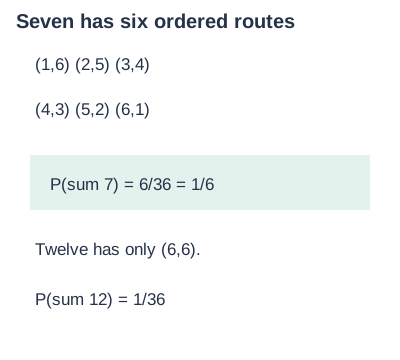
For a sum of 7, the favourable pairs are (1, 6), (2, 5), (3, 4), (4, 3), (5, 2) and (6, 1). There are six out of 36, giving 1/6. A sum of 12 has only (6, 6), giving 1/36.
For at least one 6, count the six pairs with the first die equal to 6 and the six with the second equal to 6. The pair (6, 6) appears in both groups, so subtract it once: 6 + 6 − 1 = 11 favourable outcomes.
Alternatively count the complement: no die shows 6 in 5 × 5 = 25 cases. Therefore at least one 6 occurs in 36 − 25 = 11 cases. Agreement between two counting methods is a useful check.
5. Distinguish exactly, at least and at most
Exactly one head means one head and one tail in two tosses. At least one head includes HT, TH and HH. At most one head includes TT, HT and TH. Small wording changes select different sets of outcomes.
The complement of at least one success is no successes. Since all outcomes together have probability one, P(at least one) = 1 − P(none). For two fair coin tosses, that gives 1 − 1/4 = 3/4.
Do not confuse the complement of exactly one with exactly zero. In two tosses, not exactly one head includes both zero heads and two heads. Write the excluded cases explicitly before using subtraction from one.
6. Keep the experiment and the model consistent
Drawing with replacement returns the counter before the next draw, so the bag composition is restored. Drawing without replacement changes the second draw’s possible objects and probabilities. State which experiment is intended before forming a sample space.
A theoretical probability does not promise a fixed result in a short run. A fair coin may show heads several times in succession. If independent, the next toss still has probability one half for heads; a tail is not owed because heads appeared earlier.
Check any answer against zero and one. An impossible event has probability zero; a certain event has probability one. A fraction above one usually signals a counting error, such as counting favourable cases twice or choosing an incompatible denominator.
5 worked examples with reasoning
1. Find the probability of an even number on a fair six-sided die.
- Sample space: 1, 2, 3, 4, 5, 6.
- Favourable faces: 2, 4, 6, so probability = 3/6.
- The result is 1/2.
2. Two fair independent coins are tossed. Find the probability of at least one head.
- Outcomes are HH, HT, TH, TT.
- All except TT meet the event, giving 3/4.
- Complement check: 1 − 1/4 = 3/4.
3. Two fair independent dice are rolled. Find P(sum is 8).
- Pairs: (2, 6), (3, 5), (4, 4), (5, 3), (6, 2).
- Five favourable pairs out of 36.
- Probability = 5/36; totals themselves are not equally likely.
4. A bag has 5 red and 3 blue equal-sized counters. One is drawn randomly. Find P(blue).
- There are eight individual counters.
- Three are blue, so probability = 3/8.
- P(red) = 5/8 and the two probabilities total one.
5. Two fair independent dice are rolled. Find P(at least one 6).
- There are 25 outcomes with neither die showing 6.
- The complement has 36 − 25 = 11 outcomes.
- Probability = 11/36, not 12/36 because (6, 6) cannot be counted twice.
Save the guide or print the practice
Download to save or share
Complete guide with answers (PDF) · Worksheet without answers (PDF) · Worksheet and answer key (PDF)
Try each task before opening its answer. Give an example or reason, not only a label.
14 practice questions with explanations
Try each task before opening its answer. Give an example or reason, not only a label.
Write an answer and your reason before opening the explanation. Check the reasoning as well as the final answer.
- Die
P(rolling 5 on a fair six-sided die)?
Answer and reasoning
1/6.
One favourable face out of six.
- Die
For a fair six-sided die, find P(rolling a number greater than 4).
Answer and reasoning
1/3.
Faces 5 and 6 give 2/6.
- Die
For a fair six-sided die, find P(rolling 7).
Answer and reasoning
0.
Seven is not a possible face.
- Coin
P(HH) in two fair independent tosses?
Answer and reasoning
1/4.
One of four ordered outcomes.
- Coin
Two fair independent coins are tossed. Find P(exactly one head).
Answer and reasoning
1/2.
HT and TH give 2/4.
- Coin
Two fair independent coins are tossed. Find P(at most one head).
Answer and reasoning
3/4.
TT, HT and TH qualify.
- Dice
How many ordered outcomes for two six-sided dice?
Answer and reasoning
36.
Six choices for each die.
- Dice
Two fair independent six-sided dice are rolled. Find P(sum 2).
Answer and reasoning
1/36.
Only (1, 1).
- Dice
Two fair independent six-sided dice are rolled. Find P(sum 6).
Answer and reasoning
5/36.
(1, 5), (2, 4), (3, 3), (4, 2), (5, 1).
- Dice
Two fair independent six-sided dice are rolled. Find the probability that both show the same number.
Answer and reasoning
1/6.
Six doubles out of 36.
- Bag
A bag has 2 green and 6 yellow equal counters. P(green)?
Answer and reasoning
1/4.
2/8 simplifies to 1/4.
- Complement
If P(rain) = 0.3, what is P(no rain) for the same defined period and model?
Answer and reasoning
0.7.
Complement probabilities add to one.
- Reason
Are the eleven possible two-dice totals equally likely?
Answer and reasoning
No.
Different totals have different numbers of ordered routes.
- Check
Can the probability of an event be 1.2?
Answer and reasoning
No.
An event cannot include more than all possible outcomes.
Use the ideas without looking at the notes
Define one outcome, list systematically, check equal likelihood and identify the event precisely. Count favourable routes and verify with the complement when useful.
Common questions
Why distinguish the dice?
It makes ordered outcomes explicit; a red die showing 2 and blue die showing 5 differs from the reverse.
When does favourable divided by total work?
When the elementary outcomes being counted are equally likely.
Does a long run of heads make a tail more likely next?
Not for independent fair tosses; the next toss remains equally likely to be heads or tails.
What changes without replacement?
The available objects and often the probabilities on later draws.
Why use a complement?
Counting excluded cases can be simpler and helps avoid double-counting.
Connect your learning
Ask about guided Maths learning if your child needs help explaining these ideas.
About this guide
Original explanations, examples, diagrams and practice by BananaLearn. The grade label indicates the intended learning level; this is not an official textbook extract or exam paper.