Maths · Suggested Grade 7–10
Why 7 Is the Most Likely Sum of Two Dice: Grid & Practice
Seven has six ways to appear; twelve has only one. The surprise is not in the numbers on the dice—it is in how many different pairs make each total.
Original explanations and practice by BananaLearn · Published 31 October 2026 · Check your school’s teaching sequence.
On a small screen, swipe across the illustration to read every label.
Start with two distinguishable dice
Imagine a red die and a blue die, each numbered 1 to 6. A result is a pair: red first, blue second. Red 2 and blue 5 is the pair (2,5); red 5 and blue 2 is (5,2). Both give a sum of 7, but they are different outcomes because the coloured dice show different faces.
Our model assumes both dice are fair and the results independent. That means each red face is equally likely, each blue face is equally likely, and knowing one result does not change the chances on the other die. Loaded dice or dice whose movement is linked need a different model.
You only need addition, multiplication and simple fractions to begin. If counting possible outcomes is new, start with our sample-space guide before using the larger grid.
Read the grid before using a formula
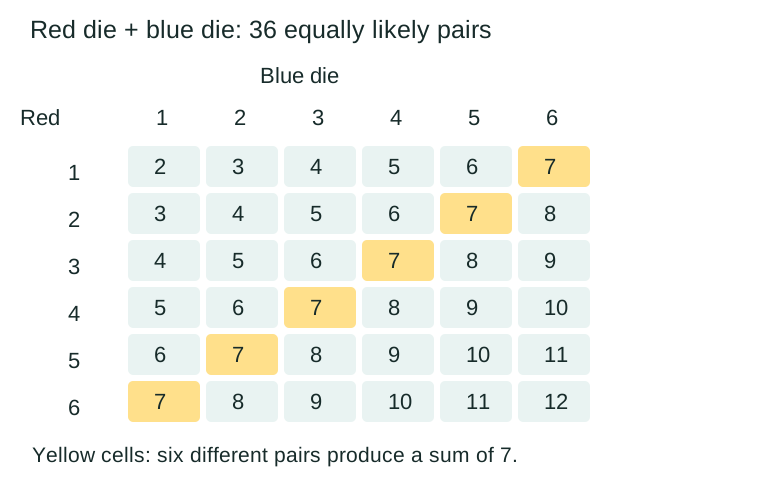
The six rows represent the red die; the six columns represent the blue die. Every cell is one ordered outcome, so there are 6 × 6 = 36 cells. The number inside is the sum. The coloured diagonal marks all the ways to make 7.
There are eleven possible sums, from 2 through 12. Those eleven labels are not equally likely: the label 7 belongs to six cells, whereas the label 12 belongs to one. Counting labels and treating them as equal would discard the very information the grid shows.
For equally likely elementary outcomes, probability = matching cells ÷ all cells. For a sum of 7, this is 6/36 = 1/6. For a sum of 12, it is 1/36. Seven is therefore six times as likely as twelve on one roll of this pair.
Worked example: compare 6 and 8
For 6, list (1,5), (2,4), (3,3), (4,2), (5,1): five outcomes. For 8, list (2,6), (3,5), (4,4), (5,3), (6,2): also five. Both probabilities are 5/36, even though 8 is the larger number.
The distribution is symmetric about 7. Pair a result (a,b) with (7−a,7−b): a sum of 6 turns into a sum of 8. That pairing explains the symmetry instead of asking you to memorise a table. It also pairs sums 2 and 12, 3 and 11, 4 and 10, and 5 and 9.
Worked example: sum at least 10
At least 10 includes 10, 11 and 12. The matching pairs number 3 + 2 + 1 = 6. So P(sum at least 10) = 6/36 = 1/6. Write the boundary explicitly: a sum of 10 is included. If the question said greater than 10, only 11 and 12 would count, giving 3/36 = 1/12.
An alternative is to list all six matching cells. These are (4,6), (5,5), (6,4), (5,6), (6,5) and (6,6). A second method is useful for checking that no boundary or order has been missed.
A fair game needs a fair comparison
Two children choose sums before rolling. Maya chooses 7 and Arun chooses 12. If each correct guess earns one point, their chances of scoring on a roll are not equal. Maya has the more likely event. To compare predictions fairly, let both children use the same event, or choose events with the same number of matching cells, such as 6 and 8.
Do not confuse the chance of a sum on one roll with the chance that a player wins a whole game. A game that stops after a first success, changes points, or rerolls some outcomes introduces new rules. State the rules before claiming that a game is fair.
Try a 36-roll investigation
Use two ordinary dice, paper and a tally table with sums 2 to 12. Before rolling, predict which totals will appear most often. Roll both dice together 36 times, recording every sum, including repeats. Compare the shape of your tally with the theoretical counts 1,2,3,4,5,6,5,4,3,2,1.
Those counts are expected frequencies in 36 rolls, not promised results. A fair experiment may produce no twelves, several twelves, or more sixes than sevens. Combine independent class results to obtain a larger sample; do not change or omit surprising rolls. Larger samples often give a clearer picture, but do not guarantee a smooth histogram every time.
For a written record, use four columns: sum; predicted relative frequency; observed tally; what I can conclude. A sensible conclusion is that observed counts vary and can be compared with the model. A weak conclusion is that a die must be unfair because 7 did not win one short run.
Avoid three tempting mistakes
First, do not use 1/11 for every sum: the eleven sums are not equally likely. Second, do not count (2,5) and (5,2) as one outcome while counting (3,3) once; that mixes an unordered list with an equal-outcome calculation. Third, a run of low sums does not make a high sum due on the next independent roll.
If a child gets stuck, return to a smaller model: a red card numbered 1 or 2 and a blue card numbered 1 or 2. The four ordered pairs give sums 2,3,3,4. Seeing 3 appear in two cells often makes the larger grid easier to explain. Then ask the child to build, rather than copy, the six-by-six grid.
10 questions with explained answers
Try each question before revealing the answer. Explain your method, then change one detail and check whether the same reasoning still works.
How many ordered outcomes give a sum of 4?
Show answer and explanation
3; probability 1/12
The pairs are (1,3), (2,2), (3,1). Divide three by 36, then simplify.Is 9 more likely than 5?
Show answer and explanation
No; both have probability 1/9
Each has four matching pairs. A larger sum is not automatically a more likely sum.Find P(sum is even).
Show answer and explanation
1/2
An even sum needs two odd faces or two even faces. There are 3×3 + 3×3 = 18 matching pairs out of 36.Find P(sum is less than 4).
Show answer and explanation
1/12
Only sums 2 and 3 qualify: 1+2=3 matching outcomes. Sum 4 is excluded.Find P(sum is not 7).
Show answer and explanation
5/6
Use the complement: 1−6/36 = 30/36.What is the probability of a double and a sum of 8?
Show answer and explanation
1/36
Both conditions must hold. Only (4,4) qualifies.In 72 rolls, how many sevens does the model predict on average?
Show answer and explanation
12
72×1/6=12. An actual set of 72 rolls can give a different count.The red die shows 6. What is the chance the sum is 7?
Show answer and explanation
1/6
Only blue 1 succeeds among the six equally likely blue faces. The information changes the sample space.Two twelves just occurred. What is P(12) on the next independent roll?
Show answer and explanation
1/36
Previous rolls do not change either die’s next-roll probabilities.Which is more likely: exactly 7, or at least 10?
Show answer and explanation
Equally likely
Both events contain six of the 36 ordered outcomes. They describe different cells but equal probabilities.
Keep the ideas connected
- Build a sample space
- Compare experimental and theoretical probability
- Use a complement
- Explore practice games
For ongoing school-learning help, bring one attempted question to a conversation about tutoring and curriculum fit. Maths is our priority; English and Science tutoring are also available after a course-fit check.
Sources, scope and sharing
Examples, diagrams and questions are original BananaLearn work. They are not copied textbook solutions, official exam questions or an endorsed assessment. Grade labels are suggestions, not a promise about every school’s syllabus.
How we prepare learning guides · Report a correction
Share the canonical guide address: https://bananalearn.com/learn/two-dice-sums-why-seven-is-most-likely.html.