What does it mean?
The complement of an event contains every outcome where that event does not occur. Together an event and its complement exhaust the complete sample space without overlap, so their probabilities add to one. A two-way table organises two classifications simultaneously, making joint and marginal counts visible.
If A is an event, not A is the complement: the outcomes where A does not happen. For a complete sample space, P(not A) = 1 − P(A). On a fair die, P(not 6) = 1 − 1/6 = 5/6. A two-way table counts two categories at once, for example sport and group. A cell is a joint count. A row total or column total is a marginal. P(cricket) uses the cricket column total over the grand total. P(group 1 and cricket) uses that one cell over the grand total. If you want a row proportion, divide the cell by the row total. A difference between row proportions suggests association. It does not prove that the row label causes the column.
Learning goal: Use complements and two-way tables to find and interpret probabilities/associations. The grade is a suggested starting point; school sequences vary. Use the first worked example to check readiness, and Fractions if an earlier idea needs revisiting.
See the idea
Read each diagram with its labels, then follow the worked examples. Practice questions include their own measurements and information.
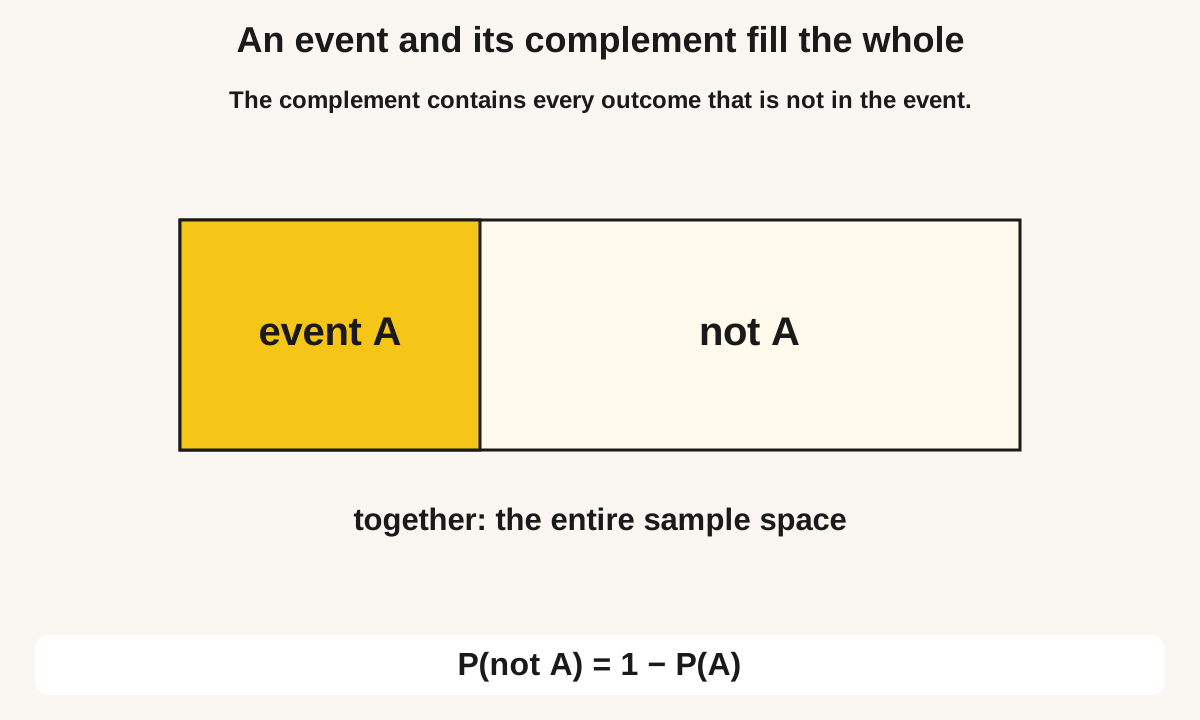
Enlarge diagram to read the labels
Swipe across the enlarged diagram to read every label.
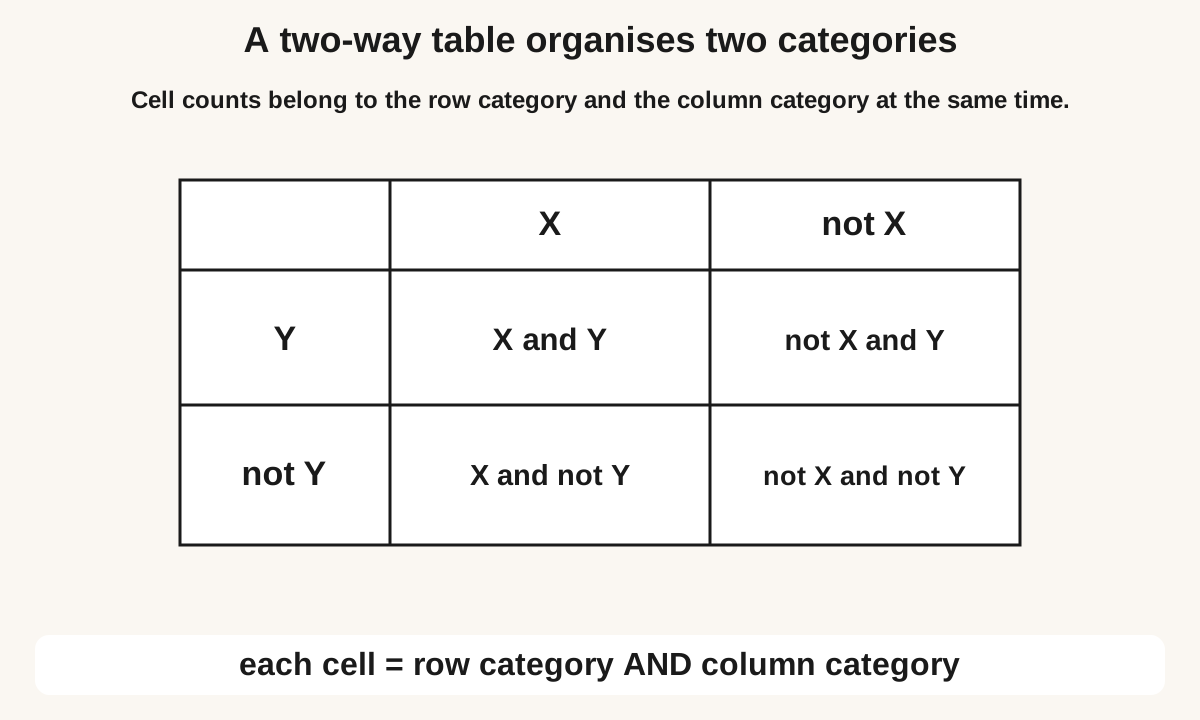
Enlarge diagram to read the labels
Swipe across the enlarged diagram to read every label.
Choose a method and explain why it works
For a complement, calculate 1 − P(A). In a table, identify whether the question names a whole row, whole column, one cell or a restricted subgroup. For an unconditional probability of a randomly selected member, divide the relevant count by the grand total. “Among group 1” changes the denominator to group 1’s total.
Notation: P(A′) = 1 − P(A). Joint: cell / grand total. Row proportion: cell / row total.
Key rule and when to use it
P(not A) = 1 − P(A). In a two-way frequency table, an overall probability uses the grand total, while a conditional question restricts the denominator.
Worked examples, step by step
Example 1: A fair die. Find P(not rolling a 6).
- P(6) = 1/6.
- P(not 6) = 1 − 1/6 = 5/6.
- Check: the faces 1, 2, 3, 4, 5 are five of six, which is 5/6.
Answer: 5/6
Check: Not 6 should be more likely than 6, and 5/6 is larger than 1/6.
Example 2: A two-way table of group and sport: group 1 cricket 12, chess 8; group 2 cricket 7, chess 13. Find P(chess) and P(group 1 and cricket).
- This is not a complement of a die. Grand total = 12+8+7+13 = 40.
- Chess column = 8+13 = 21, so P(chess) = 21/40.
- The group 1 and cricket cell is 12, so P(group 1 and cricket) = 12/40 = 3/10.
Answer: 21/40; 3/10
Check: Chess is just over half of 40, so 21/40 is plausible. 12/40 is less than half, matching one cell.
Example 3: A table records group A: 6 walkers and 4 bus users; group B: 9 walkers and 11 bus users. Find P(bus) and P(bus among group A).
- Grand total = 6 + 4 + 9 + 11 = 30. Bus total = 4 + 11 = 15.
- For everyone, P(bus) = 15/30 = 1/2.
- Among A only, the denominator is 10, so P(bus among A) = 4/10 = 2/5.
Common mistakes and important boundaries
“Not cricket” equals “chess” only if those are the only two exhaustive, mutually exclusive categories in the stated table. If a third sport exists, include it too. A joint event uses the overlap cell; a conditional proportion uses the restricted group as its reference whole.
A point to explain
A learner may compute 1 + P(A) for a complement, or divide a cell by the wrong total, or treat a table association as causation.
Compare an uncertain attempt with the closest worked example. Look at the meaning of each operation, unit and label before repeating the arithmetic.
Complement Probability and Two-Way Tables — practice
Work on paper first. Open each answer afterwards and compare the reasoning. Print the questions with or without the separate answer key; no account is required.
Name: ____________________ Date: __________
If P(A) = 2/5, what is P(not A)?
Answer and a way to check
3/5
Write 1 − 2/5 with a common denominator.
Table cells 12, 8, 7, 13. Grand total 40. Which is P(group 1 and cricket) if that cell is 12?
Answer and a way to check
12/40
A joint probability names one cell over the whole 40 people.
P(rain) = 1/8. Find P(not rain).
Answer and a way to check
7/8
Subtract 1/8 from 1.
Two-way table: 9, 6, 5, 10. Find the grand total.
Answer and a way to check
30
Add 9, 6, 5 and 10.
Table: group 1 cricket 12, chess 8; group 2 cricket 7, chess 13. Find P(cricket) as a fraction in lowest terms.
Answer and a way to check
19/40
Cricket is 12 + 7. Divide by 40.
In the 12, 8, 7, 13 table, group 1 has 12/20 cricket and group 2 has 7/20 cricket. What does that difference suggest, and what does it not prove?
Answer and a way to check
It suggests association between group and sport. It does not prove that being in group 1 causes a cricket choice.
Compare 12/20 with 7/20. Different row proportions suggest association. Cause is a stronger claim.
P(A) = 3/10. A student writes P(not A) = 3/10 + 1 = 13/10. What is the mistake?
Answer and a way to check
The complement subtracts from 1, so 1 − 3/10 = 7/10, and a probability cannot exceed 1.
P(not A) = 1 − P(A). The result must lie between 0 and 1.
Table of walk/bus and north/south: 9, 6, 5, 10 (grand total 30). Find P(not walk) and P(walk and north) if walk is the first row with cells 9 and 6, and north is the first column.
Answer and a way to check
1/2; 3/10
Walk total is 15, so not walk is 15/30. Walk and north is the 9 cell over 30.
Complement Probability and Two-Way Tables — answer key
3/5 Write 1 − 2/5 with a common denominator.
12/40 A joint probability names one cell over the whole 40 people.
7/8 Subtract 1/8 from 1.
30 Add 9, 6, 5 and 10.
19/40 Cricket is 12 + 7. Divide by 40.
It suggests association between group and sport. It does not prove that being in group 1 causes a cricket choice. Compare 12/20 with 7/20. Different row proportions suggest association. Cause is a stronger claim.
The complement subtracts from 1, so 1 − 3/10 = 7/10, and a probability cannot exceed 1. P(not A) = 1 − P(A). The result must lie between 0 and 1.
1/2; 3/10 Walk total is 15, so not walk is 15/30. Walk and north is the 9 cell over 30.
Questions students and parents ask
How is P(chess) different from P(chess given group 1)?
With group 1 counts 12 cricket and 8 chess, and group 2 counts 7 cricket and 13 chess, P(chess) = 21/40. Among group 1 only, P(chess given group 1) = 8/20 = 2/5.
Why can a denominator change between table questions?
Each denominator names the group from which selection is being made. The full population and a named subgroup are different reference wholes.
Is this a complete set of textbook exercise solutions?
No. This guide adapts BananaLearn’s own teaching examples and practice. It is not official NCERT material or a promise of the exact chapter sequence in a particular board, country or textbook edition.
What if the examples are still difficult?
Revisit Fractions. Try the first example with its model, then attempt one fresh question independently. A correct copied answer is not evidence that the method can be used without support.
Help at home
Ask the learner to circle the denominator’s group before calculating. It should match words such as “everyone”, “among” or “given that”.
Keep one example of the learner’s own working. A repeated difficulty across fresh questions can guide a discussion with their teacher; one short practice sheet does not establish a diagnosis or a full mastery profile.
Connect this idea to the next skill
About this guide
Based on BananaLearn’s Grade 8 course lesson “The Rest, and the Table”. The explanations have been adapted for independent reading; course diagrams are reused where they fit the idea, and missing classroom givens are made explicit in questions.
Need another way to understand it?
Bring one question your child found difficult to a free 50-minute session. Tell us their grade, curriculum and time zone so we can discuss a suitable next step.
Request a free session