
Start with the key idea
A force is a push or pull caused by an interaction. It can change an object’s motion or shape. Pressure describes how much perpendicular force acts per unit area: pressure = force ÷ area. For a fixed force, spreading it over a larger area lowers the average pressure. Force is measured in newtons; pressure in pascals when the area is in square metres.
1. Describe a force by its size and direction
When you push a drawer closed, your hand interacts with the drawer. When Earth pulls a falling ball down, the interaction does not require a hand touching it. Forces are interactions between objects, not substances stored inside a moving object.
A force has a magnitude (size) and a direction. A 6 N push to the right is different from a 6 N push to the left. The symbol N stands for newton. On a force diagram, name the object you are considering and draw arrows for forces acting on that object.
An unbalanced force can make an object speed up, slow down or change direction. Forces can also change shape, as when a soft ball is squeezed. Seeing no movement does not prove that no forces act: an object may be held in place by balanced forces.
2. Combine forces acting along one line
If two pushes act in the same direction, add their sizes. A 3 N and a 5 N push to the right combine to 8 N right. For opposite directions, subtract the smaller size from the larger and keep the larger force’s direction. An 8 N pull right against a 3 N pull left gives a net force of 5 N right.

Equal, opposite forces on the same object give zero net force along that line. Zero net force means no change in velocity; it does not always mean the object is stationary. A stationary object remains stationary, while an already moving object can continue at constant speed in a straight line if the net force is zero.
These examples assume the named forces are all the relevant forces along that line. Real moving carts may also experience friction. Do not silently ignore it in a question that states it is present.
3. Contact and non-contact forces
| Force | How it acts | Example to recognise |
|---|---|---|
| Muscular force through contact | A person or animal pushes or pulls through contact. | A hand pushes a trolley. |
| Friction | Opposes relative sliding, or the tendency to slide, at a contact. | The floor resists a box being dragged. |
| Support force | A surface pushes on an object touching it. | A table supports a book. |
| Gravity | Masses attract without needing contact. | Earth pulls a dropped ball down. |
| Magnetic force | Magnets can attract or repel; they can also attract suitable magnetic materials. | A magnet attracts an iron paper clip. |
| Electrostatic force | Electric charges can attract or repel. | A charged comb attracts small paper pieces. |
Friction does not simply mean ‘a force that always points backwards’. It acts against relative sliding or the tendency to slide at the contact. Static friction can help a shoe grip the ground as you walk. In a simple question about a box sliding right on a floor, the floor’s friction on the box acts left.
Non-contact does not mean that an object always feels a strong force at any distance. The interaction depends on the objects and their separation. A magnet does not attract every metal.
4. Pressure depends on force and contact area
For a perpendicular force spread over an area, average pressure P = F ÷ A. F is the force pressing normally (at right angles) on the surface. A is the contact area supporting that force. If pressure varies across the surface, this calculation gives its average over the stated area.
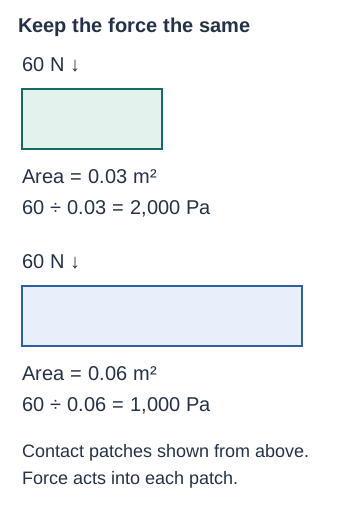
Keep one quantity fixed when explaining a comparison. ‘A larger area gives lower pressure’ needs the condition for the same force. If force and area both change, compare their ratio. Doubling both leaves the average pressure unchanged.
For the backpack example, a broad strap can spread a similar supporting force over a larger contact area. That can reduce average contact pressure. The actual pressure also depends on fit, padding and how the bag is carried; the model is not a promise that any particular bag is comfortable.
5. Use square units correctly
If F is in newtons and A is in square metres, pressure is in N/m², called pascals (Pa). Thus 1 Pa means 1 N per square metre. If you divide by an area in cm², your result is N/cm², not automatically Pa.
Because 1 m = 100 cm, a square metre has 100 × 100 = 10,000 square centimetres. Therefore 100 cm² = 0.01 m², not 1 m². Convert both dimensions or use the squared conversion factor.
Always identify the contact face. A box may have several different face areas. Its total outside surface area is not the area touching the floor. When a question rotates the same box onto another face, its weight stays the same but its contact area can change.
Mass and force also use different units. A value in kilograms is a mass, not a force in newtons. The numerical questions here supply the pressing force directly so you do not need to assume a value of gravitational acceleration.
6. Liquids, gases and atmospheric pressure
A fluid is a substance that can flow; liquids and gases are fluids. A liquid in a container presses on its base and sides. In a liquid at rest with uniform density, pressure increases with depth below the free surface. Points at the same depth in the same connected resting liquid have the same pressure under the same surface conditions.
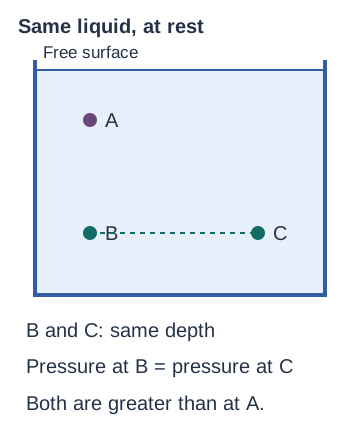
This does not mean the pressure is identical at every depth. The deeper point has more liquid above it. It also does not mean a wider container automatically produces greater pressure at a chosen depth; total force and pressure are different quantities.
Air exerts pressure too. Atmospheric pressure is associated with the weight of the atmosphere under gravity and changes with altitude and weather. A drinking straw works when the pressure in the straw is reduced and the greater pressure on the drink’s exposed surface pushes liquid upward. It is not a special upward ‘suction force’ that replaces pressure.
Our bodies are not empty containers: internal pressures and tissue structure help balance external pressure. Do not test pressure using sealed heated containers, sharp objects or heavy loads. Use the drawings and supplied data here.
Five worked examples with checks
1. A cart is pulled 9 N right and 4 N left. Find the net horizontal force.
- The forces are opposite, so subtract: 9 − 4 = 5.
- The larger force points right, so the net force is 5 N right.
- This predicts a change in velocity towards the right. It does not tell us the cart’s present speed or whether it was already moving left.
2. A flat pad carries a perpendicular force of 60 N over 0.03 m². Find its average pressure.
- Write P = F ÷ A.
- Substitute the stated contact area: P = 60 ÷ 0.03 = 2,000 Pa.
- Check: 2,000 N/m² × 0.03 m² = 60 N. The units and the original force agree.
3. The same 60 N force is spread over 0.06 m². What changes?
- The force stays fixed and the area doubles.
- P = 60 ÷ 0.06 = 1,000 Pa.
- Pressure halves from 2,000 Pa to 1,000 Pa. The force has not halved; its distribution over area has changed.
4. A 20 N force acts over 50 cm². Express the average pressure in pascals.
- Convert area: 50 ÷ 10,000 = 0.005 m².
- Calculate P = 20 ÷ 0.005 = 4,000 Pa.
- Alternatively, 20 ÷ 50 = 0.4 N/cm². Since 1 N/cm² = 10,000 Pa, this also gives 4,000 Pa. Do not label 0.4 as Pa.
5. Pad A carries 80 N over 0.04 m². Pad B carries 120 N over 0.08 m². Which has the greater average pressure?
- Both force and area change, so compare ratios instead of looking only at force.
- Pad A: 80 ÷ 0.04 = 2,000 Pa. Pad B: 120 ÷ 0.08 = 1,500 Pa.
- Pad A has the greater pressure, even though it carries the smaller force. State the comparison you calculated: pressure, not total load.
Save the guide or print the practice
Download to save or share
Complete guide with answers (PDF) · Worksheet without answers (PDF) · Worksheet and answer key (PDF)
Use paper for calculations. The examples supply force in newtons. This guide needs no unsafe experiments, sharp objects or heavy loads.
12 questions: predict, calculate and explain
Show the quantity you are finding, the formula or force combination, the units and a reason. The questions supply force values directly. Use the diagrams for reasoning; no physical experiment is required.
- Forces
A book rests on a table. Does this prove that no forces act on it?
Answer and reasoning
No.
Earth pulls the book down and the table supports it upward. If these forces balance, the book can remain at rest.
- Forces
Two pushes of 7 N and 2 N act left along the same line. Find their combined force.
Answer and reasoning
9 N left.
The pushes act in the same direction, so add their sizes and retain that direction.
- Forces
A horizontal 12 N pull right is opposed by 5 N friction left. Find the net horizontal force.
Answer and reasoning
7 N right.
Opposite forces subtract: 12 − 5 = 7. The stronger pull determines the net direction.
- Forces
A trolley moves straight at constant speed. Can its net force be zero?
Answer and reasoning
Yes.
Zero net force means no change in velocity. It does not require zero velocity. The statement assumes the relevant forces balance.
- Pressure
A force of 90 N acts perpendicularly over 0.03 m². Find the average pressure.
Answer and reasoning
3,000 Pa.
P = F ÷ A = 90 ÷ 0.03 = 3,000 N/m². Multiply the result by 0.03 m² to recover 90 N.
- Pressure
Keep the force fixed but make the contact area three times as large. What happens to pressure?
Answer and reasoning
It becomes one third as large.
Area is in the denominator of F/A. This conclusion requires the force to remain unchanged.
- Pressure
Convert 200 cm² to m².
Answer and reasoning
0.02 m².
Divide by 10,000 because the conversion is for area: 200 ÷ 10,000 = 0.02.
- Pressure
A 30 N load acts over 100 cm². Find the average pressure in Pa.
Answer and reasoning
3,000 Pa.
100 cm² = 0.01 m², so P = 30 ÷ 0.01 = 3,000 Pa.
- Compare
Pad X: 50 N over 0.01 m². Pad Y: 100 N over 0.04 m². Which pressure is greater?
Answer and reasoning
Pad X: 5,000 Pa, compared with 2,500 Pa for Pad Y.
Calculate both force-to-area ratios. The larger total force on Y does not by itself establish greater pressure.
- Fluids
Two points are at the same depth in the same connected liquid at rest. One is near a wide side and the other near a narrow side. Under the same surface conditions, which has greater pressure?
Answer and reasoning
Neither; the pressures are equal.
For a resting liquid of uniform density, depth and surface pressure control this comparison. Container width is not enough to change it.
- Explain
A learner says: ‘A magnet attracts all metals because magnetic force acts without contact.’ What needs correcting?
Answer and reasoning
A magnet does not attract every metal. Non-contact describes how a force can act, not which materials respond strongly.
The learner joins a correct category to an incorrect universal claim. Iron is a suitable example; do not generalise it to all metals.
- Transfer
Design a fair comparison of two model support pads using supplied force and area data. What should stay the same if you want to isolate the effect of area?
Answer and reasoning
Keep the perpendicular force the same and change only the contact area in the calculation.
Then compare F/A. State the assumed force and both areas, use consistent units and avoid unsafe physical loads; this can be a paper-based comparison.
What to check before handing in an answer
- Have I named the object the forces act on?
- Have I kept direction when combining forces?
- Am I calculating force or pressure?
- Is my area the contact area, in the correct square units?
- Have I kept force fixed before claiming that area alone changes pressure?
- For fluids, have I compared depth under the same conditions?
Explain a fresh example
A designer changes a model stand so that it touches a surface over four times the area. The supported force stays the same. Explain the pressure change without calculating a specific number, then choose your own force and area values to check it. The average pressure should become one quarter of its original value.
When practice gets stuck
If a learner can substitute numbers but cannot predict whether pressure should rise or fall, compare the two contact patches before calculating. If the prediction is right but the number is wrong, check the square-unit conversion. If they mix up force and pressure, ask what each unit measures. This is practice guidance, not a claim about the child’s ability.
Questions about force and pressure
Are force and pressure the same?
No. Force measures a push or pull. Pressure measures the perpendicular force per unit area. The same force can produce different average pressures when the contact area changes.
Does a heavier object always produce greater pressure?
Not necessarily. You also need the contact area. If both force and area change, calculate both ratios before comparing.
Why is the area in square metres?
Pascal is the SI unit N/m². Other area units are possible, but then you must label the resulting pressure unit correctly or convert the area first.
Does a stationary object have zero force on it?
It may have several nonzero forces that balance. Zero net force is different from no individual force.
Is this a complete NCERT chapter solution?
No. This is original Grade 8-level teaching and practice. It does not reproduce textbook exercises or certify a current chapter number. Check your school’s current edition for the required syllabus.
Connect the ideas
Ask about guided Science learning if your child needs help connecting a diagram, an explanation and a calculation.
About this guide and its sources
Original Grade 8-level explanations, diagrams and practice by BananaLearn. This is not an official paper or a reproduced textbook chapter. Formula checks use the references below; advanced material on those sites is not required for this guide.