
Start with the key idea
Matter has mass and occupies space. Under ordinary conditions, a solid has its own shape and volume; a liquid has a definite volume but takes the shape of its container; a gas spreads to fill the available space and can change volume noticeably. A material can change state when conditions change.
1. Start with what you can observe
Matter has mass and occupies space. A stone, water and the air inside a balloon are matter. You can see the stone and water easily. Air is often invisible, so use evidence such as an inflated bag taking up space instead of using visibility as the test.
Mass describes how much matter an object contains. Volume describes the space it occupies. They are different quantities: a large empty cardboard box can occupy more space than a small heavy stone. At this level, compare one property at a time.
Light and sound are not classified as matter in this school model. You do not need to see something to decide whether it is matter, and being visible does not by itself prove that it is a material object.
2. Compare shape and volume separately
Put a wooden block in a bowl and then on a tray. It retains its own shape. Pour the same water from a wide cup into a narrow one: its shape changes, but its volume stays the same if none is added or lost. Air inside a container spreads through the available space.
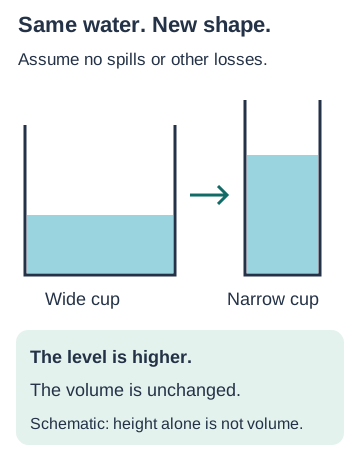
Use both shape and volume in a comparison. “A liquid has no shape” is misleading: a liquid has a shape at a particular moment, supplied by its container and surface. It does not have a fixed shape of its own like the block.
A gas can be compressed much more noticeably than a liquid under ordinary conditions. Do not say that liquids or solids can never change volume. Temperature and pressure can affect them too; the simple comparison describes familiar classroom conditions.
3. Flowing does not always mean liquid
Dry rice can be poured and a pile of sand can take the shape of a bucket. Each grain is still a solid. The whole collection moves because the grains slide past one another; it is not one liquid material. Look at one grain as well as the whole pile.
A sponge is a solid with spaces that can contain air or water. Squeezing it changes its shape. This does not mean it becomes a liquid: the solid framework remains. “Solids are always hard and impossible to bend” is not a reliable definition.
Some everyday substances are mixtures with complicated behaviour. Rather than forcing toothpaste or foam into a simple demonstration, begin with a block, clean water and air. Explain the limits of an example when the observation is not straightforward.
4. Use a simple particle model carefully
A useful model describes matter as extremely small particles. In a solid, particles remain close together and move about relatively fixed positions. In a liquid, particles stay close but can move past one another. In a gas, they are much farther apart on average and move through the available space.
A particle drawing is a model, not a magnified photograph. The dots, colours and gaps help us explain patterns. The particles are not literally large coloured balls, and particles in a solid are not completely motionless.
When water becomes ice or water vapour, the water particles do not turn into a different substance merely because the state changes. The arrangement and movement change. This model helps explain why pouring water changes its shape without making new water.
5. Follow water through changes of state
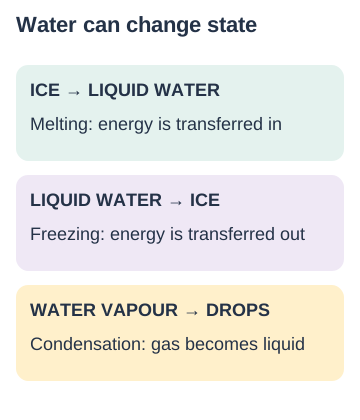
Melting changes a solid into a liquid, such as ice becoming liquid water as energy is transferred to it. Freezing changes a liquid into a solid as energy is transferred out. Water’s familiar freezing temperature is about 0°C for pure water at ordinary atmospheric pressure; dissolved substances can alter it.
Evaporation changes liquid water into water vapour at its surface and can happen below the boiling point. A puddle can dry on a cool day. Boiling is different: vapour bubbles form within the liquid when the conditions allow boiling. An adult should handle hot water; the practice here uses written observations.
Condensation changes water vapour into liquid water. Drops on the outside of a cold sealed bottle usually come from water vapour in the surrounding air, not water leaking through the bottle. Water vapour itself is invisible. The white cloud often called steam contains tiny liquid droplets.
6. Make a fair comparison and explain the limit
To compare water in two containers, use the same water and avoid spills. Notice its height and shape, but measure volume with suitable markings rather than assuming a taller column means more water. The containers’ widths matter.
For a paper observation task, imagine two identical small wet cloths, one spread out and one folded. Under otherwise similar conditions, the spread cloth exposes more surface area and will often dry faster. Air movement, temperature and humidity also matter; the observation does not establish a universal drying time.
Keep observations separate from explanations. “Drops appeared outside the cold bottle” is an observation. “Water vapour in the air condensed on the cool surface” is an explanation supported by the situation. A good answer names the state before and after, not only “it changed”.
5 worked examples with reasoning
1. A narrow cup makes the same water look taller. Has its volume increased?
- Assume none was added, spilled or evaporated during the transfer.
- The container changed the water’s shape and height.
- Its volume stayed the same; height alone does not measure the amount.
2. Rice pours from a jar. Is each grain a liquid?
- Observe one grain: it has its own shape.
- The grains can slide past one another as a collection.
- The grains are solids; pouring alone does not identify a liquid.
3. Drops form outside a cold, sealed bottle. Explain their likely source.
- The surrounding air contains water vapour.
- The vapour cools near the bottle and can condense.
- The droplets are liquid water on the outside; a sealed bottle need not have leaked.
4. A learner says “The puddle vanished, so the water stopped existing.”
- Some liquid water changed into water vapour and mixed with the air.
- The material can be present even when it is no longer visible as a puddle.
- Other routes such as soaking into the ground may also matter; use the stated situation.
5. A soft rubber ball changes shape when squeezed. Does that make it a liquid?
- A solid can deform under a force.
- The rubber remains a solid material even as its shape changes.
- Do not replace the state test with the rule that all solids must be rigid.
Save the guide or print the practice
Download to save or share
Complete guide with answers (PDF) · Worksheet without answers (PDF) · Worksheet and answer key (PDF)
Try each task before opening its answer. Give an example or reason, not only a label.
14 practice questions with explanations
Try each task before opening its answer. Give an example or reason, not only a label.
Write an answer and your reason before opening the explanation. Check the reasoning as well as the final answer.
- Compare
What two properties distinguish the usual school descriptions of solids, liquids and gases?
Answer and reasoning
Shape and volume.
Describe each property separately instead of using only whether something flows.
- Volume
The same water is poured without spilling into a wider bowl. What happens to its volume?
Answer and reasoning
It stays the same during the transfer.
The shape and height change, not the quantity of water.
- Gas
Why can invisible air still count as matter?
Answer and reasoning
It has mass and occupies space.
Visibility is not part of the definition.
- Grains
Why is a pile of sand not automatically a liquid?
Answer and reasoning
Each grain is a solid.
The grains move past one another as a collection.
- Change
Ice becomes liquid water. Name the change.
Answer and reasoning
Melting.
The starting state is solid and the final state is liquid.
- Change
Liquid water becomes ice. Name the change.
Answer and reasoning
Freezing.
The change is from liquid to solid.
- Change
Water vapour becomes droplets on a cool surface. Name the change.
Answer and reasoning
Condensation.
Gas becomes liquid.
- Evidence
Must a puddle boil before it can dry?
Answer and reasoning
No.
Evaporation can occur at temperatures below boiling.
- Model
Are particles in a solid completely still?
Answer and reasoning
No.
They move about relatively fixed positions in the simple model.
- Interpret
Is the white cloud above hot water pure invisible water vapour?
Answer and reasoning
No. The visible cloud contains tiny liquid droplets.
Water vapour itself is invisible; everyday use of steam can obscure this distinction.
- Fair test
Name two conditions besides surface area that affect drying.
Answer and reasoning
For example, temperature and air movement.
Humidity also matters; hold relevant conditions similar in a comparison.
- Reason
A sponge can be squeezed. Does that prove it is a liquid?
Answer and reasoning
No.
Its solid framework can deform and contains spaces.
- Observation
Write an observation about drops outside a cold bottle without explaining their source.
Answer and reasoning
Drops appeared on the outside surface.
That states what was observed, separately from the condensation explanation.
- Create
Write a sentence using both the starting and final states for evaporation.
Answer and reasoning
Liquid water changes into water vapour, a gas.
Naming both states makes the explanation precise.
Use the ideas without looking at the notes
Draw three boxes labelled solid, liquid and gas. Add one ordinary example and two properties to each. Then connect ice, liquid water and water vapour with arrows labelled melting, freezing, evaporation and condensation. Say which arrows transfer energy into or out of the water.
Common questions
Does a liquid have no shape?
It has a shape, but it takes the shape of its container rather than keeping a fixed shape of its own.
Are all solids hard?
No. Rubber and a sponge can deform while their material remains solid.
Is water vapour visible?
Water vapour is invisible. A visible mist or white cloud contains tiny droplets.
Can evaporation happen on a cold day?
Yes. It can happen below boiling, although conditions affect the rate.
Is this every possible state of matter?
No. This introductory guide focuses on the three states commonly compared at this level.
Connect your learning
Ask about guided Science learning if your child needs help explaining these ideas.
About this guide
Original explanations, examples, diagrams and practice by BananaLearn. The grade label indicates the intended learning level; this is not an official textbook extract or exam paper.