
Start with the key idea
Friction is a contact force opposing relative motion or the tendency to slide between surfaces. Static friction can act without sliding and adjusts up to a limit. Sliding and rolling resistance differ. Friction can be useful for grip and braking, while also causing wear and thermal energy transfer.
1. Name the two surfaces and the possible motion
Start with a box on a floor. The contact is between the bottom of the box and the floor. If the box slides right relative to the floor, friction on the box acts left. Label which object receives the force; the floor also experiences a force from the box.
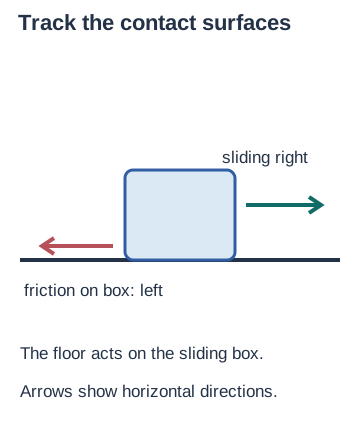
Friction opposes relative sliding or its tendency at the contact. This wording is more reliable than “friction always points backwards”. A walking person can receive a forward friction force from the ground because the foot tends to push the ground backwards.
A force diagram should show the chosen object and the relevant forces. For a simple horizontal example, identify friction separately from weight and the supporting force. Do not draw a horizontal friction arrow as though it were the object’s weight.
2. Static friction can act before sliding begins
When a small push fails to move a box, static friction can balance the horizontal push. If the push increases while the box remains still, static friction can increase too, up to a maximum determined by the contact conditions.
Static friction is not always equal to its maximum possible value. If the horizontal applied force is zero on a level surface with no other tendency to slide, the required friction may be zero. The force responds to the situation.
Once the push exceeds what the contact can support without sliding, the box begins to slide. This transition explains why starting a heavy object can feel different from keeping it moving. The exact comparison depends on the materials and conditions.
3. Compare sliding and rolling resistance
Sliding friction acts when surfaces move across one another. It can convert organised mechanical energy into internal energy, warming the contacting materials. Rubbing hands is a familiar example, but do not rub so hard that the skin is irritated.
Rolling often reduces resistance compared with dragging the same load on the same surface. Wheels and bearings exploit this. Rolling resistance is not zero: deformation, contact effects and other losses still matter.
Do not use “rolling friction is always least” as a universal rule without conditions. A small wheel on soft ground can face substantial resistance. Make comparisons for a stated load, surface and wheel arrangement.
4. Consider surfaces and the normal contact force
For many dry solid contacts, friction depends on the material pair and how strongly the surfaces are pressed together. The supporting normal force is perpendicular to the contact. On a simple horizontal floor with no other vertical forces, it equals the object’s weight.
Roughness is one influence, but microscopic adhesion and deformation also matter. Polishing a surface does not guarantee friction decreases in every situation. School models simplify this behaviour; state the model rather than treating it as an exception-free law.
Changing the apparent contact area alone does not necessarily change dry friction in the simple model. A broad box face and a narrow face can have similar sliding friction when the load and material pair remain the same, although real soft surfaces can behave differently.
5. Friction can help or hinder the task
Shoe soles need enough grip for walking. Brakes use friction to slow motion. Writing with a pencil depends partly on contact that leaves material on paper. Removing all friction would make many ordinary actions difficult.
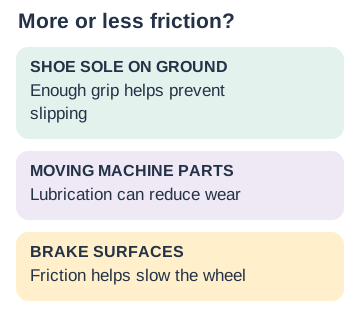
Lubricants can reduce direct contact and wear in moving machine parts. Bearings replace much sliding with rolling. Streamlined shapes can reduce fluid resistance. These are different ways to change resistance, chosen for different jobs.
Never put oil on brakes or shoe soles to demonstrate friction reduction. Use safe pictures or classroom models. A useful material in one location can make another location unsafe because the task needs grip.
6. Extend the idea to drag in air and water
A moving object in air or water experiences fluid resistance, often called drag. Its size depends on speed, shape, orientation and fluid properties. The effect is not identical to the simple dry-friction model for a block.
A cyclist crouching changes the shape presented to the air. A swimmer’s position changes water resistance. Increasing speed can greatly increase drag, so do not assume that doubling speed merely doubles the resisting force in every regime.
For a final explanation, identify the contact or fluid, the motion and whether resistance helps the task. Then suggest a change and explain its trade-off. “Increase friction” and “reduce friction” are decisions that need a purpose.
5 worked examples with reasoning
1. A box slides right on a fixed floor. Draw friction on the box.
- Identify the relative sliding direction: right.
- Friction on the box opposes that sliding.
- Draw its arrow left.
2. A box remains still under a small push. Is friction absent?
- There is a tendency to slide.
- Static friction can balance the push.
- It need not be at its maximum value.
3. Why do wheels help move a suitcase?
- They replace much sliding with rolling.
- Rolling resistance is often lower for the stated conditions.
- It is reduced, not eliminated.
4. Why should brake surfaces not be lubricated for an experiment?
- Braking requires sufficient friction.
- Reducing it can reduce stopping ability.
- Use a safe model instead of changing real brakes.
5. Why can friction act forward on a walking person?
- The foot tends to push backwards against the ground.
- The ground’s friction force on the foot can act forward.
- The direction follows relative sliding tendency at the contact.
Save the guide or print the practice
Download to save or share
Complete guide with answers (PDF) · Worksheet without answers (PDF) · Worksheet and answer key (PDF)
Try each task before opening its answer. Give an example or reason, not only a label.
14 practice questions with explanations
Try each task before opening its answer. Give an example or reason, not only a label.
Write an answer and your reason before opening the explanation. Check the reasoning as well as the final answer.
- Direction
A book slides left on a desk. Which way is friction on it?
Answer and reasoning
Right.
It opposes the relative sliding.
- Static
Can static friction be non-zero when an object is still?
Answer and reasoning
Yes.
It can oppose a tendency to slide.
- Limit
Is static friction always at its maximum?
Answer and reasoning
No.
It adjusts up to a limiting value.
- Zero
Can required friction be zero on a level surface?
Answer and reasoning
Yes.
If no force tends to cause sliding.
- Energy
Why can rubbing surfaces become warm?
Answer and reasoning
Mechanical energy is transferred into internal energy.
Friction dissipates organised motion.
- Rolling
Do wheels eliminate all resistance?
Answer and reasoning
No.
Rolling resistance and other losses remain.
- Use
Why are tyre treads useful?
Answer and reasoning
They help maintain suitable grip, especially in relevant surface conditions.
The purpose is controlled contact rather than zero friction.
- Use
Why lubricate suitable moving machine parts?
Answer and reasoning
To reduce direct friction and wear.
Use depends on the machine design.
- Contact
What does normal mean in normal contact force?
Answer and reasoning
Perpendicular to the contact surface.
It does not mean ordinary or average.
- Walking
Must friction always point opposite a person’s forward motion?
Answer and reasoning
No.
It opposes relative sliding at the contact and can act forward on a foot.
- Fluid
Name the resistance from air around a moving cyclist.
Answer and reasoning
Drag or air resistance.
It depends on speed, shape and other conditions.
- Model
Does more apparent contact area always mean more dry friction?
Answer and reasoning
No.
The simple dry-contact model does not predict that automatically.
- Safety
Should you oil a shoe sole to test reduced friction?
Answer and reasoning
No.
That creates a slipping hazard.
- Explain
Give one helpful and one unwanted effect of friction.
Answer and reasoning
For example: grip while walking; wear in machinery.
Its value depends on the task.
Use the ideas without looking at the notes
Choose walking, braking and moving a suitcase. For each, identify the contact, draw the relevant friction direction and explain whether more or less resistance helps.
Common questions
Can friction act on a stationary object?
Yes. Static friction can balance a tendency to slide.
Is friction always harmful?
No. Grip, writing and braking depend on it.
Is rolling resistance zero?
No. It is often lower than sliding resistance under comparable conditions.
Why does friction’s direction need care?
It follows relative sliding or its tendency at the contact, not always the object’s overall travel direction.
Is air resistance the same as dry sliding friction?
Both resist motion, but their detailed behaviour and models differ.
Connect your learning
Ask about guided Science learning if your child needs help explaining these ideas.
About this guide
Original explanations, examples, diagrams and practice by BananaLearn. The grade label indicates the intended learning level; this is not an official textbook extract or exam paper.