
Start with the key idea
Magnets have north and south poles. Like poles repel and unlike poles attract. Some materials, including iron and many steels, are strongly attracted by ordinary magnets; many metals are not. Attraction alone does not prove an object is itself a magnet, because unmagnetised iron can also be attracted.
1. Test the material, not the word metal
An ordinary magnet strongly attracts iron and many types of steel. It does not strongly attract common samples of aluminium, copper or brass. “All metals are magnetic” is therefore an unreliable classroom rule.
Steel is a family of alloys, and different types can behave differently. Some stainless-steel objects are attracted strongly and some are not. Describe the actual object and observation rather than claiming that every spoon gives the same result.
An object may contain several materials. A plastic-covered item can be attracted because of steel inside it. Seeing a plastic outer surface does not prove that plastic itself caused the attraction. Test safe, clearly identified samples where possible.
2. Compare the facing poles
A freely suspended suitable bar magnet tends to align roughly north–south, away from nearby magnetic interference. Its ends are labelled north and south. These labels describe poles, not positive and negative electric charges.
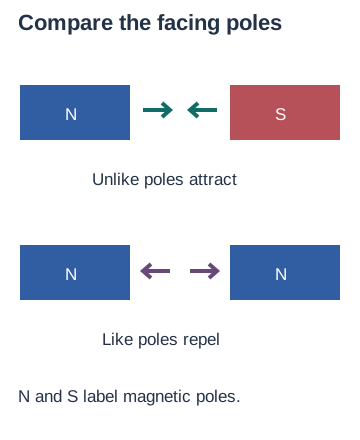
Bring two known magnets near each other without letting them snap together. North facing south attracts. North facing north repels, and south facing south repels. A force can act across a gap without the magnets touching.
The force depends on separation, orientation and magnet strength. Keep these conditions comparable when investigating. A failure to notice motion at a large distance does not mean the magnetic interaction has ceased completely.
3. Attraction and repulsion provide different evidence
A known magnet can attract another magnet’s opposite pole, but it can also attract unmagnetised iron through induced magnetisation. Attraction is therefore not enough to distinguish those two possibilities.
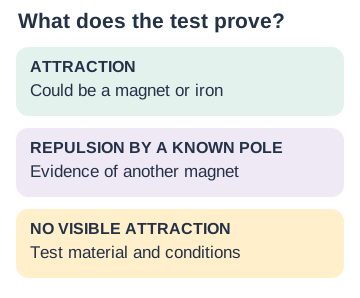
If one end of a test object repels a known pole under a sensible controlled test, that is evidence the object is magnetised. Repulsion is useful because ordinary unmagnetised iron would be attracted to either pole rather than repel one.
Use cautious wording: the test concerns this object in these conditions. Do not conclude that an item is non-magnetic from one distant test, or that a weak movement must be caused by magnetism when a surface is tilted.
4. A magnetic field describes the region of influence
A magnetic field is a way to describe magnetic effects around a magnet. A compass needle can help show a local direction. It does not have to touch the bar magnet to respond. Nearby iron objects, other magnets and electrical equipment can disturb the observation.
Field-line drawings are models. Outside a bar magnet, the conventional direction is from north to south. More closely spaced lines often represent a stronger field in a diagram, but the drawn lines are not physical threads.
At this level, a compass and diagram are enough. Avoid loose iron filings around eyes, electronics or young children. Do not cut a magnet to look for its poles; breaking a magnet produces smaller magnets with both poles, not a simple isolated north end.
5. Make a fair material comparison
Place safe samples on the same non-magnetic surface. Move the same magnet towards each sample in a similar orientation and note whether attraction is visible. Record the material, distance and result. Keep small magnets away from children who might swallow them.
To compare strength using identical paper clips, control the clips, magnet orientation and procedure. Counting lifted clips is an approximate test, not an absolute measurement of magnetic field strength. Different clip chains and contact arrangements can change the count.
Do not bring strong magnets near medical devices, magnetic storage, watches or delicate electronics. Use classroom magnets as intended. If an object is too heavy to move, attraction may still exist; inability to lift it does not prove absence of magnetic response.
6. Connect properties to uses and limitations
A magnetic catch holds a door because attraction acts between the magnet and a suitable counterpart. A compass uses a magnetised needle responding to the surrounding magnetic field. These are different uses of the same broad phenomenon.
A recycling magnet can separate strongly magnetic items from a mixture, but it does not collect all metals. Aluminium cans and copper pieces require other separation methods. The material property determines the method’s reach.
Finish by explaining a surprising observation: a covered steel object is attracted, or an aluminium object is not. State the material evidence and avoid treating appearance, shininess or heaviness as the deciding clue.
5 worked examples with reasoning
1. A copper wire is not noticeably attracted. Is the magnet necessarily broken?
- No. Copper is not strongly attracted by an ordinary magnet.
- Check the magnet with a known suitable sample such as iron.
- Material choice matters.
2. Two north poles face one another. Predict the interaction.
- Like poles repel.
- The force tends to push the magnets apart.
- Keep them close enough for an observable effect and handle safely.
3. A nail is attracted to both poles. What does that prove?
- The nail responds to the magnet.
- Unmagnetised iron can be attracted to either pole.
- The result alone does not prove the nail is a permanent magnet.
4. A plastic-covered clip is attracted. Explain a possible cause.
- There may be steel inside the covering.
- The observed force can act on the hidden material.
- Do not attribute the response to plastic without checking composition.
5. A recycling magnet misses aluminium. Is that unexpected?
- No. Ordinary magnets do not strongly attract aluminium.
- The method selects strongly magnetic materials.
- Other materials need other separation methods.
Save the guide or print the practice
Download to save or share
Complete guide with answers (PDF) · Worksheet without answers (PDF) · Worksheet and answer key (PDF)
Try each task before opening its answer. Give an example or reason, not only a label.
14 practice questions with explanations
Try each task before opening its answer. Give an example or reason, not only a label.
Write an answer and your reason before opening the explanation. Check the reasoning as well as the final answer.
- Poles
What happens when north faces south?
Answer and reasoning
Attraction.
Unlike poles attract.
- Poles
What happens when south faces south?
Answer and reasoning
Repulsion.
Like poles repel.
- Material
Name one strongly attracted common material.
Answer and reasoning
Iron.
Many steels are also strongly attracted.
- Material
Are all metals strongly attracted by ordinary magnets?
Answer and reasoning
No.
Copper and aluminium are common counterexamples.
- Evidence
Does attraction alone prove a test object is a magnet?
Answer and reasoning
No.
Unmagnetised iron can also be attracted.
- Evidence
Which observation is stronger evidence of another magnet: attraction or repulsion?
Answer and reasoning
Repulsion by a known pole.
Ordinary unmagnetised iron does not repel a known pole in this test.
- Gap
Must magnets touch to exert a force?
Answer and reasoning
No.
Magnetic effects can act across a gap.
- Compass
What can interfere with a compass observation?
Answer and reasoning
Nearby magnets or suitable metal objects, for example.
The needle responds to the local field.
- Model
Are drawn field lines physical threads?
Answer and reasoning
No.
They are a model of field direction and strength.
- Break
Would breaking a bar magnet normally create a north-only piece?
Answer and reasoning
No.
The smaller pieces still have both poles.
- Fair test
Name one variable to control when comparing magnets with clips.
Answer and reasoning
For example: use identical clips and the same arrangement.
Different procedures can change the count.
- Weight
Does failure to lift a heavy object prove no attraction?
Answer and reasoning
No.
The force may be too small to lift its weight.
- Safety
Why keep small magnets away from young children?
Answer and reasoning
Swallowing them can cause serious injury.
Use safe supervised materials.
- Apply
Why can a recycling magnet not sort every metal?
Answer and reasoning
Different metals have different magnetic responses.
The method selects a property, not the general label metal.
Use the ideas without looking at the notes
Make a table of safe sample materials and observed responses. Explain one attraction result, one non-attraction result and why attraction alone does not identify a permanent magnet.
Common questions
Are magnetic poles electric charges?
No. North and south are magnetic-pole labels, not positive and negative electric charges.
Is every stainless-steel item magnetic?
No. Stainless steels differ in their magnetic response.
Can a magnet act through a thin covering?
Yes, if a suitable magnetic material is behind it and the conditions allow a noticeable force.
Does attraction prove an object is a magnet?
No. Repulsion by a known pole is more diagnostic in a simple test.
Can I cut a magnet for this lesson?
No. Use diagrams and safe observations rather than cutting or breaking magnets.
Connect your learning
Ask about guided Science learning if your child needs help explaining these ideas.
About this guide
Original explanations, examples, diagrams and practice by BananaLearn. The grade label indicates the intended learning level; this is not an official textbook extract or exam paper.