Science · Suggested Grade 9
Class 9 Density and Buoyancy: Why Objects Float or Sink
A heavy ship can float while a small metal piece sinks. Total mass alone does not settle the question; volume, average density and the water displaced matter too.
Original explanations and practice by BananaLearn · Published 31 October 2026
On a small screen, swipe across the illustration to read every label.
Density compares mass with volume
Density = mass ÷ volume. It tells us how much mass occupies a specified volume. A 54 g object with volume 20 cm³ has density 2.7 g/cm³. Keep units consistent: grams with cubic centimetres or kilograms with cubic metres. The unit is not grams per centimetre, which would describe mass per length.
Objects of the same uniform material can have different masses and volumes but approximately the same density under the same conditions. Doubling both mass and volume leaves the ratio unchanged. A hollow object’s average density includes its enclosed space, so it can differ greatly from the density of the solid material making its shell.
Worked example: find an irregular solid’s volume
A small non-absorbing solid is fully submerged in a measuring cylinder. The water reading rises from 48 mL to 68 mL, with no spill or trapped air. The displaced volume is 20 mL. Since 1 mL = 1 cm³, the object’s volume is 20 cm³. If its mass is 54 g, density = 54/20 = 2.7 g/cm³.
The final reading 68 mL includes water that was already there; it is not the object’s volume. The method assumes the object does not dissolve, absorb water or react with it, and that it is completely submerged. Use stable school equipment with adult supervision if a teacher chooses a demonstration; the supplied numbers are enough for calculation practice.
Buoyancy is an upward force from the fluid
An immersed object experiences an upward force called buoyant force or upthrust. Archimedes’ principle relates it to the weight of the fluid displaced. For a simple model, buoyant force = fluid density × gravitational field strength × submerged volume. In SI units, kg/m³ × N/kg × m³ gives newtons.
The volume in this formula is the submerged volume, not automatically the object’s entire volume. A partly floating object displaces water only with its submerged part. If an object is held down below the surface, the force comparison may differ from its eventual freely floating state.
Worked example: compare forces
An object has weight 30 N and experiences 20 N upward buoyant force while fully submerged. Ignoring other forces at that instant, the net force is 10 N downward. If released from rest under those conditions, it initially accelerates downward; the calculation does not establish a constant sinking speed.
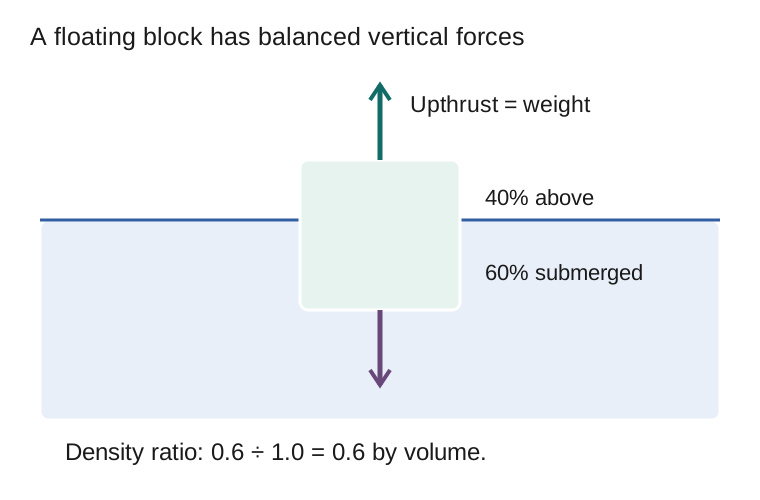
An object floating at rest has upward buoyant force equal to its weight. It does not float because the upward force remains permanently larger than the weight. As it rises and less of it stays submerged, the displaced volume can decrease until the forces balance, provided a stable floating position is possible.
Use average density for a first comparison
In water with density approximately 1 g/cm³, a freely placed object with average density 0.6 g/cm³ can float with part above the surface in the simple uniform model. An average density of 2.7 g/cm³ gives a sinking prediction if the object remains intact, fills no new cavities and other effects are negligible.
For a uniformly dense floating block, the fraction submerged equals object density divided by fluid density. The 0.6 g/cm³ block in 1 g/cm³ water is about 60% submerged by volume. This relationship does not say 60% of the block’s height is submerged for every possible shape; volume and height fractions coincide for a block with a constant horizontal cross-section.
Worked explanation: why a metal ship can float
A ship’s metal shell encloses a large volume that includes air. Its total mass divided by the whole displaced-envelope volume can be lower than water’s density. The ship sinks enough to displace water whose weight balances its own weight. A solid piece of the same metal has much less volume for its mass and may sink.
Adding cargo increases the weight and generally requires more displaced water, so the ship sits lower until a new balance is reached within its safe design limits. If water enters spaces that formerly held air, the situation changes. Do not turn a simple density lesson into advice about real vessel loading or water safety.
Check the model’s assumptions
Surface tension can support some small objects in ways that a simple bulk-density comparison misses. Trapped air, absorption and changes in shape can also matter. Begin with the stated idealised conditions and name extra effects only when relevant to the observation. A single object’s behaviour does not establish a rule that all metal always sinks.
For revision, keep mass, weight, density and force in separate columns. Explain what each quantity measures and which unit belongs to it. A parent can ask why the object’s volume is the rise in cylinder readings and why a floating-at-rest diagram needs equal force arrows. These explanations reveal understanding beyond substituting into a formula.
Keep the physical quantities separate
Use this reference while checking an explanation or solving a related question.
| Quantity | Meaning | Example unit | Example value |
|---|---|---|---|
| Mass | Amount of matter in the object | g or kg | 54 g |
| Volume | Space occupied | cm³ or m³ | 20 cm³ |
| Density | Mass per volume | g/cm³ or kg/m³ | 2.7 g/cm³ |
| Weight / upthrust | Forces, with directions | N | 30 N down / 20 N up |
10 questions with explained answers
Try the questions before opening the answers. Explain the reason, then try a changed example to check your understanding.
Mass 54 g and volume 20 cm³: find density.
Show answer and explanation
2.7 g/cm³
54 ÷ 20 = 2.7.Water rises from 48 to 68 mL. Find displaced volume.
Show answer and explanation
20 mL = 20 cm³
Subtract the initial reading.If mass and volume both double, what happens to density?
Show answer and explanation
It stays the same
The common scale factor cancels in m/V.Weight 30 N and upthrust 20 N: find net force.
Show answer and explanation
10 N downward
The downward weight exceeds the upward force.A block floats at rest with weight 12 N. Find upthrust.
Show answer and explanation
12 N
The vertical forces balance.A uniform block has density 0.6 g/cm³ in water of density 1 g/cm³. What fraction is submerged?
Show answer and explanation
0.6, or 60% by volume
Use the density ratio in the simple floating model.Does a ship’s metal density alone determine its average density?
Show answer and explanation
No
The whole object includes enclosed volume and its contents.Fluid density 1,000 kg/m³, g = 10 N/kg, submerged volume 0.002 m³. Find buoyant force.
Show answer and explanation
20 N
1,000 × 10 × 0.002 = 20.Is the final cylinder reading automatically the object’s volume?
Show answer and explanation
No
Subtract the initial water volume, assuming full immersion and suitable material.Does heavier always mean more likely to sink?
Show answer and explanation
No
Volume, average density and force balance also matter.
Keep the ideas connected
- Review forces and pressure
- Distinguish force from constant speed
- Keep units consistent
- Practise reading physical relationships
For help with a school-learning difficulty, bring one attempted question to a discussion about tutoring and curriculum fit. Maths is our priority; English and Science tutoring are also available.
Sources, scope and sharing
The examples, diagrams and practice are original BananaLearn work. Grade labels suggest a learning level; teaching sequences and school requirements can differ. Official sources below support the stated facts and resource links. These activities are independent resources, not official exam questions or endorsed campaign materials.
How we prepare learning guides · Report a correction
Share this guide: https://bananalearn.com/learn/class-9-density-buoyancy-floating-sinking.html