Start with the school’s actual course
CBSE Class 3 Maths syllabus: a parent’s map
Maths Mela moves between number stories, shapes, sharing and everyday measurement. Use its smaller number contexts to develop reasoning; larger numbers are not automatically better practice.
Source and scope. NCERT textbook catalogue and the 2026–27 Delhi Directorate of Education chapter cross-check. School textbooks and teaching order should be confirmed; Delhi term dates are not universal CBSE deadlines. This is a skill summary, not a replacement for the official syllabus and its exclusions.
Counting and hundreds
Use place value, number lines and comparisons through the school’s current range, building toward 1000.
Adding and taking away
Connect number stories to flexible addition and subtraction, including regrouping when needed.
Equal groups
Link tables, multiplication and division to familiar collections rather than isolated chants.
Fair shares
Explain halves and quarters with equal parts of a whole and equal shares of a collection.
Shapes and space
Recognise 2D/3D shapes in different orientations and describe their features.
Length, mass and capacity
Choose suitable units, compare, estimate and measure everyday objects.
Money and time
Find costs or change and read simple time/calendar situations.
Data and patterns
Collect, organise and explain a small set of observations or a number pattern.
What to check before starting harder work
Choose the operation, then calculate
Read place value in the number range taught; explain addition and subtraction; build small equal groups.
A keyword such as “more” does not always mean add. Ask what is known and what is missing. If one child has 18 cards, which is 5 more than another child, finding the other collection needs subtraction.
Use a blank sheet and let your child show a method. Record the first point where help is needed: reading the question, choosing a representation, carrying out a calculation or explaining the answer. That observation makes a tutoring conversation more specific than “Maths is weak”.
Two examples that reveal the reasoning
These are original teaching examples, not copied textbook answers or predictions of an exam question.
Worked example 1
The word “more” can hide subtraction
Mira has 18 cards. That is 5 more than Dev has. How many cards does Dev have?
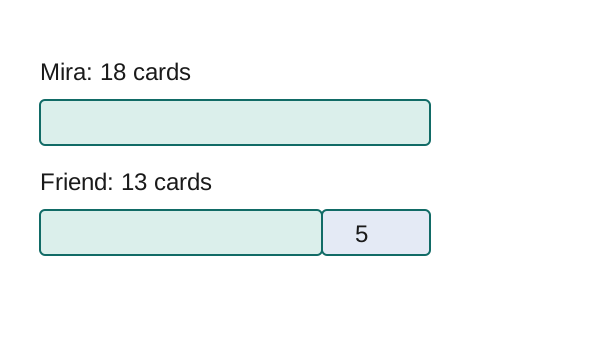
Swipe across the diagram to see the full explanation.
Work it through. Draw Mira’s bar of 18 as Dev’s unknown bar plus 5. Remove the extra 5:18 − 5 = 13. Check the story: 13 + 5 = 18. Adding 18 and 5 would find a collection bigger than Mira’s, which the story does not ask for.
What to notice: Look for the relationship, not a single word.
Worked example 2
A quarter of a collection
Twelve seed packets are shared equally among 4 garden teams. What fraction and how many packets does each team receive?
Work it through. Four equal groups each contain 3. Each team gets one of four equal shares, or one quarter of the collection. The number 3 counts packets; the fraction 1/4 describes a share of the whole collection.
What to notice: Keep the number of groups, the amount in each and the fraction distinct.
A short Class 3 Maths check, with explained answers
Try these before opening the answers. Use drawings or working; speed is not the aim. This samples a few skills and is not a full syllabus test.
Find 245 + 130.
Show answer and reasoning
375: add one hundred and three tens.
A child has 24 stamps,6 more than a friend. How many does the friend have?
Show answer and reasoning
18; 24 − 6, checked with 18 + 6.
Six trays hold 4 cups each. Find the total.
Show answer and reasoning
24 cups; 6 × 4.
Find one quarter of 20 counters.
Show answer and reasoning
5; share 20 into four equal groups.
A drink costs ₹ 18. Find change from ₹ 50.
Show answer and reasoning
₹ 32; 18 + 32 = 50.
A shape is turned upside down. Must its number of sides change?
Show answer and reasoning
No; a turn changes orientation, not its sides.
Use the result to choose the next step
- Correct answer and clear explanation: change the numbers or context and check transfer.
- Correct method, calculation slip: practise the specific operation and use an estimate or inverse check.
- Unsure how to begin: return to an object, drawing or simpler example of the same idea before assigning more questions.
A short check cannot diagnose a learning condition or establish full mastery. Keep the actual working to discuss with the school teacher or tutor.
A focused learning sequence you can adapt
Choose one priority from the school chapter and the practice above. These are four learning steps, not a promise that every learner finishes in four lessons.
- Step 1. Retell a short story without calculating.
- Step 2. Draw a bar, a collection or equal groups that match the story.
- Step 3. Choose the operation and explain the units in the answer.
- Step 4. Change one condition and ask whether the method still works.
After each step, keep one independent attempt and one note about the help needed. Move on when the explanation holds up in a changed example; revisit the prerequisite when it does not.
Go deeper into the relevant concepts
Use the lesson that matches the difficulty you observed. These topic guides may carry another grade label because a prerequisite can be introduced or revisited at different times in different schools.
Explore Maths practice games for extra practice. A game score is one piece of information; pair it with a spoken or written explanation.
When one-to-one CBSE Maths tuition may help
Bring the current textbook, one independently attempted question and the school’s next topic. A tutor can use the working to separate a prerequisite gap from a new topic that simply needs clearer explanation.
- Individual attention: one child and one teacher in a 50-minute online class.
- First session: request a free 50-minute session and discuss the teaching fit and next priorities.
- Ongoing plan: agree the topics, schedule and how progress will be reviewed before committing.
- Prices: check the current pricing page. Packs are 16, 32 or 64 or more classes of 50 minutes; they are not purchased hours.
Maths is our priority. English and Science tutoring are also available; ask about the relevant school course. Availability and curriculum fit are confirmed before ongoing lessons.
Tell us where Class 3 Maths gets difficult
Include CBSE, Class 3, the textbook or chapter and a question your child found difficult. Add your time zone if you live overseas.
Request a free Class 3 sessionQuestions parents ask
Does my child need tuition for every CBSE Class 3 topic?
Not necessarily. Start with the school’s current chapter and ask your child to explain a question without prompts. If the difficulty is confined to one prerequisite, a focused plan may be more useful than repeating every chapter.
Will you follow our school textbook?
Share the NCERT or school textbook title, edition and current chapter. New textbook sequences differ from many older online lists. Confirm the school’s sequence rather than relying only on a class label.
How do we judge whether the first session helped?
Keep one question your child needed help with. Later, try a similar question with changed numbers and ask for an explanation. Look for more independent reasoning, not only a higher score on a familiar exercise. One session does not establish mastery.
What happens before we pay for ongoing classes?
Request the free 50-minute first session. Discuss the topic, teaching fit and available time. Ask for the next learning priorities and confirm the current paid plan on the pricing page. Class packs count 50-minute classes, not hours.
Can we join from outside India?
Share your country, local time zone, school curriculum and preferred times. Availability and curriculum fit must be confirmed. For CBSE or ICSE schools overseas, include the class and textbook; for another curriculum, use the international tutoring page.
Curriculum sources and how to use this guide
Curriculum checked 30 October 2026. NCERT textbook catalogue and the 2026–27 Delhi Directorate of Education chapter cross-check. School textbooks and teaching order should be confirmed; Delhi term dates are not universal CBSE deadlines.
Open the official NCERT textbook catalogue.
For a second official cross-check, see the Delhi Directorate of Education 2026–27 syllabus collection. Use the relevant class’s Mathematics document; its school calendar applies to that system.
BananaLearn’s examples, explanations and practice are original. School-issued instructions and the official examination syllabus take precedence. How we prepare learning guides.