Start with the school’s actual course
CBSE Class 1 Maths syllabus: a parent’s map
Use the stories and pictures in Joyful Mathematics to connect quantity, number symbols and everyday language. A short conversation about a picture can be more informative than a page of copied sums.
Source and scope. NCERT textbook catalogue and the 2026–27 Delhi Directorate of Education chapter cross-check. School textbooks and teaching order should be confirmed; Delhi term dates are not universal CBSE deadlines. This is a skill summary, not a replacement for the official syllabus and its exclusions.
Position and sorting
Describe where an object is, pair matching objects and explain a sorting rule.
Numbers and tens
Count small groups reliably, compose ten and build numbers through 99 with tens and ones.
Joining and taking away
Act out simple addition and subtraction stories; connect a picture to a number sentence.
Shapes and comparison
Recognise familiar flat and solid shapes; compare length and discuss rolling or sliding.
Patterns and repeated actions
Continue a stated pattern and count equal repeated actions without rushing to formal tables.
Time, money and data
Order daily events, explore familiar coins and organise a small picture collection.
What to check before starting harder work
From counting aloud to knowing how many
Match one spoken number to one object; compare small collections; use words such as inside, above and beside.
A child may recite far beyond the numbers they can actually count. Begin with a small collection, move each object once and ask how many there are altogether. Spreading the same objects farther apart should not change the count.
Use a blank sheet and let your child show a method. Record the first point where help is needed: reading the question, choosing a representation, carrying out a calculation or explaining the answer. That observation makes a tutoring conversation more specific than “Maths is weak”.
Two examples that reveal the reasoning
These are original teaching examples, not copied textbook answers or predictions of an exam question.
Worked example 1
Seven passengers, three empty seats
A toy bus has 10 seats and 7 passengers. How many more passengers can sit?
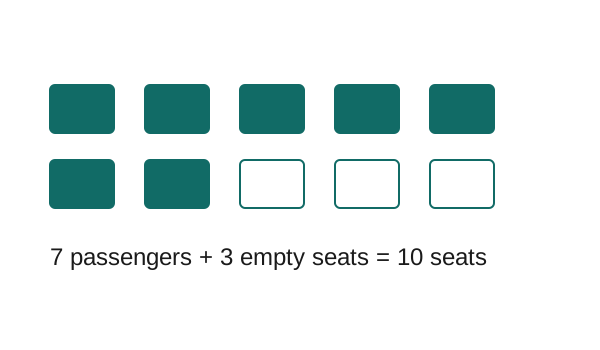
Swipe across the diagram to see the full explanation.
Work it through. Draw ten seats and place a counter on seven. Count the three empty seats. Record 7 + 3 = 10; the missing part is 3. Then cover the drawing and ask what changes if one passenger gets off. There are now 6 passengers and 4 empty seats. The total number of seats remains 10.
What to notice: The child is relating a whole to its parts, not merely reciting a number bond.
Worked example 2
Does a longer row mean more?
Put 6 counters close together, then spread those same counters into a longer row. Are there more now?
Work it through. No objects were added or removed, so there are still 6. Pair the counters with six marks to check. A longer row measures the space between counters; it does not measure how many counters there are.
What to notice: If the answer changes when the spacing changes, revisit one-to-one matching before harder written sums.
A short Class 1 Maths check, with explained answers
Try these before opening the answers. Use drawings or working; speed is not the aim. This samples a few skills and is not a full syllabus test.
Make 10 using 4 and another number.
Show answer and reasoning
6; four and six fill ten places.
There are 8 birds. 2 fly away. How many remain?
Show answer and reasoning
6; remove two from the group of eight.
Which is more: 9 buttons or 7 buttons?
Show answer and reasoning
9 buttons; pair seven and two remain unmatched.
Continue red, blue, red, blue using the same repeat.
Show answer and reasoning
Red, then blue. The repeating unit has two colours.
A box is under a chair. Is it above the chair?
Show answer and reasoning
No. The two position words describe different locations.
Sort 5 toy cars and 3 toy animals. How many toys altogether?
Show answer and reasoning
8; combine both groups and count each toy once.
Use the result to choose the next step
- Correct answer and clear explanation: change the numbers or context and check transfer.
- Correct method, calculation slip: practise the specific operation and use an estimate or inverse check.
- Unsure how to begin: return to an object, drawing or simpler example of the same idea before assigning more questions.
A short check cannot diagnose a learning condition or establish full mastery. Keep the actual working to discuss with the school teacher or tutor.
A focused learning sequence you can adapt
Choose one priority from the school chapter and the practice above. These are four learning steps, not a promise that every learner finishes in four lessons.
- Step 1. Count and rearrange a small collection without adding any objects.
- Step 2. Build the same total in two parts; record with a picture before symbols.
- Step 3. Retell a joining or taking-away story using objects.
- Step 4. Return to a fresh story and check whether the child chooses a method independently.
After each step, keep one independent attempt and one note about the help needed. Move on when the explanation holds up in a changed example; revisit the prerequisite when it does not.
Go deeper into the relevant concepts
Use the lesson that matches the difficulty you observed. These topic guides may carry another grade label because a prerequisite can be introduced or revisited at different times in different schools.
Explore Maths practice games for extra practice. A game score is one piece of information; pair it with a spoken or written explanation.
When one-to-one CBSE Maths tuition may help
Bring the current textbook, one independently attempted question and the school’s next topic. A tutor can use the working to separate a prerequisite gap from a new topic that simply needs clearer explanation.
- Individual attention: one child and one teacher in a 50-minute online class.
- First session: request a free 50-minute session and discuss the teaching fit and next priorities.
- Ongoing plan: agree the topics, schedule and how progress will be reviewed before committing.
- Prices: check the current pricing page. Packs are 16, 32 or 64 or more classes of 50 minutes; they are not purchased hours.
Maths is our priority. English and Science tutoring are also available; ask about the relevant school course. Availability and curriculum fit are confirmed before ongoing lessons.
Tell us where Class 1 Maths gets difficult
Include CBSE, Class 1, the textbook or chapter and a question your child found difficult. Add your time zone if you live overseas.
Request a free Class 1 sessionQuestions parents ask
Does my child need tuition for every CBSE Class 1 topic?
Not necessarily. Start with the school’s current chapter and ask your child to explain a question without prompts. If the difficulty is confined to one prerequisite, a focused plan may be more useful than repeating every chapter.
Will you follow our school textbook?
Share the NCERT or school textbook title, edition and current chapter. New textbook sequences differ from many older online lists. Confirm the school’s sequence rather than relying only on a class label.
How do we judge whether the first session helped?
Keep one question your child needed help with. Later, try a similar question with changed numbers and ask for an explanation. Look for more independent reasoning, not only a higher score on a familiar exercise. One session does not establish mastery.
What happens before we pay for ongoing classes?
Request the free 50-minute first session. Discuss the topic, teaching fit and available time. Ask for the next learning priorities and confirm the current paid plan on the pricing page. Class packs count 50-minute classes, not hours.
Can we join from outside India?
Share your country, local time zone, school curriculum and preferred times. Availability and curriculum fit must be confirmed. For CBSE or ICSE schools overseas, include the class and textbook; for another curriculum, use the international tutoring page.
Curriculum sources and how to use this guide
Curriculum checked 30 October 2026. NCERT textbook catalogue and the 2026–27 Delhi Directorate of Education chapter cross-check. School textbooks and teaching order should be confirmed; Delhi term dates are not universal CBSE deadlines.
Open the official NCERT textbook catalogue.
For a second official cross-check, see the Delhi Directorate of Education 2026–27 syllabus collection. Use the relevant class’s Mathematics document; its school calendar applies to that system.
BananaLearn’s examples, explanations and practice are original. School-issued instructions and the official examination syllabus take precedence. How we prepare learning guides.