
Start with the key idea
A number bond shows how parts make a whole. For bonds to 10, the whole is 10 and the two parts add to 10. If one part is 7, the other is 3: 7 + 3 = 10. You can show the same relationship with objects, a ten-frame, a part–whole diagram or a number sentence.
1. Find the whole before the parts
For the learner: Start with ten objects. Put seven on one side and three on the other. There are still ten altogether. You have moved the objects, not added new ones.
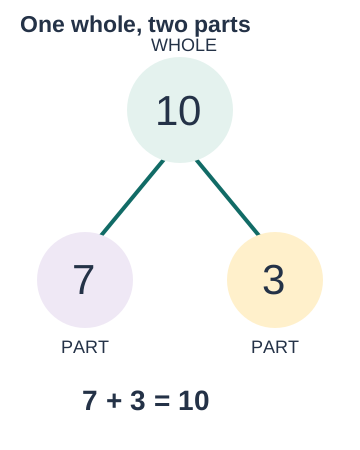
The whole tells us how many there are altogether. The parts tell us how that same collection is split. Say: ‘Ten is the whole. Seven is one part. Three is the other part.’ Join the groups to check.
A part–whole picture has three labelled spaces. Do not count 10, 7 and 3 as three separate collections to add. The ten already includes the seven and the three. Adding all three labels would count the collection twice.
For an adult: Check that the learner can count ten objects accurately, touching each once. If counting is still uncertain, use a smaller whole such as five before expecting missing-part reasoning with ten.
2. See the missing part in a ten-frame
A ten-frame has two rows of five spaces. Put one counter in each space, starting across the top row. With seven counters, the top row is full and two spaces in the bottom row are filled. Three spaces remain empty.
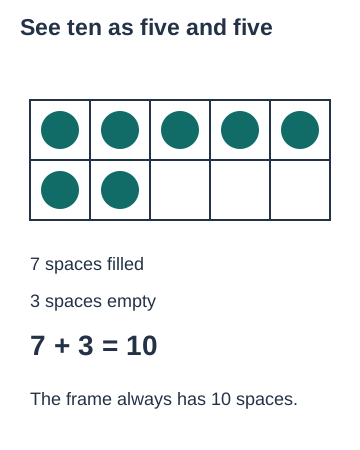
Point to the groups as you say: ‘Seven filled and three empty make ten spaces.’ The empty spaces are the missing part. They are not extra spaces outside the frame.
The picture gives you more than a count. A full row shows five. One more counter shows six. Two more show seven. Seeing five and some more can help you avoid starting from one every time.
Do not hide the objects immediately or insist on mental answers. Let the learner check with the model, then gradually cover a small part and ask what must be underneath.
3. Build all the pairs in a sensible order
Begin with none on the left and ten on the right. Move one object from right to left each time. The left part grows by one while the right part shrinks by one. The whole stays ten.
| First part | Other part | Whole |
|---|---|---|
| 0 | 10 | 10 |
| 1 | 9 | 10 |
| 2 | 8 | 10 |
| 3 | 7 | 10 |
| 4 | 6 | 10 |
| 5 | 5 | 10 |
| 6 | 4 | 10 |
| 7 | 3 | 10 |
| 8 | 2 | 10 |
| 9 | 1 | 10 |
| 10 | 0 | 10 |
For the learner, read a few rows aloud while moving the objects. For an adult, there are eleven ordered pairs here. If reversed pairs count as the same pair, there are six: 0 and 10, 1 and 9, 2 and 8, 3 and 7, 4 and 6, and 5 and 5. Explain which meaning you intend before asking how many pairs there are.
Zero belongs in the list. It means there are no objects in that part; it does not mean the whole disappears.
4. Find a missing part, not a new whole
In 6 + □ = 10, we already know the whole. The box asks for the other part. Place six counters in the frame and count the four empty spaces. Write 4 in the box and read the complete sentence: ‘Six plus four equals ten.’
Do not add the two visible numbers and write 16. That would answer ‘What is six plus ten?’ It is a different question. Use the position of the missing box and the meaning of the story.
The equal sign means the amounts on its two sides have the same value. 10 = 6 + 4 is also correct. Moving the whole to the left of the equal sign does not change the relationship.
A useful check is to put the parts back together. If the known part is six and the answer is four, count six and four to confirm the total is ten.
5. Connect the bond to subtraction
If ten counters are split into seven and three, covering the seven leaves three visible. That gives 10 − 7 = 3. Covering the three leaves seven: 10 − 3 = 7.
The same bond also gives 7 + 3 = 10 and 3 + 7 = 10. Swapping the two parts changes their order but not their total. This does not mean you can swap the numbers in subtraction and keep the same answer.
With equal parts, the written sentences repeat: 5 + 5 = 10 and 10 − 5 = 5. Do not demand four different facts for the 5-and-5 bond when there are only two distinct sentences of these forms.
Use both joining stories and missing-part stories. For example, ‘There are ten seats and seven are taken’ asks about the remaining part; ‘Seven children arrive and three more arrive’ asks about the whole.
6. Practise a little, then use it in a new story
Show: choose one bond and build it with ten counters. Say: name the whole and both parts. Write: record a matching number sentence. Change: move one counter between the parts and describe what changed and what stayed the same.
Next, cover one group with a sheet of paper. Keep the total known and count the visible group. Ask how many are hidden and uncover them to check. Use objects large enough for the child to handle safely.
Finish with a new context, such as ten spaces on a toy shelf or ten paper stars for a display. A learner who remembers ‘7 and 3’ but cannot use it in a story may need more time linking words, objects and equations.
For a child ready for more, connect a bond to adding beyond ten: 8 + 5 can become 8 + 2 + 3, then 10 + 3. This is an optional next step, not a requirement before the bonds to ten are understood.
5 worked examples with reasoning
1. A ten-frame has 8 counters. How many more fill it?
- The frame has ten spaces altogether.
- Eight are filled and two are empty.
- Two more fill it: 8 + 2 = 10.
2. There are 10 paper stars. Four are on a poster. How many are still on the table?
- Ten is the whole collection.
- Four are one part. We need the other part.
- Six remain: 4 + 6 = 10, so 10 − 4 = 6.
3. Complete 10 = □ + 9.
- The whole is still ten even though it is written first.
- Nine needs one more to make ten.
- Write 1 in the box: 10 = 1 + 9.
4. A learner says 6 and 5 make 10. Check the claim.
- Fill six spaces of a ten-frame.
- Only four empty spaces remain. A fifth extra counter would sit outside the full frame.
- Six and five make eleven. The bond to ten is six and four.
5. Split ten into two equal parts. What are the parts?
- Share the ten counters equally into two groups.
- Each group has five.
- The bond is 5 and 5: 5 + 5 = 10. Equal parts are allowed.
Save the guide or print the practice
Download to save or share
Complete guide with answers (PDF) · Worksheet without answers (PDF) · Worksheet and answer key (PDF)
An adult can read the questions aloud. Draw dots or use ten large counters if helpful. Write or say the missing number and show how you checked. Work through a few questions at a time; this is not a speed test.
16 practice questions with explanations
An adult can read the questions aloud. Draw dots or use ten large counters if helpful. Write or say the missing number and show how you checked. Work through a few questions at a time; this is not a speed test.
Write an answer and your reason before opening the explanation. Check the reasoning as well as the final answer.
- See it
A ten-frame has 6 counters. How many empty spaces remain?
Answer and reasoning
4 spaces.
Ten spaces minus six filled spaces leaves four; 6 + 4 = 10.
- See it
A frame has one full row of five and four counters in the other row. How many more fill the frame?
Answer and reasoning
1 counter.
There are nine counters and one empty space.
- Missing part
Complete 3 + □ = 10.
Answer and reasoning
7.
Three and seven are the two parts. Join them to check ten.
- Missing part
Complete □ + 8 = 10.
Answer and reasoning
2.
The missing part can appear first. Two and eight make ten.
- Missing part
Complete 10 = 6 + □.
Answer and reasoning
4.
The equal sign compares the same amount on both sides; six and four make ten.
- Zero
Complete 10 + □ = 10.
Answer and reasoning
0.
Adding no extra objects leaves the total at ten.
- Story
Ten toy spaces are ready. Two toys are put away. How many spaces are still empty?
Answer and reasoning
8 spaces.
Two filled spaces and eight empty spaces make ten spaces altogether.
- Story
There are ten bookmarks. Seven are handed out. How many remain?
Answer and reasoning
3 bookmarks.
Seven and three make ten; taking the seven part leaves three.
- Check
Do 4 and 5 make ten? Explain with dots.
Answer and reasoning
No. They make nine; 4 needs 6 to make ten.
Draw four dots and five dots. The total is one short of ten.
- Check
A friend says 2 + 8 and 8 + 2 have different totals. What would you show?
Answer and reasoning
Show the same two groups swapped. Both totals are ten.
Moving the groups does not add or remove objects.
- Subtract
Complete 10 − 6 = □.
Answer and reasoning
4.
Six and four make ten, so removing the six part leaves four.
- Subtract
Complete 10 − □ = 9.
Answer and reasoning
1.
Removing one from ten leaves nine. The box asks for the removed part.
- Whole and parts
The diagram labels are whole 10, part 7 and part 3. Should you add 10 + 7 + 3 to find the collection’s size?
Answer and reasoning
No. The collection already has ten objects.
The labels seven and three describe parts of those same ten objects. Adding all labels counts the collection twice.
- Pattern
The parts are 4 and 6. Move one counter from the group of six into the group of four. What are the new parts?
Answer and reasoning
5 and 5.
One part grows by one and the other shrinks by one. The whole remains ten.
- Create
Draw a bond to ten that uses zero.
Answer and reasoning
Whole 10, with parts 0 and 10, in either order.
One group is empty and the other contains all ten objects.
- Create
Make your own missing-part story for 9 and 1 making ten.
Answer and reasoning
For example: ten seats are ready and nine are taken. One seat is empty.
Other stories work if ten is the whole and nine and one describe its two parts.
Use the ideas without looking at the notes
Whole: ten. Known part: ___. Missing part: ___. Draw the parts or fill a ten-frame. Then write one addition sentence and, when ready, one subtraction sentence for the same bond.
Do not mark finger counting as failure. It can help a learner check a new relationship. Look for growing flexibility: can they show the pair in a different arrangement, find the missing part in a story and explain why the whole stays the same?
If practice becomes guessing, return to a visible collection. If the learner is comfortable, vary which part is hidden instead of adding a timer. Save a few fresh questions for another day to see what they remember.
Common questions
Is zero a number bond partner?
Yes. Zero and ten make ten. One part can contain no objects.
Are there six or eleven bonds to ten?
There are six pairs if reversing their order counts as the same pair. There are eleven ordered pairs when both orders are listed separately, with 5 and 5 listed once.
Should my child answer without counting?
Understanding comes first. Objects, fingers or drawings can support checking. Gradually encourage recognising a pair, without rushing or banning useful models.
Does a number bond have to look like three circles?
No. Circles are one representation. The same part–whole relationship can be shown with objects, a ten-frame, bars or number sentences.
Can this be used outside Grade 1?
Yes. The grade is a suggested starting level. Use it when the learner is ready to compose and split ten, whatever the school’s sequence.
Connect your learning
Ask about guided Maths learning if your child needs help explaining these ideas.
About this guide
Original explanations, examples, diagrams and practice by BananaLearn. The grade label indicates the intended learning level; this is not an official textbook extract or exam paper.