What does it mean?
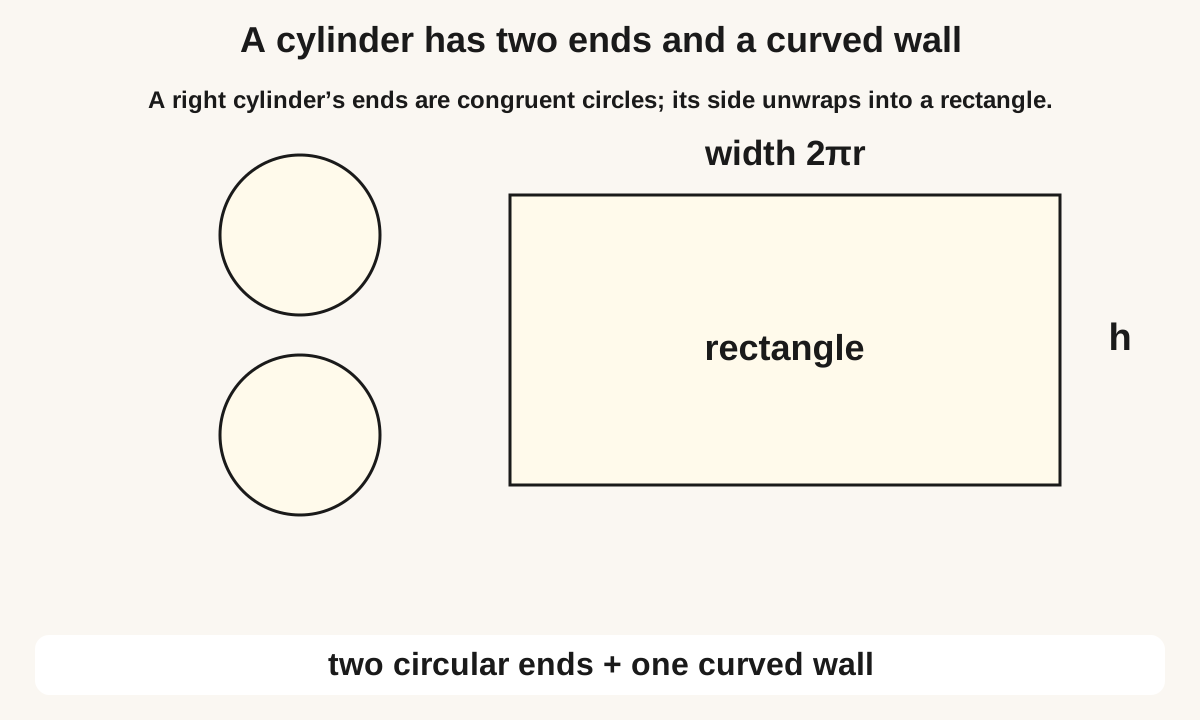
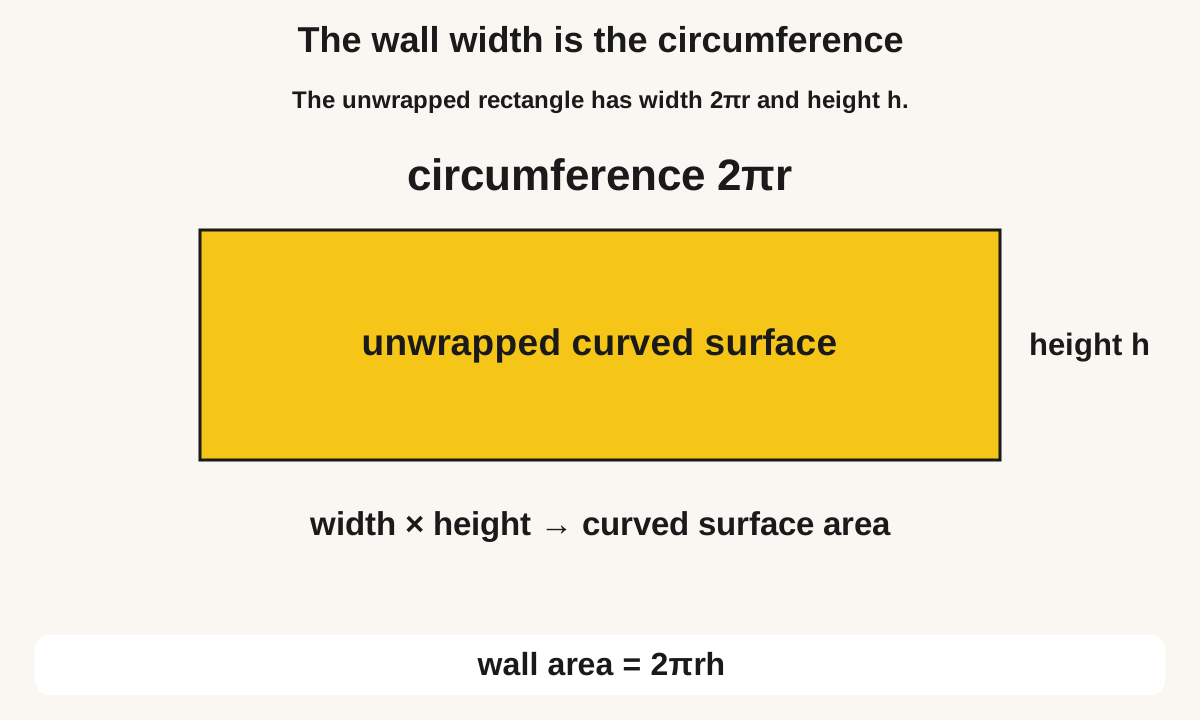
A right circular cylinder has a circular cross-section and a perpendicular height. Volume stacks the end area through that height. Surface area covers its outside: the curved wall unwraps to a rectangle whose width is the circumference and whose other dimension is the height.
A right cylinder has two parallel circular ends of radius r and a perpendicular height h. Use π = 22/7 in this guide. The volume is the area of one end times h: V = πr²h. Unroll the curved wall to a rectangle of width 2πr and height h, so CSA = 2πrh. Closed total surface area adds both ends: TSA = 2πrh + 2πr² = 2πr(h + r). If one end is missing, add only one πr². Diameter is twice the radius. Diagrams are not to scale.
Learning goal: Calculate surface area and volume of cylinders. The grade is a suggested starting point; school sequences vary. Use the first worked example to check readiness, and Area and perimeter: the difference, examples and practice if an earlier idea needs revisiting.
See the idea
Read each diagram with its labels, then follow the worked examples. Practice questions include their own measurements and information.
Enlarge diagram to read the labels
Swipe across the enlarged diagram to read every label.
Enlarge diagram to read the labels
Swipe across the enlarged diagram to read every label.
Choose a method and explain why it works
Use radius r, not diameter, in V = πr²h and curved area = 2πrh. Decide which ends exist in the question. A closed cylinder adds two circles; an open-top container adds one base. Keep π exact unless the problem gives a value or asks for rounding. The course examples below explicitly use 22/7.
Notation: V = πr²h. CSA = 2πrh. TSA = 2πr(h + r). π = 22/7.
Key rule and when to use it
Cylinder volume = πr²h. Curved area = 2πrh. A closed right cylinder has total surface area 2πrh + 2πr².
Worked examples, step by step
Example 1: A closed cylinder has radius 7 cm and height 10 cm. Using π = 22/7, find the volume and the total surface area.
- r = 7, h = 10, π = 22/7. Volume = πr²h = (22/7) × 49 × 10 = 1540 cm³.
- CSA = 2πrh = 2 × (22/7) × 7 × 10 = 440 cm². Two ends = 2πr² = 308 cm².
- TSA = 440 + 308 = 748 cm², which matches 2πr(h + r) = 44 × 17 = 748 cm².
Answer: 1540 cm³; 748 cm²
Check: The volume is 10 stacks of a 154 cm² circle. TSA is larger than CSA, as the ends were added.
Example 2: An open cylinder (no top) has radius 7 cm and height 3 cm. Using π = 22/7, find the area of metal needed.
- This is not a closed TSA. Include the wall and one circular base only.
- CSA = 2πrh = 2 × (22/7) × 7 × 3 = 132 cm². One end = πr² = 154 cm².
- Metal area = 132 + 154 = 286 cm², which is πr(2h + r) = 22 × 13 = 286 cm².
Answer: 286 cm²
Check: Closed TSA would add a second 154 cm² end. 286 is 154 less than that closed total.
Example 3: A closed cylinder has r = 3 cm and h = 5 cm. Give exact volume and total surface area in terms of π.
- Volume = π × 3² × 5 = 45π cm³.
- Curved area = 2π × 3 × 5 = 30π cm².
- Add both ends: 2π × 3² = 18π cm². Total surface area = 48π cm².
Common mistakes and important boundaries
The value 22/7 is an approximation to π, not an exact identity. A label d = 14 cm means r = 7 cm. Volume uses cubic units while surface area uses square units. Material thickness, seams and waste are ignored in these idealised geometry questions unless stated.
A point to explain
A learner may use diameter as radius, treat CSA as TSA, or use a slant as height.
Compare an uncertain attempt with the closest worked example. Look at the meaning of each operation, unit and label before repeating the arithmetic.
Cylinder Surface Area and Volume — practice
Work on paper first. Open each answer afterwards and compare the reasoning. Print the questions with or without the separate answer key; no account is required.
Name: ____________________ Date: __________
Which formula is the volume of a right cylinder?
Answer and a way to check
πr²h
Volume stacks the circular end. Multiply πr² by h.
Closed cylinder, r = 7 cm, h = 10 cm, π = 22/7. Which expression is TSA?
Answer and a way to check
2 × (22/7) × 7 × (10 + 7)
TSA includes the wall and both ends: 2πr(h + r).
Closed cylinder, radius 7 cm, height 5 cm, π = 22/7. Find the volume.
Answer and a way to check
770 cm³
Compute (22/7) × 7 × 7 × 5. Use radius, not diameter.
Closed cylinder, radius 7 cm, height 4 cm, π = 22/7. Find the total surface area.
Answer and a way to check
484 cm²
h + r = 11. Then 2 × (22/7) × 7 × 11.
A cylinder has diameter 14 cm and height 10 cm. Using π = 22/7, find the curved surface area only.
Answer and a way to check
440 cm²
Radius is half of 14. Then CSA = 2πrh.
Why is 2πrh the curved surface area of a cylinder, not the total surface area?
Answer and a way to check
2πrh is the unrolled rectangular wall. TSA also adds the two circular ends 2πr² unless an end is missing.
Unroll the wall to a rectangle 2πr by h. Then decide whether the circular ends are included.
Closed cylinder, diameter 14 cm, height 10 cm, π = 22/7. A student computes volume as (22/7) × 14 × 14 × 10. What is the mistake?
Answer and a way to check
The student used diameter in place of radius inside πr²h.
Volume is πr²h. r is half of the diameter.
A closed tin is a cylinder of radius 7 cm and height 6 cm. Using π = 22/7, find the metal area, including lid and base.
Answer and a way to check
572 cm²
Include wall and both ends: 2πr(h + r) with π = 22/7.
Cylinder Surface Area and Volume — answer key
πr²h Volume stacks the circular end. Multiply πr² by h.
2 × (22/7) × 7 × (10 + 7) TSA includes the wall and both ends: 2πr(h + r).
770 cm³ Compute (22/7) × 7 × 7 × 5. Use radius, not diameter.
484 cm² h + r = 11. Then 2 × (22/7) × 7 × 11.
440 cm² Radius is half of 14. Then CSA = 2πrh.
2πrh is the unrolled rectangular wall. TSA also adds the two circular ends 2πr² unless an end is missing. Unroll the wall to a rectangle 2πr by h. Then decide whether the circular ends are included.
The student used diameter in place of radius inside πr²h. Volume is πr²h. r is half of the diameter.
572 cm² Include wall and both ends: 2πr(h + r) with π = 22/7.
Questions students and parents ask
What changes for an open-top cylinder?
Include the curved wall and one circular base: 2πrh + πr². If both ends are open, include neither disk. Use the surfaces actually present in the model.
Why does the curved wall use circumference rather than diameter?
Unwrapping goes all the way around the circular end. That length is 2πr, while a diameter crosses the circle only once.
Is this a complete set of textbook exercise solutions?
No. This guide adapts BananaLearn’s own teaching examples and practice. It is not official NCERT material or a promise of the exact chapter sequence in a particular board, country or textbook edition.
What if the examples are still difficult?
Revisit Area and perimeter: the difference, examples and practice. Try the first example with its model, then attempt one fresh question independently. A correct copied answer is not evidence that the method can be used without support.
Help at home
Ask whether the question wants space inside or material outside. Then have the learner sketch the wall and the required ends before choosing a formula.
Keep one example of the learner’s own working. A repeated difficulty across fresh questions can guide a discussion with their teacher; one short practice sheet does not establish a diagnosis or a full mastery profile.
Connect this idea to the next skill
About this guide
Based on BananaLearn’s Grade 8 course lesson “Cylinders: Wall and Ends”. The explanations have been adapted for independent reading; course diagrams are reused where they fit the idea, and missing classroom givens are made explicit in questions.
Need another way to understand it?
Bring one question your child found difficult to a free 50-minute session. Tell us their grade, curriculum and time zone so we can discuss a suitable next step.
Request a free session