
Start with the key idea
Perimeter is the total length of a shape’s boundary. Area measures its enclosed surface. For a rectangle, area=length×width and perimeter=2(length+width). Choose the quantity from the real task and keep linear units separate from square units.
1. Decide whether the task covers or surrounds
Fencing a garden, edging a mat and running around a field involve boundary length. Painting a floor, laying turf and covering a tabletop involve area. The story tells you which measurement matters.
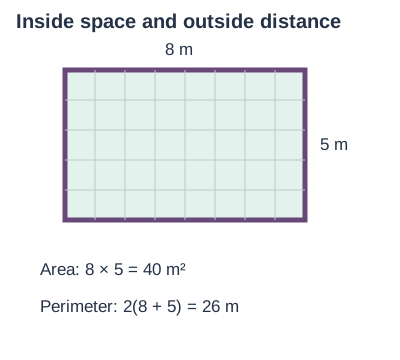
Do not choose a formula merely because two lengths are printed. A rectangle has both an area and a perimeter, but the question may ask for only one. Write “I need the inside space” or “I need the outside distance” before substituting.
Use two physical gestures for the same drawing: trace the boundary with a finger, then sweep across the interior. A path around the field has a length, while the turf covers a surface. If a question includes a cost, inspect the rate’s unit: per metre points to length; per square metre points to area.
2. Derive the rectangle formulas from the shape
A rectangle of 8 m by 5 m has five rows of eight square-metre units, giving 40 m². Its boundary contains two 8 m sides and two 5 m sides, giving 8+5+8+5=26 m.
A square is a special rectangle with equal sides. Its area is side×side and perimeter is 4×side. Squaring a side produces square units; multiplying a side by four still measures a length.
The formula 2(length + width) comes from grouping the two equal lengths and two equal widths. It is not 2 × length × width, which would double the area. Substitute a small rectangle, such as three by two, and add its four sides to test an uncertain formula before applying it to larger numbers.
3. Split a composite shape without overlap
An L-shape can be divided into a 6 m by 2 m top rectangle and a 3 m by 3 m lower rectangle. Their areas are 12 m² and 9 m², making 21 m² altogether. The dividing line is a thinking aid, not an extra piece of land.
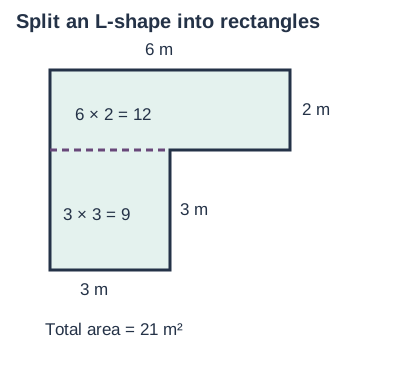
When finding perimeter, follow only the outside boundary. Do not add the interior dividing line. Calculate missing side lengths from aligned total lengths before adding; never estimate an unlabelled side from the drawing.
For the illustrated L-shape, the full left height is two plus three, or five metres. The horizontal indentation is six minus three, or three metres. Following the outside gives six, two, three, three, three and five metres, totalling twenty-two metres. This perimeter calculation uses the original outline; the internal split contributes only to the area method.
4. Convert lengths before multiplying
A mat 2 m long and 80 cm wide has width 0.8 m, so its area is 2×0.8=1.6 m². Alternatively convert both lengths to centimetres: 200×80=16,000 cm². Both describe the same mat.
One square metre is 100 cm by 100 cm, or 10,000 cm². It is not 100 cm². For a first calculation, converting both input lengths to one chosen unit is usually clearer than repairing mixed units after multiplying.
A unit square grows in two directions when the length unit changes. A one-metre square contains one hundred centimetre lengths along each side, so it contains one hundred rows of one hundred square centimetres. Drawing a smaller ten-by-ten grid first can help explain why area conversion factors are squared rather than copied from length conversion.
5. Keep cost and quantity in separate steps
If turf costs ₹120 per m² and the garden area is 40 m², the turf cost is 40×120=₹4,800 before any separately stated charges. If fencing costs ₹120 per metre, the 26 m boundary costs ₹3,120 instead.
A gate changes the length of fencing needed. A 2 m gate in that boundary leaves 24 m to fence. It does not reduce the garden’s area. State whether gates, waste, overlaps or extra charges are included in the problem.
If paint covers eight square metres per litre and a wall has area twenty square metres, the mathematical requirement is 20 ÷ 8 = 2.5 litres. If paint is sold only in one-litre tins, three tins are needed. State whether the question asks for paint used or tins purchased; these are different quantities even though they arise from the same area.
6. Test answers with units and alternative shapes
A proposed area of 26 m for the 8-by 5 rectangle has the wrong unit and the wrong quantity. Check that area uses square units and perimeter uses linear units. Then estimate whether the numerical result is plausible.
Equal perimeter does not guarantee equal area. A 6-by 4 rectangle and an 8-by 2 rectangle both have perimeter 20 units, but areas 24 and 16 square units. Keep the two measurements independent when comparing designs.
Try a reverse check for a rectangle whose area is thirty square centimetres and width five centimetres: the length six centimetres gives thirty when multiplied back. If perimeter were thirty centimetres instead, the length would be ten centimetres because 2(length + 5) = 30. The same number thirty can lead to different answers when it labels a different measurement.
5 worked examples with reasoning
1. Find area and perimeter of a 7 cm by 3 cm rectangle.
- Area=7×3=21 cm².
- Perimeter=2(7+3)=20 cm.
- Label each result with its quantity and unit.
2. A 9 m by 4 m garden has a 2 m gate. How much fencing is required?
- Full perimeter=2(9+4)=26 m.
- Subtract the gate opening: 26−2=24 m.
- The area is not needed for this question.
3. Find the area of a 2 m by 50 cm mat.
- Convert 50 cm to 0.5 m.
- Area=2×0.5=1 m².
- Check in centimetres: 200×50=10,000 cm².
4. An L-shaped floor consists of two non-overlapping rectangles measuring 6 m by 2 m and 3 m by 3 m. Find the total area.
- Find 12 m² and 9 m².
- Add to get 21 m².
- The shared interior edge does not belong in the outside perimeter.
5. A square has perimeter 36 cm. Find its area.
- Each side=36÷4=9 cm.
- Area=9×9=81 cm².
- Do not divide the perimeter directly to obtain area.
Save the guide or print the practice
Download to save or share
Complete guide with answers (PDF) · Worksheet without answers (PDF) · Worksheet and answer key (PDF)
Try each task before opening its answer. Give an example or reason, not only a label.
14 practice questions with explanations
Try each task before opening its answer. Give an example or reason, not only a label.
Write an answer and your reason before opening the explanation. Check the reasoning as well as the final answer.
- Rectangle
Find the area of a rectangle measuring 8 cm by 3 cm.
Answer and reasoning
24 cm².
Multiply the two lengths.
- Boundary
Find the perimeter of a rectangle measuring 8 cm by 3 cm.
Answer and reasoning
22 cm.
Add two of each side.
- Square
Find the area of a square with side length 6 m.
Answer and reasoning
36 m².
6×6=36.
- Square
Find the perimeter of a square with side length 6 m.
Answer and reasoning
24 m.
Four sides each measure 6 m.
- Reverse
A rectangle has area 30 cm² and width 5 cm. Find its length.
Answer and reasoning
6 cm.
30÷5=6.
- Gate
A rectangular garden is 10 m long and 4 m wide. A 3 m gate replaces part of the fence. How much fencing is required?
Answer and reasoning
25 m.
2(10+4)−3=25.
- Units
Find the area of a rectangular mat measuring 1 m by 30 cm.
Answer and reasoning
0.3 m² or 3,000 cm².
Use consistent lengths.
- Cost
Cover 12 m² at ₹50 per m². Cost?
Answer and reasoning
₹600.
12×50=600.
- Compare
Do rectangles measuring 5 units by 5 units and 8 units by 2 units have the same perimeter?
Answer and reasoning
Yes, 20 units.
Both side sums are 10.
- Compare
Do rectangles measuring 5 units by 5 units and 8 units by 2 units have equal areas?
Answer and reasoning
No: 25 and 16 square units.
Equal perimeter does not fix area.
- Composite
Two regions with areas 18 m² and 7 m² join without overlapping. Find the combined area.
Answer and reasoning
25 m².
Add the non-overlapping parts.
- Boundary
Should an interior splitting line count towards perimeter?
Answer and reasoning
No.
Perimeter follows the outside only.
- Unit
What unit fits the area of a classroom: m or m²?
Answer and reasoning
m².
Area measures square units.
- Reverse
A square has perimeter 20 m. Find its area.
Answer and reasoning
25 m².
Side 5 m, then 5².
Use the ideas without looking at the notes
Before calculating, label the task “cover” or “surround”. Convert units, mark any excluded boundary and check the final unit.
Common questions
Does area mean the space inside?
Yes, for the plane shapes in this guide; perimeter is their outside boundary length.
Why use square units?
Area counts how many unit squares cover a surface.
How do I handle a gate?
Subtract its width from the boundary needing fencing when the gate replaces fencing.
Can I estimate missing lengths from a drawing?
No. Use stated dimensions and geometric relationships unless a scale is explicitly supplied.
Can two shapes have equal perimeter and different areas?
Yes. Changing the side lengths can preserve the boundary total while changing the area.
Connect your learning
Ask about guided Maths learning if your child needs help explaining these ideas.
About this guide
Original explanations, examples, diagrams and practice by BananaLearn. The grade label indicates the intended learning level; this is not an official textbook extract or exam paper.